← Back to BetterChess
Chess glossary
Rules
Adjournment
An adjournment pauses an unfinished game for resumption later: the player to move writes a sealed move, it goes into an envelope, and play resumes from that position another day.
Read ›Armageddon
Armageddon is a tiebreak game that cannot end level: White gets extra time, and Black advances if the game is drawn.
Read ›Castling
Castling is a single move where the king and a rook move at once: the king steps two squares toward a rook, and that rook hops to the king’s other side.
Read ›Check
Check is when your king is under direct attack, and you must answer it immediately on your next move.
Read ›Checkmate
Checkmate is when a king is in check and has no legal way to escape — it ends the game immediately, and the side delivering it wins.
Read ›Dead Position
A dead position is one where no sequence of legal moves could ever produce checkmate for either side. The game is drawn the moment such a position arises.
Read ›Draw
A draw is a tied game in which neither player wins; each side scores half a point.
Read ›Draw Offer
A draw offer is a proposal to end the game as a draw. The correct procedure: make your move, offer the draw, then press your clock. The offer stands until your opponent accepts, declines, or moves.
Read ›En Passant
En passant is a special pawn capture: a pawn that has just advanced two squares can be taken by an enemy pawn beside it, as if it had moved only one.
Read ›Fifty-Move Rule
The fifty-move rule lets a player claim a draw if 50 moves by each side have passed with no capture and no pawn move.
Read ›Increment
An increment is bonus time, usually a few seconds, added to your clock after every move you make.
Read ›Insufficient Material
Insufficient material is an automatic draw that occurs when neither side has enough pieces to possibly deliver checkmate.
Read ›J'adoube
J'adoube is French for 'I adjust': announce it before straightening a piece on its square, and the touch-move rule does not apply to that touch.
Read ›Promotion
Promotion is when a pawn reaches the opponent's back rank and is immediately replaced by a queen, rook, bishop or knight of the same colour.
Read ›Resignation
Resignation is conceding the game: a player who resigns loses immediately. It is usually announced verbally or by stopping the clocks; tipping over the king is the traditional gesture.
Read ›Stalemate
Stalemate is when the side to move has no legal move but its king is not in check — the game is an immediate draw.
Read ›Threefold Repetition
Threefold repetition is a draw rule: if the exact same position occurs three times in a game, with the same player to move, a draw can be claimed.
Read ›Time Control
A time control is the clock setting for a game: how much total thinking time each player has, plus any increment per move.
Read ›Touch-Move Rule
The touch-move rule says that if you deliberately touch one of your pieces you must move it, and if you touch an enemy piece you must capture it, whenever a legal move or capture exists.
Read ›Tactics
Alekhine's Gun
Alekhine's Gun is an attacking formation in which both rooks are doubled on a file with the queen stacked behind them, creating a battery that overwhelms any single defender.
Read ›Anastasia’s Mate
Anastasia’s Mate is a pattern where a knight and a rook combine to mate a king pinned against the edge of the board, usually the h-file.
Read ›Anderssen's Mate
Anderssen's mate is a checkmate on the eighth rank in which the mating rook or queen on the corner square is supported diagonally, classically by a pawn on g7.
Read ›Arabian Mate
The Arabian Mate is a classic pattern in which a knight and a rook combine to checkmate a king trapped in the corner of the board.
Read ›Attraction
Attraction is a tactic, usually a sacrifice, that forces an enemy piece or king onto a specific square where a follow-up blow wins the game or decisive material.
Read ›Back-Rank Mate
A back-rank mate is checkmate delivered by a rook or queen along the king’s back rank, where the king is boxed in by its own unmoved pawns and can’t escape.
Read ›Battery
A battery is two pieces of the same colour stacked on one line — file, rank, or diagonal — so they support each other and bring doubled force to bear.
Read ›Blackburne's Mate
Blackburne's mate is a rare pattern in which both bishops and a knight combine: the light-squared bishop mates on h7, the knight guards it, and the dark-squared bishop rakes the long diagonal.
Read ›Blind Swine Mate
The blind swine mate is delivered by two rooks doubled on the seventh rank: they devour the pawns in front of the castled king and then mate it in the corner.
Read ›Boden’s Mate
Boden’s Mate is a pattern where two bishops on crisscrossing diagonals deliver checkmate to a king hemmed in by its own pieces, usually after queenside castling.
Read ›Clearance Sacrifice
A clearance sacrifice gives up material to vacate a square, file, or diagonal so that another of your pieces can occupy or sweep through it with decisive effect.
Read ›Combination
A combination is a forced sequence of moves — usually built around a sacrifice — that leads to a concrete gain such as checkmate or winning material.
Read ›Corner Mate
The corner mate is a checkmate in which a knight delivers the final blow to a king stuck in the corner, with a rook sealing the adjacent file and the king's own pawn blocking its head.
Read ›Damiano’s Mate
Damiano’s Mate is a pattern where a queen, supported by a pawn, delivers checkmate on the edge file — typically the h-file — often after a rook sacrifice clears the way.
Read ›Decoy
A decoy lures an enemy piece — frequently the king — onto a particular square, usually with a sacrifice, so it can then be forked, checked, or mated.
Read ›Deflection
A deflection forces an enemy piece away from an important defensive job, usually with a check or threat it must answer, so the thing it was guarding falls.
Read ›Desperado
A desperado is a piece that is already doomed and so captures as much material as it can — or sells itself for the best price — before it is inevitably lost.
Read ›Discovered Attack
A discovered attack is when you move one piece out of the way so that a different piece behind it suddenly attacks an enemy target.
Read ›Double Attack
A double attack is any single move that creates two threats at the same time, so the opponent can parry only one of them.
Read ›Double Check
A double check is a special discovered check where the moving piece and the piece it unveils both give check at the same instant.
Read ›Dovetail Mate
The Dovetail Mate, also called Cozio’s mate, is a queen checkmate where the king’s two diagonal escape squares are both blocked by its own pieces.
Read ›Epaulette Mate
The Epaulette Mate is a pattern in which a king is checkmated while flanked on both sides by its own rooks, which block the only squares it could escape to.
Read ›Fool’s Mate
Fool’s Mate is the fastest possible checkmate in chess, delivered by Black on the second move after White fatally weakens the squares around their own king.
Read ›Fork
A fork is a single move that attacks two (or more) enemy pieces at once, so the opponent can only save one.
Read ›Greco's Mate
Greco's mate is a checkmate delivered by a rook or queen on the open h-file, with a bishop covering g8 and the defender's own g-pawn shutting the king in.
Read ›Greek Gift Sacrifice
The Greek Gift is a bishop sacrifice on h7 (or h2 for Black), giving up the bishop with check to drag the castled king out and launch a mating attack.
Read ›Hook Mate
The Hook Mate is a pattern using a rook, a knight, and a pawn together, with one of the enemy’s own pawns blocking the king’s last escape square.
Read ›Interference
Interference is a tactic where you place a piece on the line between two enemy pieces, breaking the defence or communication that runs along it.
Read ›Kill Box Mate
The kill box mate is a rook and queen checkmate in which the rook checks next to the king and the queen supports it from one empty square away on the diagonal, forming a 3 by 3 box.
Read ›King Hunt
A king hunt is a sustained series of checks and threats that drags the enemy king out of its shelter and drives it across the board, usually ending in mate or decisive material gain.
Read ›Lolli's Mate
Lolli's mate is a checkmate against a fianchettoed king in which a pawn wedged on f6 supports a queen that mates on g7.
Read ›Mayet's Mate
Mayet's mate is a checkmate in which a rook mates on the corner square h8, protected from capture by a distant bishop on the long diagonal.
Read ›Morphy's Mate
Morphy's mate is a checkmate where a bishop strikes the cornered king along the long diagonal while a rook controls the adjacent file and the king's own pawn blocks its last square.
Read ›Opera Mate
The opera mate is a back-rank checkmate in which a rook, protected by a bishop on the diagonal, mates an uncastled king that is boxed in by its own pieces.
Read ›Overloading
Overloading is when a single enemy piece is responsible for two defensive duties at once, so taking one job away lets the other collapse.
Read ›Pawn Storm
A pawn storm is the advance of two or more pawns toward the enemy king, aiming to trade themselves off and rip open files for the pieces behind them.
Read ›Pillsbury's Mate
Pillsbury's mate is a checkmate in which a rook mates down the open g-file while a bishop on the long diagonal covers the corner escape square.
Read ›Pin
A pin is when a piece can’t move (or shouldn’t) because a more valuable piece sits directly behind it along the line of attack.
Read ›Removing the Defender
Removing the defender means capturing or trading off the piece that guards a target, so that the target is left undefended and can be taken.
Read ›Réti Mate
The Réti mate is a checkmate in which a bishop, protected by a rook or queen, mates a king whose escape squares are all occupied by its own pieces.
Read ›Rook Lift
A rook lift moves a rook vertically to the third or fourth rank and then sideways in front of its own pawns, bringing it into the attack without opening any files.
Read ›Sacrifice
A sacrifice is deliberately giving up material — a pawn, a piece, or more — in return for something worth even more, such as a mating attack, a winning position, or material won back later.
Read ›Skewer
A skewer is a pin in reverse: a valuable piece is attacked in front and must move, exposing a piece behind it on the same line.
Read ›Smothered Mate
A smothered mate is a checkmate delivered by a knight against a king that is completely hemmed in by its own pieces and so has no square to flee to.
Read ›Suffocation Mate
The suffocation mate is a checkmate in which a knight attacks the king while a bishop (or queen) takes away the remaining escape squares from a distance.
Read ›Swallow’s Tail Mate
The Swallow’s Tail Mate, also called the guéridon mate, is a queen checkmate where the king’s two rear escape squares are blocked by its own pieces.
Read ›Trapped Piece
A trapped piece is one that has no safe square to move to and is about to be captured, because every escape leads to it being taken.
Read ›Undermining
Undermining is attacking the pawn or piece that supports an enemy structure, so that once the support is removed the thing it was defending becomes weak or falls.
Read ›Vukovic Mate
The Vukovic mate is a checkmate in which a protected rook mates the king on the edge of the board face to face, while a knight covers the remaining escape squares.
Read ›Windmill
A windmill is a tactic where a piece swings back and forth giving discovered check each way, forcing the king to dodge while a rook gobbles material every cycle.
Read ›X-Ray Attack
An x-ray is when a long-range piece exerts its influence through an enemy piece along a rank, file, or diagonal, attacking or defending what lies beyond it.
Read ›Zwischenzug
A zwischenzug, or in-between move, is a surprise move (often a check or a stronger threat) inserted before the reply your opponent is expecting.
Read ›Strategy
Backward Pawn
A backward pawn is one that has fallen behind the pawns beside it and can’t safely advance, leaving it stuck — often on a half-open file where it becomes a target.
Read ›Bad Bishop
A bad bishop is one whose own pawns are fixed on the same colour squares it travels on, blocking its diagonals and leaving it passive.
Read ›Bishop Pair
The bishop pair is the advantage of having both of your bishops while the opponent has only one (or none), since together they cover squares of both colours.
Read ›Blockade
A blockade is placing one of your pieces directly in front of a passed (or isolated) pawn so it can’t advance, while your piece sits safe behind it.
Read ›Calculation
Calculation is the concrete work of analyzing specific move sequences in your head: I go here, they go there, and evaluating the resulting positions.
Read ›Candidate Moves
Candidate moves are the small set of plausible moves you shortlist in a position before calculating any single line deeply.
Read ›Centralization
Centralization is placing your pieces toward the middle of the board, where they control the most squares and can switch quickly to either wing.
Read ›Closed Position
A closed position is one where interlocked pawn chains block the center, shifting play to the wings and favoring knights and long-term maneuvering.
Read ›Compensation
Compensation is the non-material value, such as activity, structure, initiative, or king safety, that justifies being behind in material.
Read ›Connected Passed Pawns
Connected passed pawns are two passed pawns on adjacent files; because they can defend each other as they advance, they are extremely hard to stop.
Read ›Connected Rooks
Rooks are connected when they stand on the same rank with no pieces between them, so each defends the other, usually on the first rank after development.
Read ›Development
Development is the process of bringing your pieces off their starting squares to active posts in the opening, getting ready to castle and fight for the centre.
Read ›Doubled Pawns
Doubled pawns are two pawns of the same colour stacked on one file, the result of a capture that pulled a pawn sideways onto a file it already occupied.
Read ›Doubling Rooks
Doubling rooks means placing both rooks on the same file or rank, one behind the other, so their power combines on a single line.
Read ›Exchange Sacrifice
An exchange sacrifice is deliberately giving up a rook for an enemy minor piece in return for positional or attacking compensation rather than immediate material.
Read ›Fianchetto
A fianchetto is developing a bishop to the second rank on the knight’s file (g2, b2, g7 or b7) so it rakes down the long diagonal.
Read ›Half-Open File
A half-open file is a file on which you have no pawn but your opponent still does, giving your rook a ready-made target to pile up against.
Read ›Hanging Pawns
Hanging pawns are two adjacent friendly pawns — usually on c and d — standing side by side on half-open files with no pawns beside them to defend them.
Read ›Imbalance
An imbalance is any meaningful, lasting difference between the two positions: bishop versus knight, structure versus activity, material versus initiative.
Read ›Initiative
The initiative is the ability to keep making threats so your opponent is forced to react to you, rather than carry out plans of their own.
Read ›Isolated Pawn
An isolated pawn is a pawn with no friendly pawns on either adjacent file, so it can never be defended by a pawn and must be guarded by pieces.
Read ›King Safety
King safety is a measure of how exposed your king is to attack, governed by whether it has castled, kept its pawn shelter intact, and has pieces nearby to defend it.
Read ›King Walk
A king walk is a deliberate multi-move march of the king across the board, either to escape danger, to support an endgame plan, or even to join an attack.
Read ›Liquidation
Liquidation is a deliberate, usually forcing series of exchanges that transforms the position into a simpler endgame you have already judged as won or drawn.
Read ›Luft
Luft is the German word for 'air': a small pawn move in front of a castled king (such as h3 or g3) that opens an escape square and guards against back-rank mate.
Read ›Minority Attack
A minority attack is when you push your smaller group of pawns on one wing against the opponent’s larger group, forcing a swap that leaves them with a weak pawn.
Read ›Open File
An open file is a file (column) with no pawns of either colour on it, giving rooks and queens a clear path up and down the board.
Read ›Open Position
An open position is one where central pawns have been exchanged, leaving open files and diagonals where piece activity dominates.
Read ›Opposite-Colored Bishops
Opposite-colored bishops means each side has one bishop, but they travel on different colours, so they can never challenge or defend against each other directly.
Read ›Outpost
An outpost is a square, usually in or near enemy territory, that your pawn defends and no enemy pawn can attack — an ideal home for a piece, especially a knight.
Read ›Overextension
Overextension means pushing pawns further than your pieces can support, so the advanced pawns and the squares behind them become lasting weaknesses.
Read ›Overprotection
Overprotection is defending an important point with more pieces than strictly necessary, so those pieces draw strength and flexibility from guarding it.
Read ›Passed Pawn
A passed pawn is a pawn with no enemy pawns ahead of it on its own file or the two files beside it, so no pawn can block or capture it on the way to promotion.
Read ›Pawn Break
A pawn break is a pawn advance that challenges the enemy pawn structure, aiming to open files and diagonals or to undermine a pawn chain.
Read ›Pawn Center
A pawn center is a formation of pawns on the central squares, classically d4 and e4 or d5 and e5, that controls key territory and cramps the opponent.
Read ›Pawn Chain
A pawn chain is a diagonal line of pawns where each one defends the next; the front pawn is the head and the undefended rear pawn is the base.
Read ›Pawn Island
A pawn island is a group of one side's pawns connected along adjacent files but separated from that side's other pawns by one or more empty files.
Read ›Pawn Majority
A pawn majority is having more pawns than your opponent on one wing — for example three against two on the queenside — which can be mobilised to make a passed pawn.
Read ›Pawn Tension
Pawn tension exists when pawns attack each other and both sides choose not to capture, keeping the structure flexible and the options open.
Read ›Piece Activity
Piece activity is how mobile and influential your pieces are: active pieces control many squares and create threats, while passive pieces are tied down or hemmed in.
Read ›Piece Coordination
Piece coordination means your pieces defend each other and aim at the same targets, multiplying their strength instead of working alone.
Read ›Positional Sacrifice
A positional sacrifice gives up material for long-term advantages, such as structure, squares, or piece dominance, rather than for immediate tactics.
Read ›Prophylaxis
Prophylaxis is preventing your opponent’s plan before you carry out your own — a move that stops their idea rather than directly advancing yours.
Read ›Rook on the Seventh Rank
A rook on the seventh rank sits on the row where the enemy pawns start, attacking them sideways and pinning the enemy king to its back rank.
Read ›Simplification
Simplification means trading pieces to reduce the number of men on the board, typically to convert a material edge or to blunt an opponent's attack.
Read ›Space Advantage
A space advantage means your pawns and pieces control more of the board than the opponent’s, giving your pieces more room to manoeuvre while theirs stay cramped.
Read ›Tempo
A tempo is a single move counted as a unit of time — you ‘gain a tempo’ when you make a useful move while forcing the opponent to make a useless one.
Read ›The Exchange
The exchange is the value difference between a rook and a minor piece; winning the exchange means trading a bishop or knight (worth ~3) for a rook (worth ~5).
Read ›Visualization
Visualization is the ability to see future positions in your head, keeping track of where every piece stands several moves into a variation.
Read ›Weak Color Complex
A weak color complex is a group of squares of the same colour that one side can no longer adequately defend, frequently because the bishop of that colour has been traded or lost.
Read ›Weak Square
A weak square (or ‘hole’) is a square that can no longer be defended by any of your pawns, so an enemy piece can settle there safely.
Read ›Endgame
Active King
An active king is a king used as a fighting piece in the endgame, marching toward the centre or enemy pawns instead of hiding behind cover.
Read ›Bare King
A bare king is a side that has nothing left on the board except the king itself.
Read ›Bishop and Knight Checkmate
The bishop and knight checkmate is the trickiest of the basic mates: with just a bishop, a knight and the king you must drive the enemy king into a corner of the bishop’s colour.
Read ›Corresponding Squares
Corresponding squares are pairs of squares in blocked king and pawn endings where, if the enemy king stands on one, your king must occupy its partner to hold or win.
Read ›Fortress
A fortress is a defensive setup so solid that the stronger side can’t break in — the position is drawn even though one player is down material.
Read ›Key Squares
Key squares are the squares your king needs to reach to guarantee promoting a pawn — get the king onto one and the pawn queens, no matter what the opponent does.
Read ›King and Pawn Endgame
A king and pawn endgame is a position where only kings and pawns remain, and the outcome usually turns on opposition, key squares and precise counting.
Read ›Ladder Mate
The Ladder Mate, also called the lawnmower or staircase mate, uses two rooks (or a queen and rook) to push the enemy king to the edge of the board and mate it.
Read ›Lucena Position
The Lucena position is a winning rook-and-pawn-versus-rook setup: the attacker’s king is in front of a pawn on the 7th rank, and they force promotion by ‘building a bridge’.
Read ›Opposition
The opposition is when the two kings stand on the same line with one square between them, and whoever has to move must give ground — so you want the move to be the opponent’s.
Read ›Outside Passed Pawn
An outside passed pawn is a passed pawn far away from the rest of the pawns, and its advance forces the defending king to abandon the main battlefield.
Read ›Pawn Breakthrough
A pawn breakthrough is a sacrifice of one or two pawns that forces a passed pawn to promote, most famously the three-against-three break with a far-advanced trio.
Read ›Pawn Race
A pawn race is an endgame sprint in which both sides push passed pawns toward promotion and the result hinges on who queens first and on what happens the moment both queens appear.
Read ›Perpetual Check
A perpetual check is a string of checks the opponent can never escape, so the same position keeps recurring and the game is drawn by threefold repetition.
Read ›Philidor Position
The Philidor position is the standard drawing method in rook-and-pawn-versus-rook: the defender keeps their king in front of the pawn and their rook on the third rank, then checks from behind once the pawn advances.
Read ›Protected Passed Pawn
A protected passed pawn is a passed pawn defended by another friendly pawn, which makes it immune to capture by the enemy king.
Read ›Reti Maneuver
The Reti maneuver is the endgame idea of marching the king along a diagonal so it pursues two goals at once, made famous by Richard Reti's 1921 study where a hopeless king catches an uncatchable pawn.
Read ›Rook and Pawn Endgame
A rook and pawn endgame is a position with rooks and pawns as the main forces, by far the most common type of ending and famously drawish when material is close.
Read ›Rule of the Square
The rule of the square is a shortcut for pawn races: draw the square from the pawn to its promotion file, and if the lone king can step into that square it catches the pawn.
Read ›Saavedra Position
The Saavedra position is the most famous endgame study in chess: White wins rook versus pawn with a stunning underpromotion to a rook.
Read ›Shouldering
Shouldering is the endgame technique of placing your king so that its body physically blocks the enemy king from the squares it needs to reach.
Read ›Tablebase
A tablebase is a database of endgame positions computed backward from checkmate, giving the exact result and a perfect move for every position it covers.
Read ›Theoretical Draw
A theoretical draw is a position whose objective result, with best play from both sides, is known to be a draw.
Read ›Triangulation
Triangulation is deliberately ‘losing a move’: your king takes three moves to return to the same square, so the same position arrives with the opponent to move — and in zugzwang.
Read ›Troitsky Line
The Troitsky line is the boundary of squares showing when two knights win against a king and one pawn: if the pawn is safely blockaded on or behind the line, the knights win.
Read ›Underpromotion
Underpromotion is choosing a knight, rook or bishop when a pawn reaches the last rank, instead of the usual queen, because that lesser piece does the job better.
Read ›Vancura Position
The Vancura position is a drawing setup in rook endgames where the defending rook attacks the enemy rook pawn from the side, leaving the stronger side's rook stuck in front of its own pawn.
Read ›Wrong Bishop
The ‘wrong bishop’ is a rook’s pawn together with a bishop that does not control the pawn’s queening square, a famous case where bishop-and-pawn versus king is only a draw.
Read ›Wrong Rook Pawn
A wrong rook pawn is a rook pawn whose promotion corner is the color the bishop does not control, so king, bishop and pawn cannot beat a lone king that reaches that corner.
Read ›Zugzwang
Zugzwang is a position where it’s your turn and every legal move worsens your position — you’d love to pass, but you can’t.
Read ›Openings
Book Move
A book move is a move that follows established opening theory, the recorded body of well studied opening lines.
Read ›Closed Game
The Closed Game is the family of openings beginning 1.d4 d5, the double queen pawn openings headed by the Queen's Gambit and the Slav.
Read ›Countergambit
A countergambit is an opening in which you answer the opponent’s gambit (or opening move) by offering a gambit of your own, sacrificing a pawn to seize the initiative yourself.
Read ›Gambit
A gambit is an opening where you deliberately give up a pawn (sometimes more) early on, in return for quicker development, central control, or an attack.
Read ›Hedgehog System
The Hedgehog is a setup where Black places pawns on a6, b6, d6, and e6 behind a White c4 and e4 bind, staying compact and waiting to strike with ...b5 or ...d5.
Read ›Hypermodern
Hypermodern chess is the school of thought that controls the center with pieces and flank pressure instead of occupying it immediately with pawns, inviting the opponent to overextend.
Read ›Main Line
A main line is the principal, most deeply analyzed sequence of moves in an opening, the continuation that theory considers best or most critical for both sides.
Read ›Maroczy Bind
The Maroczy Bind is a formation with White pawns on c4 and e4 against a Sicilian structure, clamping the d5 square and denying Black the freeing ...d5 break.
Read ›Open Game
The Open Game is the family of openings beginning 1.e4 e5, the classical double king pawn openings such as the Italian Game, Ruy Lopez, and Scotch.
Read ›Opening Book
An opening book is a stored library of opening positions and moves, consulted by engines, bots and review tools before any real calculation starts.
Read ›Opening Repertoire
An opening repertoire is a player's prepared, connected set of openings: what you play as White and how you answer each of the opponent's main choices as Black.
Read ›Poisoned Pawn
A poisoned pawn is a pawn deliberately left capturable because taking it costs the grabber dearly in time, position, or a trapped piece, most often a queen that strays to win it.
Read ›Semi-Open Game
A Semi-Open Game is any opening where White plays 1.e4 and Black replies with a move other than 1...e5, such as the Sicilian, French, or Caro-Kann.
Read ›Sideline
A sideline is a playable but less common alternative to an opening's main line, chosen more for surprise and practical value than for objective ambition.
Read ›Theoretical Novelty
A theoretical novelty, or TN, is the first move in a known opening position that has never been played in recorded practice, typically the product of home preparation.
Read ›Transposition
A transposition is when a different order of moves leads to a position that could also have arisen from another opening or sequence.
Read ›General
Accuracy
Accuracy is a percentage score from game review that measures how closely your moves matched the engine's preferred choices.
Read ›Algebraic Notation
Algebraic notation is the standard way to record chess moves: every square gets a file letter (a to h) and a rank number (1 to 8), and each move names the piece and its destination square.
Read ›Arbiter
An arbiter is the official who enforces the Laws of Chess at a tournament: starting rounds, ruling on disputes and illegal moves, applying penalties, and recording results.
Read ›Blitz Chess
Blitz chess is fast chess, roughly three to ten minutes per player, and the most played speed online.
Read ›Blunder
A blunder is a serious mistake — typically one that hangs a piece, allows a winning tactic, or loses the game outright.
Read ›Brilliant Move
A brilliant move, marked with two exclamation points, is a spectacular and hard to see move, usually a sound sacrifice, that is also among the best in the position.
Read ›Bullet Chess
Bullet chess gives each player under three minutes for the entire game, most commonly one minute each.
Read ›Candidate Master
Candidate Master (CM) is FIDE's entry-level international title, awarded for reaching a FIDE rating of 2200. No norms are required, and the title is held for life.
Read ›Centipawn
A centipawn is one hundredth of a pawn, the unit chess engines use to measure how far a position is from equal.
Read ›Chess960
Chess960, also called Fischer Random, is a variant where the back-rank pieces are shuffled into one of 960 possible starting positions, making memorized opening theory useless.
Read ›Classical Chess
Classical chess is the slow form of the game, with each player getting an hour or more, often several, for one game.
Read ›Correspondence Chess
Correspondence chess is played at a pace of days per move rather than minutes, historically by post and today mostly as online daily games.
Read ›Elo Rating
An Elo rating is a number that measures a player's strength from results; the gap between two ratings predicts how often the stronger player should score.
Read ›En Prise
A piece is en prise when it is attacked and undefended, so the opponent can simply capture it for free.
Read ›Engine Evaluation
An engine evaluation is a number stating who is better and by how much, measured in pawns from White's point of view.
Read ›FEN
FEN (Forsyth-Edwards Notation) is a one-line text format that describes a chess position exactly: piece placement plus five short fields covering whose move it is and the game state.
Read ›FIDE
FIDE, the International Chess Federation, is the world governing body of chess. It writes the Laws of Chess, runs the official rating system, awards titles, and organizes the World Championship.
Read ›FIDE Master
FIDE Master (FM) is a lifetime FIDE title awarded to players who reach a FIDE rating of 2300. Unlike the IM and GM titles, it requires no norms.
Read ›Flagging
Flagging means winning on time: your opponent's clock reaches zero before the game ends on the board, so they lose whatever the position.
Read ›Grandmaster
Grandmaster (GM) is the highest title FIDE awards to chess players. It requires a FIDE rating of 2500 plus three norm-level tournament performances, and it is held for life.
Read ›International Master
International Master (IM) is FIDE's second highest over-the-board title, one step below grandmaster. It requires a FIDE rating of 2400 plus three IM norms, and it is held for life.
Read ›Material
Material is the pieces and pawns you have on the board, usually counted with a point-value system to compare both sides’ forces.
Read ›Mouse Slip
A mouse slip is an accidental online move, where the piece lands on a square you did not intend, and the move stands just as if you had meant it.
Read ›Norm
A norm is a single tournament performance at the level required for a FIDE title. The GM and IM titles each require three norms plus a minimum rating.
Read ›PGN
PGN (Portable Game Notation) is the standard text format for recording chess games: header tags in square brackets, followed by the moves in algebraic notation.
Read ›Premove
A premove is an online feature that lets you enter your next move while your opponent is thinking, so it executes instantly when your turn comes.
Read ›Rapid Chess
Rapid chess gives each player more than ten minutes and less than an hour, the middle ground between blitz and classical.
Read ›Round-Robin
A round-robin is an all-play-all tournament: every participant faces every other participant, usually once, or twice with colors reversed in a double round-robin.
Read ›Sandbagging
Sandbagging is deliberately losing rated games to push your own rating down, usually to face weaker opposition or sneak under a tournament section limit.
Read ›Simultaneous Exhibition
A simultaneous exhibition, or simul, is an event where one strong player takes on many opponents at once, walking from board to board and making one move at each.
Read ›Swiss System
The Swiss system is a tournament format where nobody is eliminated: each round pairs players on the same score, so winners meet winners and the leaders emerge quickly.
Read ›Time Trouble
Time trouble, also called zeitnot, is the phase when a player has very little clock time left for the remaining moves, and the blunder rate climbs steeply.
Read ›More terms on the way. BetterChess is a practice tool — we make no guarantee you'll reach 1800 or any rating.
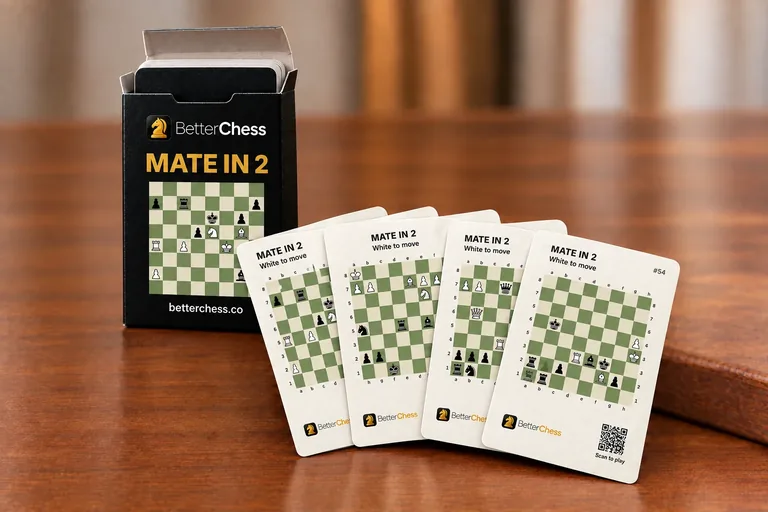
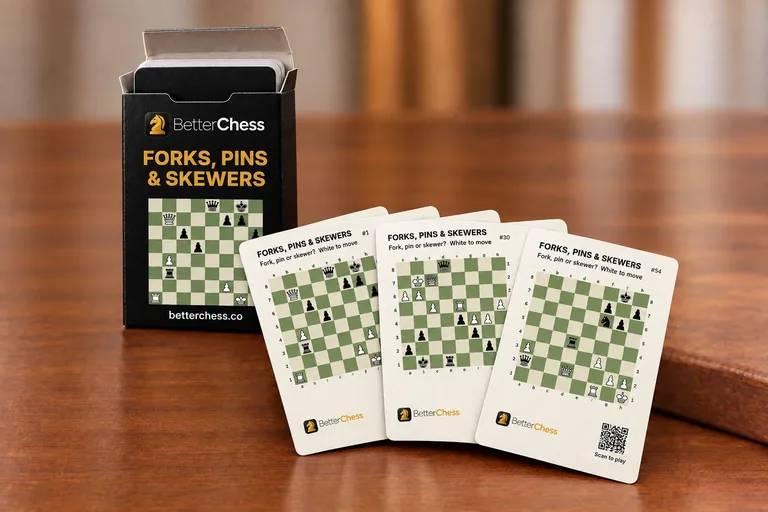
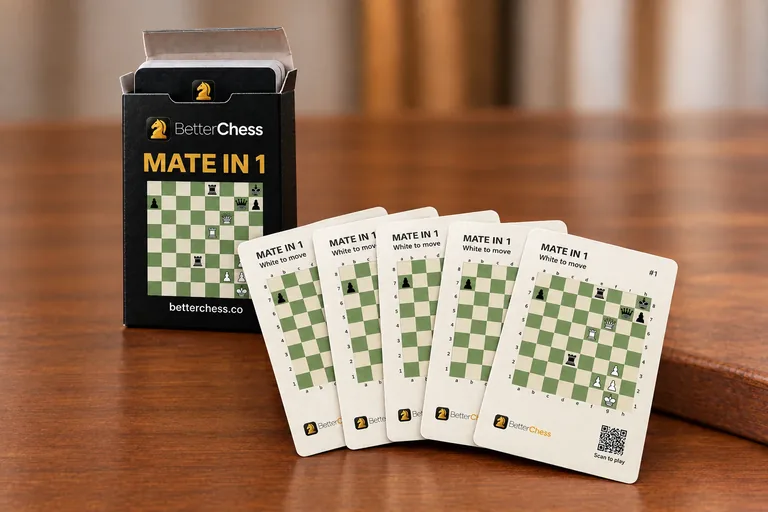
PRINTED CHESS PUZZLE CARDS
Chess puzzle playing card decks
54 poker-size cards in a tuck box. Puzzle on the front, solution on the back.