Morphy's Mate
Morphy's mate is a checkmate where a bishop strikes the cornered king along the long diagonal while a rook controls the adjacent file and the king's own pawn blocks its last square.
Named after Paul Morphy, this pattern needs only three attacking ideas: a bishop aimed at the corner along the long diagonal, a rook controlling the g-file (or b-file on the queenside), and the defender's own rook-pawn still sitting on its home square.
The typical sequence is a rook capture on g7 followed by a quiet rook retreat along the g-file: the retreat unveils the bishop's check on the corner king, and the rook keeps covering both g8 and g7. With h7 blocked by Black's own pawn, the king has literally nowhere to go.
Watch for this pattern whenever the enemy king hides in the corner behind an unmoved h-pawn and you own the long diagonal plus an open g-file. It is also the reason a fianchetto bishop is such a valuable defender: trade it off and the dark squares around the king collapse.
Frequently asked
How does Morphy's mate usually arrive?
Most often via a rook sacrifice or capture on g7. When the rook then moves away down the g-file, it discovers the bishop's check on the corner king while still covering the g-file, and the king's own h-pawn does the rest.
What is the difference between Morphy's mate and Pillsbury's mate?
Same three pieces, swapped jobs. In Morphy's mate the bishop delivers mate and the rook seals the file; in Pillsbury's mate the rook delivers mate down the g-file and the bishop covers the corner.
Related terms
BetterChess is a practice tool — we make no guarantee you'll reach 1800 or any rating. Definitions are standard chess terminology; every diagram position is checked legal with the same engine the board runs.
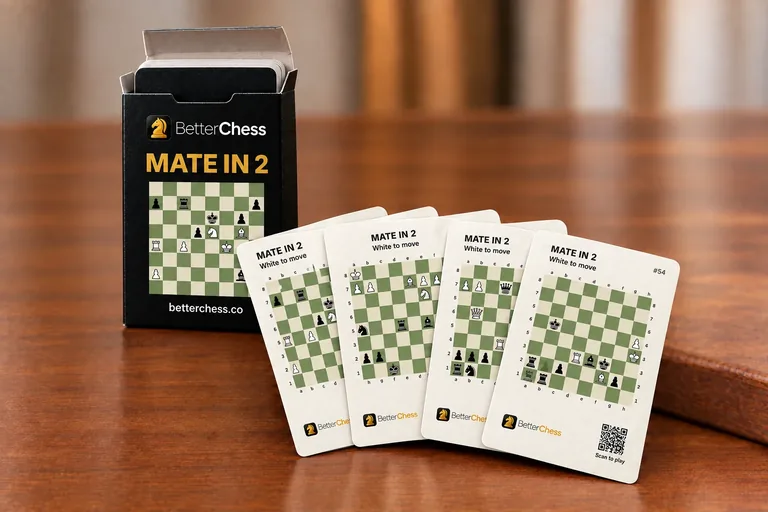
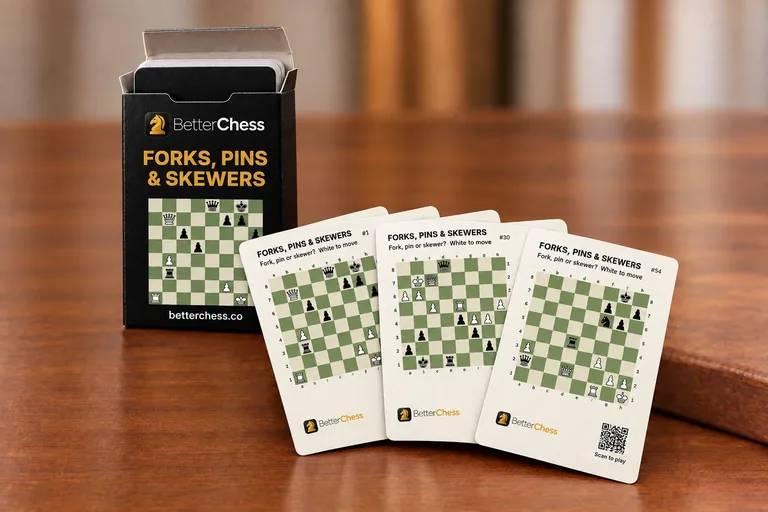
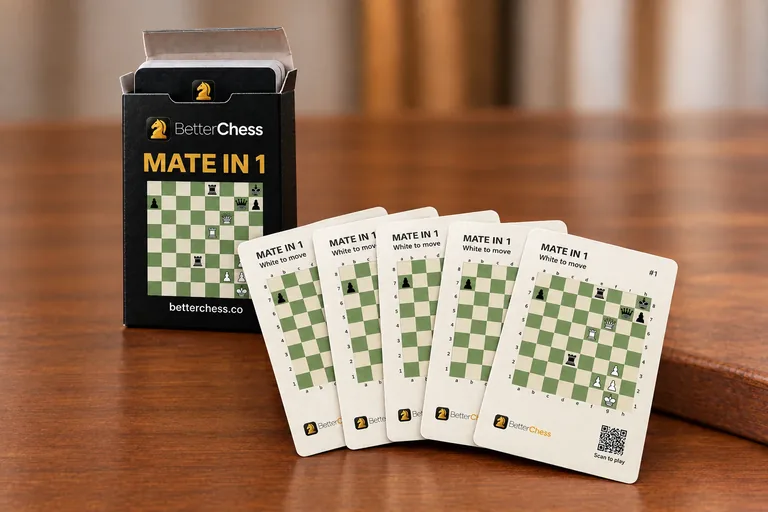
PRINTED CHESS PUZZLE CARDS
Chess puzzle playing card decks
54 poker-size cards in a tuck box. Puzzle on the front, solution on the back.