Algebraic Notation
Algebraic notation is the standard way to record chess moves: every square gets a file letter (a to h) and a rank number (1 to 8), and each move names the piece and its destination square.
The grid is the whole trick: files are lettered a to h from White's left, ranks are numbered 1 to 8 from White's side, so every square has a name like e4 or g7. Pieces get one letter each (K, Q, R, B, N), and pawn moves are written with no letter at all: 1.e4 means a pawn moved to e4.
A handful of symbols completes the system: x for a capture (Bxe5, or exd5 for a pawn capture named by its starting file), + for check, # for checkmate, O-O and O-O-O for castling, and e8=Q for promotion. When two identical pieces can reach the same square, you add the file or rank of the one that moved: Nbd2, R1e2.
FIDE has required algebraic notation in its tournaments since 1981, retiring the old descriptive system (1.P-K4), and keeping score is mandatory in classical over-the-board play. Fluency comes fast: read through a few annotated games and the notation disappears, leaving only the moves.
Frequently asked
What do the symbols x, +, and # mean?
x marks a capture (Bxe5), + is check, and # is checkmate. Castling is written O-O for kingside and O-O-O for queenside, and pawn promotion looks like e8=Q.
What happens when two identical pieces can reach the same square?
You disambiguate with the file or rank of the departing piece: Nbd2 means the knight from the b-file goes to d2, and R1e2 means the rook on the first rank goes to e2.
Related terms
BetterChess is a practice tool — we make no guarantee you'll reach 1800 or any rating. Definitions are standard chess terminology; every diagram position is checked legal with the same engine the board runs.
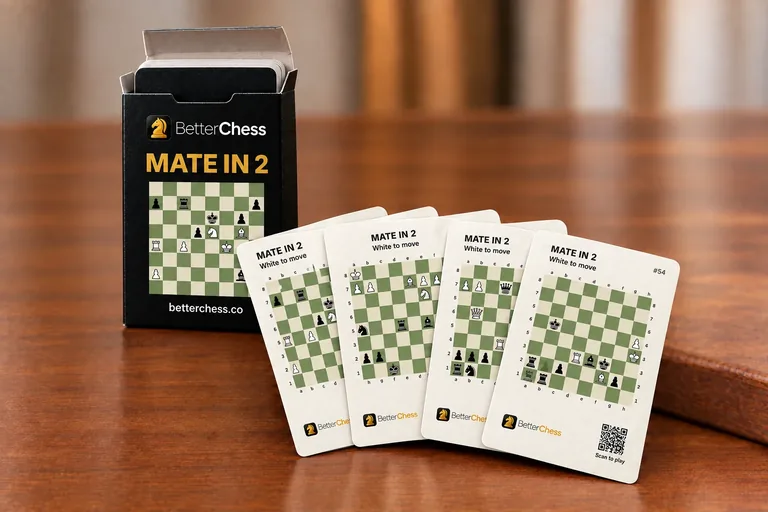
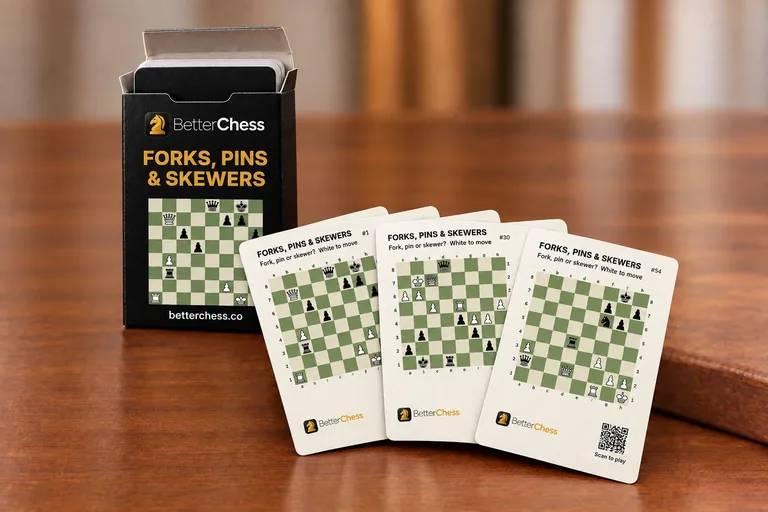
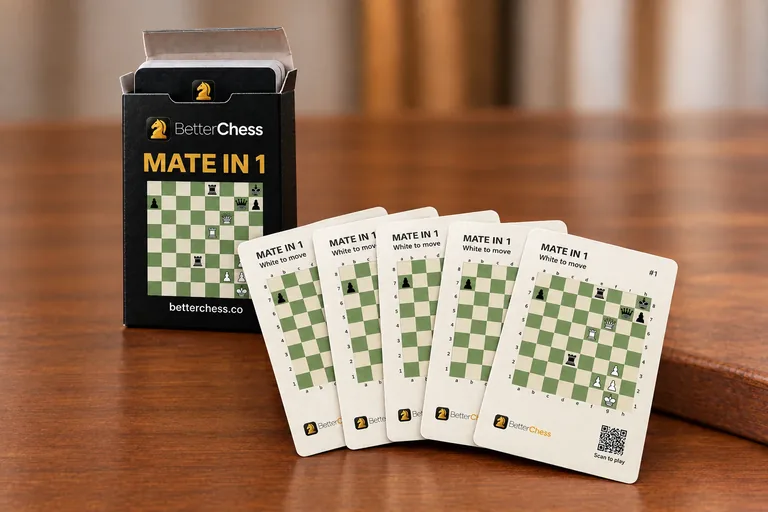
PRINTED CHESS PUZZLE CARDS
Chess puzzle playing card decks
54 poker-size cards in a tuck box. Puzzle on the front, solution on the back.