Bishop Pair
The bishop pair is the advantage of having both of your bishops while the opponent has only one (or none), since together they cover squares of both colours.
Each bishop is stuck on one colour forever, so a single bishop can only ever influence half the board. Keep both and they complement each other perfectly, sweeping light and dark squares alike — that combined reach is what makes the pair valuable.
The bishop pair is at its best in open positions where the long diagonals are clear; in blocked, locked-up positions a well-placed knight can be just as good or better. As a rough guide, masters treat the two bishops as worth around half a pawn of long-term advantage.
Practically, this shapes trading decisions: if you hold the pair, try to keep the position open and avoid swapping a bishop for a knight without good reason. If the opponent has it, look to close the position or trade one of their bishops off.
Frequently asked
Why is the bishop pair an advantage?
Two bishops cover both colours of squares between them, giving long-range control of the whole board. That's especially powerful in open positions where their diagonals are clear.
Is the bishop pair always better?
No. In closed positions with locked pawns, a knight can be as good as or better than a bishop, so the pair is most valuable when the position is — or can be — opened up.
Related terms
BetterChess is a practice tool — we make no guarantee you'll reach 1800 or any rating. Definitions are standard chess terminology; every diagram position is checked legal with the same engine the board runs.
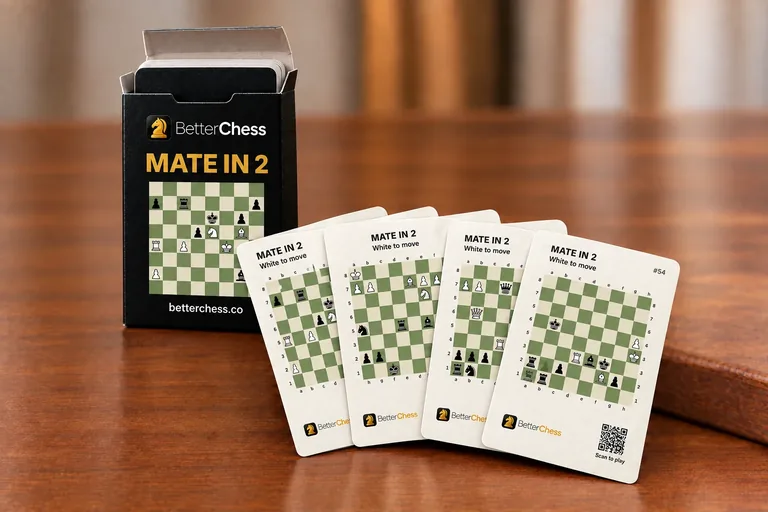
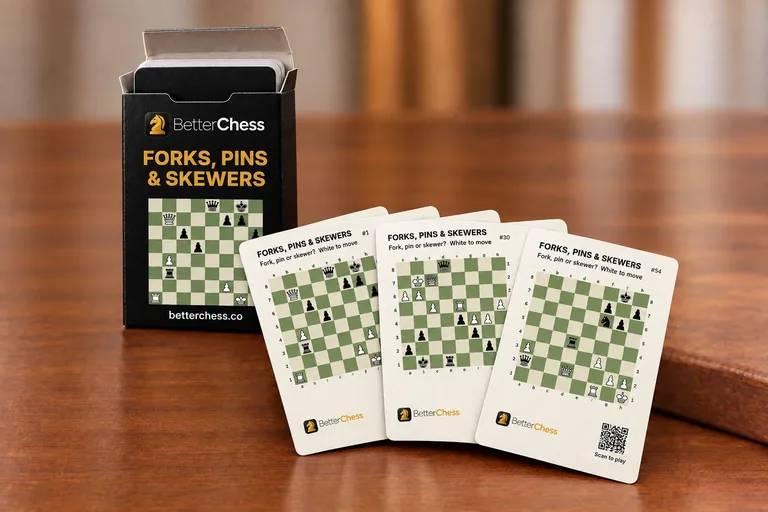
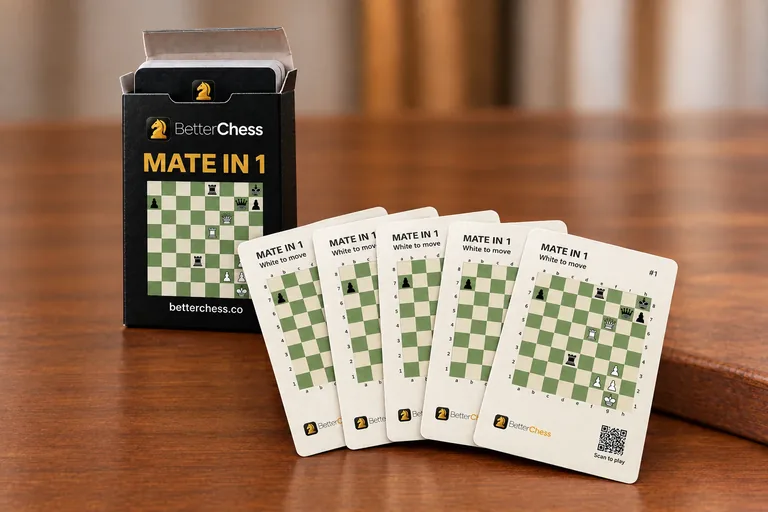
PRINTED CHESS PUZZLE CARDS
Chess puzzle playing card decks
54 poker-size cards in a tuck box. Puzzle on the front, solution on the back.