Opening Book
An opening book is a stored library of opening positions and moves, consulted by engines, bots and review tools before any real calculation starts.
The term comes from literal books of opening theory, but today an opening book is a database: positions from millions of games, each with its known continuations, statistics and evaluations. When a position is still in book, theory already has an answer for it.
Engines and bots play their first moves straight from book, instantly and without calculating, which is why a bot blitzes out its opening. Engine matches often force both sides down prescribed book lines so the same opening gets tested from both colors, and game review labels your moves as book from the same kind of library.
Your repertoire is your personal opening book. Keep it small enough to understand: a handful of lines you know six to ten moves deep, with the plans behind them, will serve a club player far better than a giant tree of memorized branches.
Frequently asked
Why do bots and engines move instantly in the opening?
They are reading stored theory, not thinking. While the position remains in their opening book they simply play a recorded move; calculation only starts once the game leaves the book.
Is consulting an opening book during a game cheating?
In live play, yes: no outside help is allowed while a rated game is running. Correspondence chess is the traditional exception, where books and databases are part of the format. Between games, studying them is exactly how you are supposed to learn.
Related terms
BetterChess is a practice tool — we make no guarantee you'll reach 1800 or any rating. Definitions are standard chess terminology; every diagram position is checked legal with the same engine the board runs.
PRINTED CHESS PUZZLE CARDS
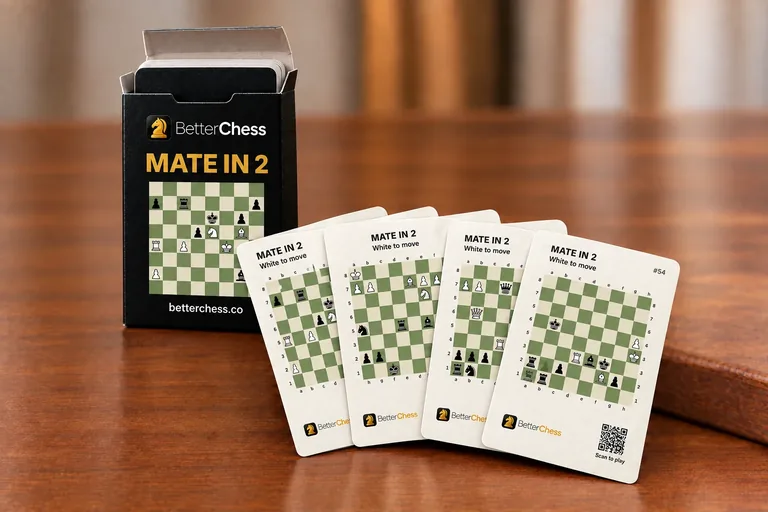
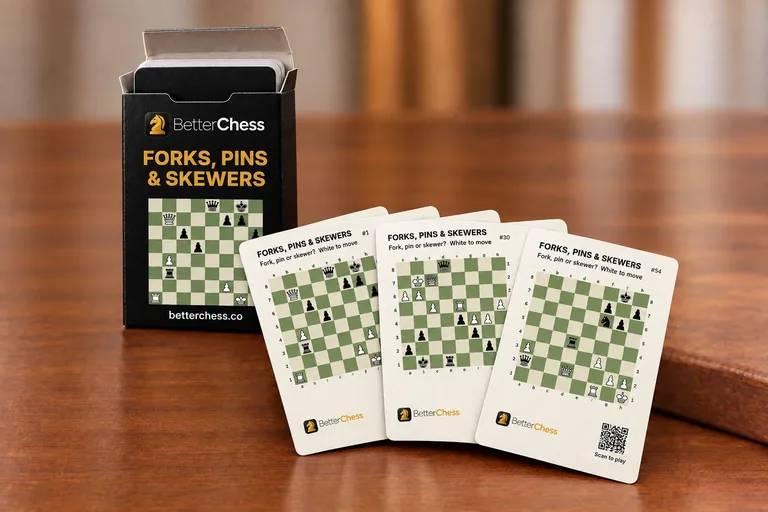
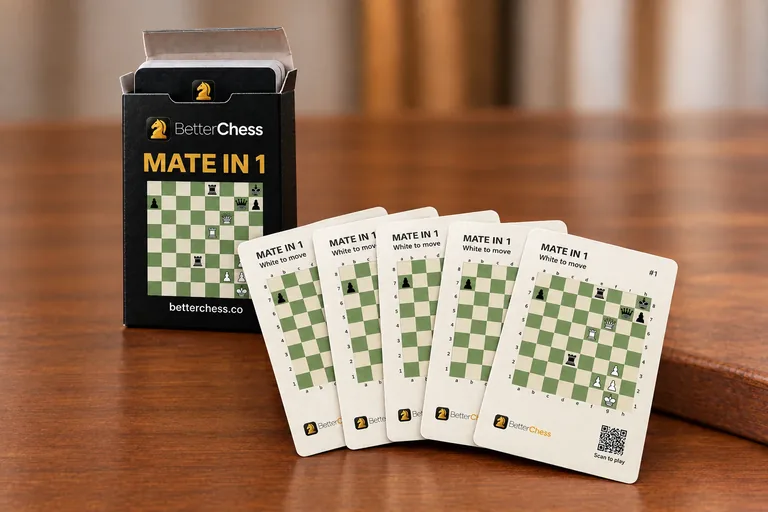
Chess puzzle playing card decks
54 poker-size cards in a tuck box. Puzzle on the front, solution on the back.