← Back to BetterChess
What's a good chess rating? Check your percentile
The short answer. In online rapid, a rating near 1000 is already above the median of all rated accounts, 1200 is roughly the top 10%, 1500 is around the top 4%, and 2000 is about the top 1%. The median sits near 600 because the pool is full of casual and abandoned accounts — so a "beginner" number is closer to average than it feels. Enter your rating below to see exactly what percentile you land in.
Source: Rapid rating distribution (www.chess.com), retrieved 2026-06-17. Percentiles are approximate and drift over time as the player pool grows.
What counts as a "good" chess rating?
There's no single number that flips you from bad to good — strength is a spectrum, and "good" only means something relative to the pool you're measured against. The honest framing is by tier. Below ~900 you're a beginner-to-novice: the games are decided by who blunders a piece last, and almost every loss starts with a one- or two-move tactic you walked into. From roughly 1000 to 1300 you're a genuine intermediate club player — you develop with purpose, spot common tactics, and can convert a clean extra piece. By 1400–1700 you're a strong amateur with a real repertoire and working endgame technique, and from 1800 up you're in the serious-player range where improvement is hard-won and specific.
The number that surprises people most is the median. Because the rating pool counts every rated account, including the millions made since 2020 that played a handful of casual games and stopped, the all-accounts median rapid rating sits near 600. That's why a 1000 already clears the top half and a 1200 reaches the top 10%. It doesn't mean 1200 is a master; it means most accounts barely play. If you compared only active, regularly-playing members the bar would be higher. The practical takeaway: don't measure yourself against the headline numbers from elite play — measure yourself against the opponents you actually face, and against your own game last month.
Chess rating percentiles (online rapid)
Here's where each rating band lands on the online rapid curve. "Better than" is the share of rated accounts at or below that rating. Tap any rating to read an honest, band-specific breakdown of how a player at that level typically plays and the one thing worth working on next.
| Rating | Better than | Tier |
|---|---|---|
| 400 | 28% | Beginner |
| 500 | 37% | Beginner |
| 600 | 46% | Beginner |
| 700 | 56% | Novice |
| 800 | 65% | Novice |
| 900 | 73% | Novice |
| 1000 | 81% | Intermediate |
| 1100 | 86% | Intermediate |
| 1200 | 90% | Intermediate |
| 1300 | 92% | Intermediate |
| 1400 | 95% | Advanced |
| 1500 | 96% | Advanced |
| 1600 | 97% | Advanced |
| 1700 | 98% | Advanced |
| 1800 | 98% | Expert |
| 1900 | 99% | Expert |
| 2000 | 99% | Expert |
| 2100 | 99% | Expert |
| 2200 | 100% | Master-level |
Where these numbers come from (and what they aren't)
Accuracy is the whole point of a page like this, so here's the honest source note. The percentiles are built from a cumulative curve anchored on chess.com's own published Rapid percentile figures (the widget shown on a member's stats page), corroborated by community rating analysis and a third-party percentile tool, retrieved 2026-06-17. Directly sourced anchors include 600≈46th, 800≈65th, 1000≈81st, 1200≈90th, 1500≈96th and 2000≈99th percentile; the points between and beyond those are interpolated to keep the curve smooth, and are marked as such in our data. The basis is all rated accounts, not active-only.
What these figures are not: a live leaderboard, an exact ranking, or comparable across platforms. Distributions drift as the player pool grows, Lichess Rapid runs a few hundred points higher for the same strength (Glicko-2, provisional 1500 start), and over-the-board FIDE/USCF numbers are a different scale again. Treat everything here as a close estimate, not a precise verdict — the value is in roughly locating yourself, not in chasing a decimal.
The number won't go up by watching it
Knowing your percentile is satisfying, but it doesn't move it. Rating is just the scoreboard; it rises when you stop repeating the mistake that keeps costing you games. The quickest way to find that mistake is to look at a game you lost: paste it into the free game review and it marks the exact move where the evaluation flipped and tells you what went wrong, in about 30 seconds, no sign-up. Across a handful of reviews one type of error usually dominates — and that pattern is worth more to your rating than any single number ever is.
From there, point yourself at the matching free resource: drill an opening's ideas in the interactive opening guides, learn both sides of a trick in the famous opening traps library, or look up any term you didn't know in the chess glossary. BetterChess is a practice tool — it can make finding your weakness fast, but the improvement is yours to earn. We make no promise of any specific rating.
Frequently asked
What is a good chess rating?
It depends on the platform, but in online rapid, the pool where most people who ask this question play, a rating around 1000 already puts you above the median of all rated accounts, and 1200 is roughly the top 10%. 'Good' is relative: 800 is a solid beginner who has stopped hanging pieces, 1500 is a strong club player, and 2000 is around the top 1%. There is no single magic number — what matters is whether you're improving against players near your own level.
What is the average chess rating?
On the biggest chess site today the median rapid rating across all rated accounts sits near 600, dragged down by the huge number of casual and abandoned accounts created since 2020. That means a 'beginner' number on paper is closer to average than people expect. Note that this is all-accounts data; if you only counted active, regularly-playing members the median would be meaningfully higher. Lichess and over-the-board (FIDE/USCF) ratings run on completely different scales and can't be compared one-to-one.
How is chess rating percentile calculated?
A percentile answers 'what fraction of players are rated at or below me'. We build a cumulative curve from the source site's published rapid percentile figures and corroborating community data, then read your rating off that curve. So '1200 is better than 90%' means roughly 90% of rated accounts there are 1200 or lower. It's an estimate from a real distribution, not an exact live ranking — the player pool shifts over time, so treat the numbers as close, not precise.
Why is my rating so different on different chess sites?
Because the big chess sites use different number lines, not different measurements of the same thing. Lichess uses Glicko-2 and starts new players provisionally at 1500, so its ratings typically run a few hundred points higher than other sites' for the same playing strength. A 1500 in online rapid on one site is not the same as a 1500 on another. Always note which platform and time control a rating refers to before comparing it to anything.
Does a higher rating mean I'm a better player?
Over a large number of games, yes — rating is a reasonable measure of results against a pool of opponents. But a single rating is a snapshot, it swings with form and tilt, and it says nothing about why you win or lose. The fastest way to raise yours isn't watching the number; it's finding the recurring mistake that keeps costing you games. That's a practice problem, not a rating problem, and no tool can promise you a specific gain.
Related: Free game review · Chess openings explained · Famous opening traps · Chess glossary
Percentiles are estimates from published online rapid distribution data (see source note above) and drift as the player pool changes. BetterChess is a practice tool — we make no guarantee that you'll reach any particular rating. Improvement depends on your own practice and effort. Product names are trademarks of their respective owners.
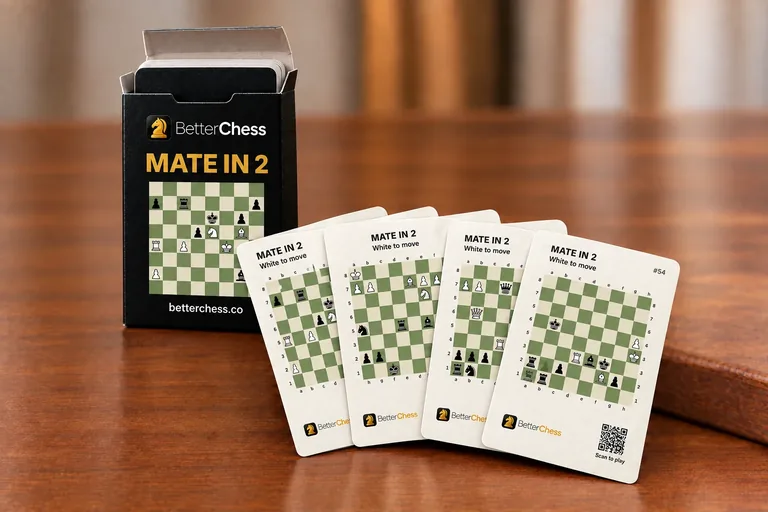
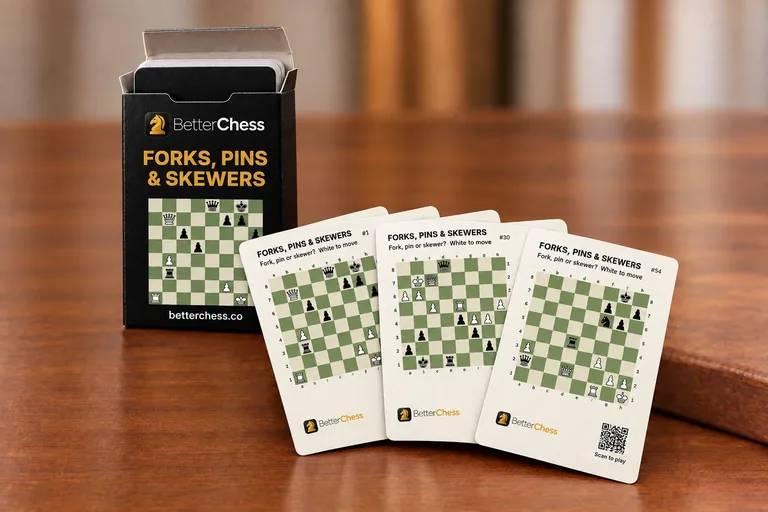
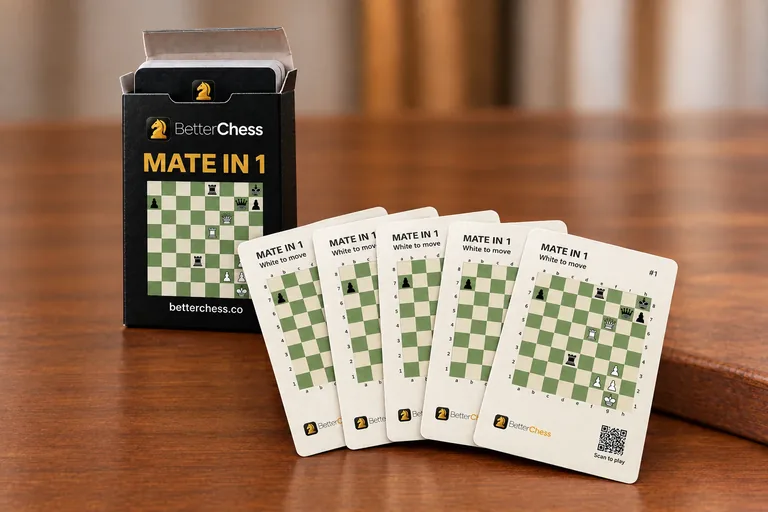
PRINTED CHESS PUZZLE CARDS
Chess puzzle playing card decks
54 poker-size cards in a tuck box. Puzzle on the front, solution on the back.