Opera Mate
The opera mate is a back-rank checkmate in which a rook, protected by a bishop on the diagonal, mates an uncastled king that is boxed in by its own pieces.
The pattern takes its name from Paul Morphy's famous 1858 game at the Paris opera against Duke Karl of Brunswick and Count Isouard, who consulted against him. Morphy sacrificed nearly everything, finished development in record time, and ended the game with 17.Rd8#: rook to the back rank, guarded by a bishop.
The mechanics are simple: the enemy king is still in the center, its own pieces occupy or block the nearby squares, and your rook lands on the back rank where the king cannot capture it because a bishop defends it from a distance. The bishop also covers the one diagonal flight square, so the net is airtight.
The opera game is the classic advertisement for rapid development and open lines. If your opponent leaves the king in the middle and grabs material, look for sacrifices that clear the central file: the opera mate is often waiting at the end of them.
Frequently asked
Where does the opera mate get its name?
From Paul Morphy's 1858 game played in a box at the Paris opera against two consulting noblemen. Morphy sacrificed his queen and mated with rook and bishop on move 17, and the finish became the textbook example.
How is the opera mate different from a back-rank mate?
A standard back-rank mate traps a castled king behind its own pawns. The opera mate targets an uncastled king: the mating rook is defended by a bishop on the diagonal, and the king's own pieces block its escape.
Related terms
BetterChess is a practice tool — we make no guarantee you'll reach 1800 or any rating. Definitions are standard chess terminology; every diagram position is checked legal with the same engine the board runs.
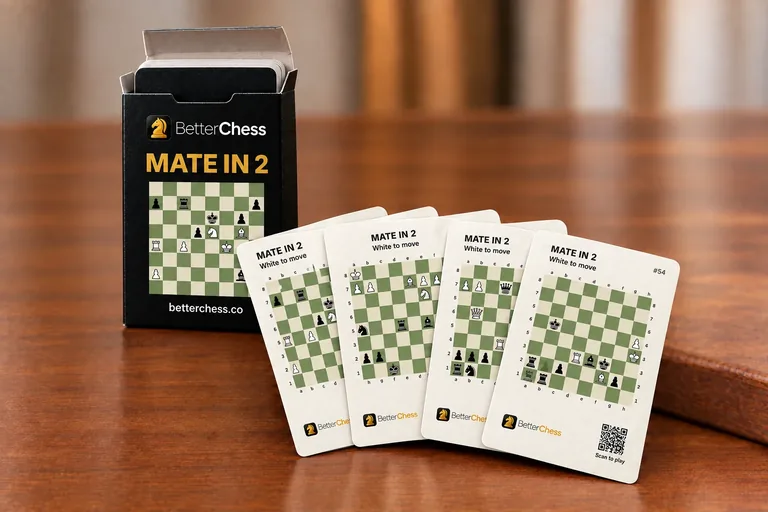
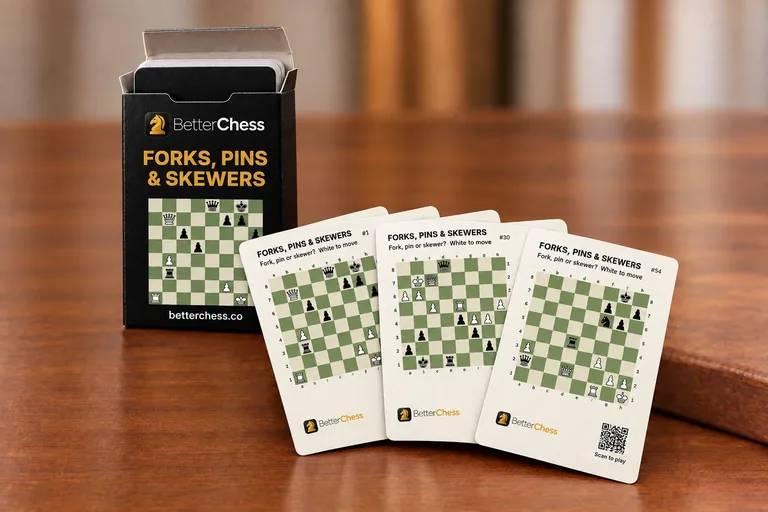
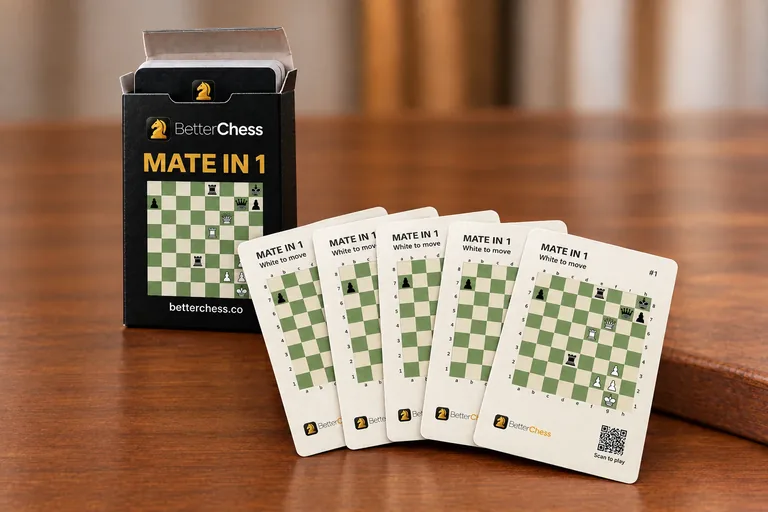
PRINTED CHESS PUZZLE CARDS
Chess puzzle playing card decks
54 poker-size cards in a tuck box. Puzzle on the front, solution on the back.