Vancura Position
The Vancura position is a drawing setup in rook endgames where the defending rook attacks the enemy rook pawn from the side, leaving the stronger side's rook stuck in front of its own pawn.
The setup is specific: the stronger side has a rook pawn that has reached the sixth rank (say a6) with its own rook parked in front on a8, while the defender's rook sits on the pawn's rank, hitting it from the side, and the defending king stays home near g7. The attacking rook now has a terrible job: it cannot leave a8 without dropping the pawn.
The drawing mechanism is the side check. If the attacking king walks over to relieve the rook, the defender starts checking from the f-file: the king has no shelter anywhere near the pawn, and the moment it steps away, the rook returns to attack the pawn again. The stronger side simply cannot make progress.
The position is named after the Czech analyst Josef Vancura, whose work on it appeared in 1924. For club players it is one of the highest-value endgame patterns to memorize: rook endgames a pawn down against an outside rook pawn are common, and knowing to get your rook to the pawn's rank early, before the pawn reaches a7, turns many lost-looking games into draws.
Frequently asked
Why does the defending rook attack the pawn from the side?
Because it ties the attacking rook to a8 permanently while staying flexible. From the pawn's rank the rook both hits the pawn and is ready to deliver side checks the moment the enemy king comes to help. Passive defense from the back rank loses in this structure.
When should I set up the Vancura defense?
Against a rook pawn that has reached the sixth rank while the attacking rook stands in front of it. Rush your rook to the pawn's rank and keep your king near g7. If the pawn gets to a7 first, this specific mechanism no longer applies, so act early.
Related terms
BetterChess is a practice tool — we make no guarantee you'll reach 1800 or any rating. Definitions are standard chess terminology; every diagram position is checked legal with the same engine the board runs.
PRINTED CHESS PUZZLE CARDS
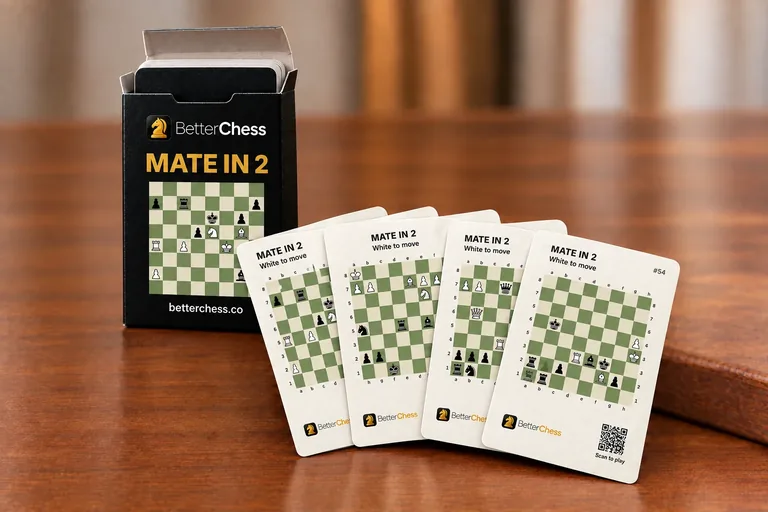
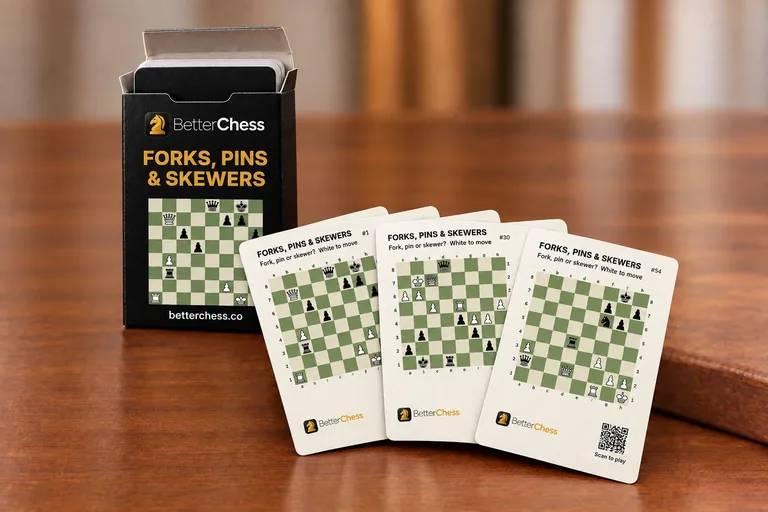
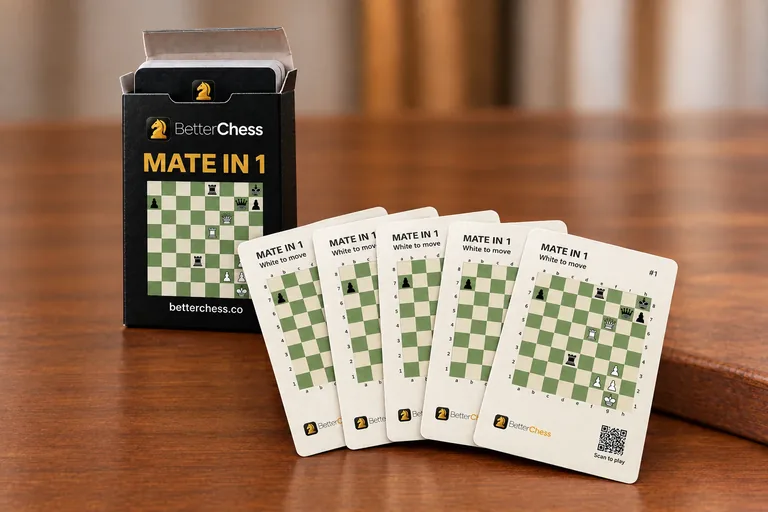
Chess puzzle playing card decks
54 poker-size cards in a tuck box. Puzzle on the front, solution on the back.