Blackburne's Mate
Blackburne's mate is a rare pattern in which both bishops and a knight combine: the light-squared bishop mates on h7, the knight guards it, and the dark-squared bishop rakes the long diagonal.
Named after the English attacking master Joseph Henry Blackburne, this mate is the bishop pair at its most violent. The light-squared bishop lands on h7, right next to the castled king, defended by a knight on g5. On its own that would just be a check.
What turns it into mate is the second bishop, firing down the a1 to h8 diagonal: it covers both g7 and h8, the only dark squares the king could run to. The defender's own rook on f8 blocks the last exit, so the king is caught in a crossfire of three minor pieces.
The pattern often appears as a threat after a queen sacrifice on h5 or g6 has stripped the king's cover. As a defender, the alarm signs are an open bishop diagonal to h7, a knight ready to jump to g5, and a fianchetto diagonal you no longer control.
Frequently asked
Why is Blackburne's mate considered rare?
Because it needs both bishops on full open diagonals plus a knight on g5 at the same time, which well-defended kingsides rarely allow. It appears more often as a threat that wins material than as an actual mate on the board.
How do I defend against Blackburne's mate ideas?
Keep a defender covering h7 (a knight on f6 is ideal), avoid trading off your fianchetto bishop, and challenge an enemy knight that lands on g5. Breaking any one link, the h7 bishop, the g5 knight, or the long diagonal, kills the mate.
Related terms
BetterChess is a practice tool — we make no guarantee you'll reach 1800 or any rating. Definitions are standard chess terminology; every diagram position is checked legal with the same engine the board runs.
PRINTED CHESS PUZZLE CARDS
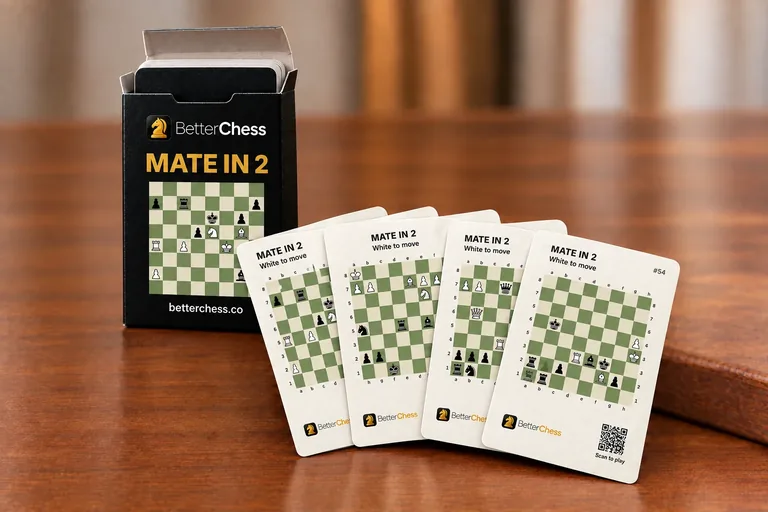
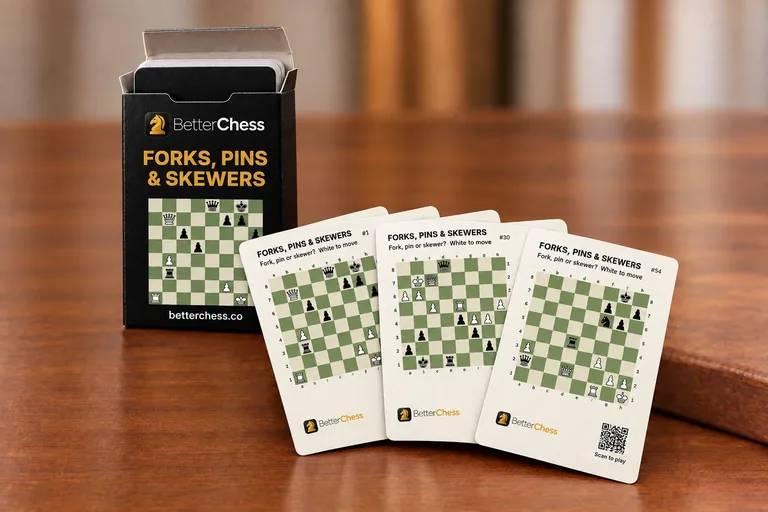
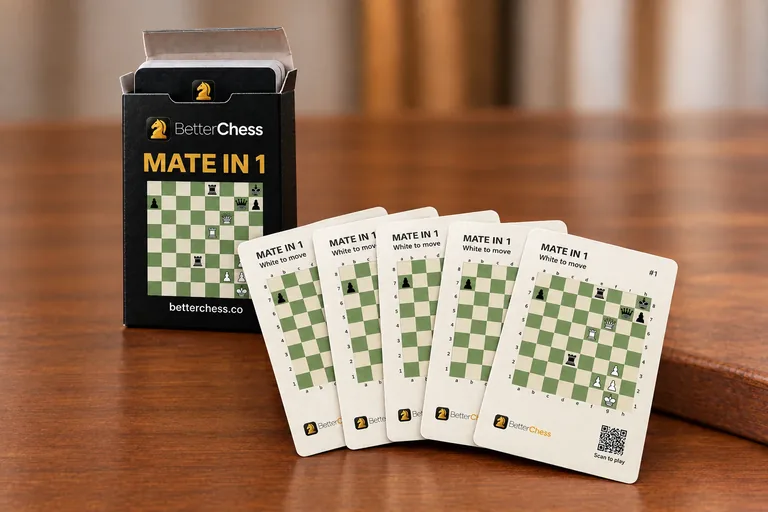
Chess puzzle playing card decks
54 poker-size cards in a tuck box. Puzzle on the front, solution on the back.