Swiss System
The Swiss system is a tournament format where nobody is eliminated: each round pairs players on the same score, so winners meet winners and the leaders emerge quickly.
In a Swiss tournament every player plays every round. The first round typically pairs the top half of the field against the bottom half by rating; from then on you are paired against someone with the same score whenever possible, without ever facing the same opponent twice, while colors are kept balanced.
The format was first used in Zurich in 1895, hence the name, and it solves a real problem: nine rounds can produce a clear winner from a field of hundreds, which a round-robin could never do. That is why nearly every open tournament, and the Chess Olympiad, runs as a Swiss.
Practical consequences for you: every half point matters because your score decides your pairings, a win usually buys you a harder opponent next round, and final standings among equal scores are separated by tiebreaks such as Buchholz, the sum of your opponents' scores.
Frequently asked
How are Swiss pairings decided?
By score first: you face someone with the same points whenever possible, never the same opponent twice, with colors balanced along the way. Round one typically pairs the top half of the field against the bottom half by rating.
How many rounds does a Swiss need?
Far fewer than the field size suggests. Nine rounds can sort out an open with hundreds of players, which is why almost every large chess tournament, including the Olympiad, uses the Swiss system.
Related terms
BetterChess is a practice tool — we make no guarantee you'll reach 1800 or any rating. Definitions are standard chess terminology; every diagram position is checked legal with the same engine the board runs.
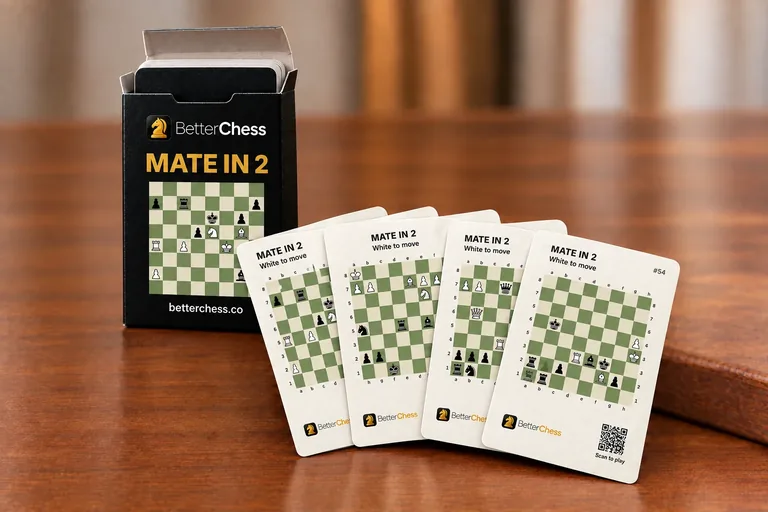
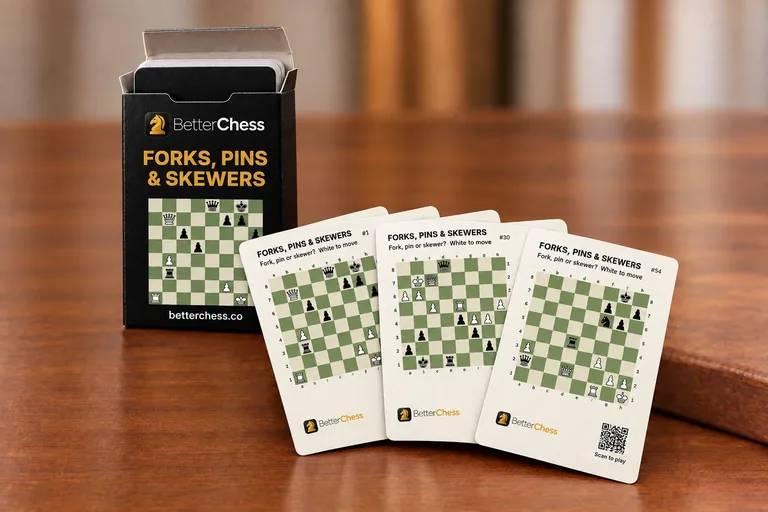
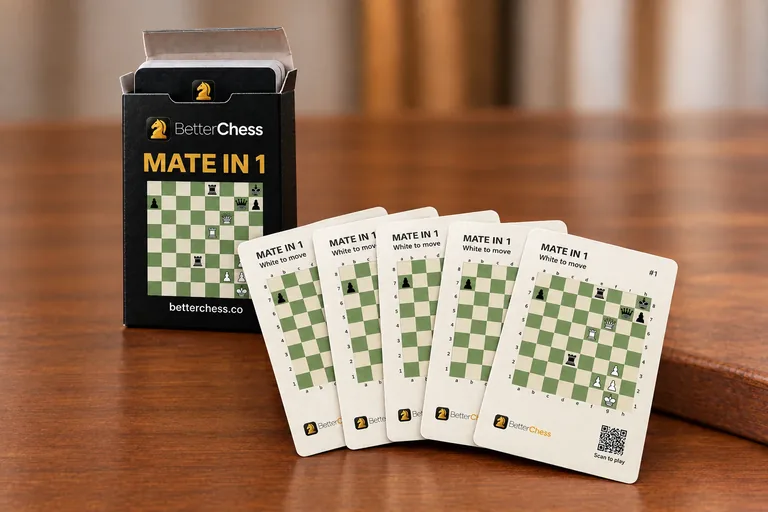
PRINTED CHESS PUZZLE CARDS
Chess puzzle playing card decks
54 poker-size cards in a tuck box. Puzzle on the front, solution on the back.