Alekhine's Gun
Alekhine's Gun is an attacking formation in which both rooks are doubled on a file with the queen stacked behind them, creating a battery that overwhelms any single defender.
The name comes from Alexander Alekhine's game against Aron Nimzowitsch at San Remo 1930, where the world champion lined up both rooks on the c-file with his queen behind them. Nimzowitsch's position collapsed shortly after: he literally ran out of moves.
The formation is brutal for a simple arithmetic reason: the front rook can capture on a defended square, be recaptured, and be instantly replaced by the second rook, then the queen. Three attackers arrive on the same square in sequence, with the most valuable piece safely at the back of the queue.
Building the gun takes time, so it belongs in closed or semi-open positions where the target, often a backward pawn or an entry square on a half-open file, cannot run away. Defensively, the cure is to trade a pair of rooks before the battery assembles or to challenge the file with your own heavy pieces.
Frequently asked
Why is the queen placed at the back of Alekhine's Gun?
So the cheapest pieces absorb the trades. The rooks can capture and be recaptured while the queen backs them up; putting the queen in front would let the defender win her for a rook and break the battery.
Where does the name Alekhine's Gun come from?
From Alekhine versus Nimzowitsch, San Remo 1930. Alekhine stacked both rooks and his queen on the c-file, and the formation squeezed Nimzowitsch into total paralysis. The tripled pieces looked like a loaded cannon, and the name stuck.
Related terms
BetterChess is a practice tool — we make no guarantee you'll reach 1800 or any rating. Definitions are standard chess terminology; every diagram position is checked legal with the same engine the board runs.
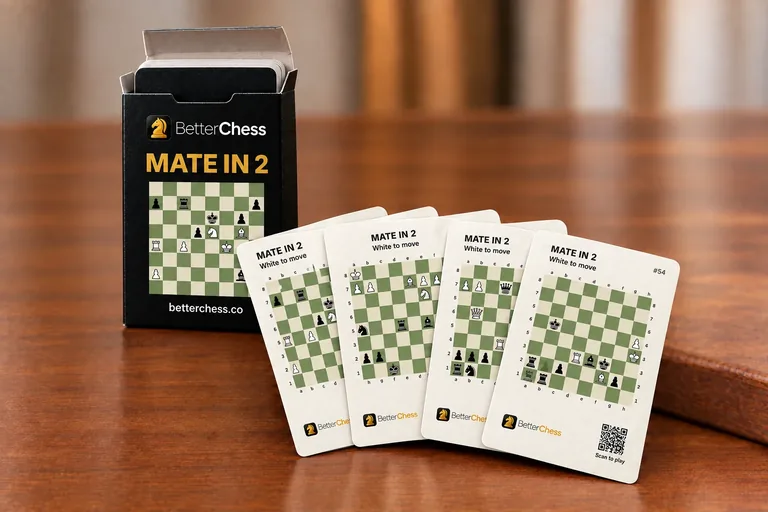
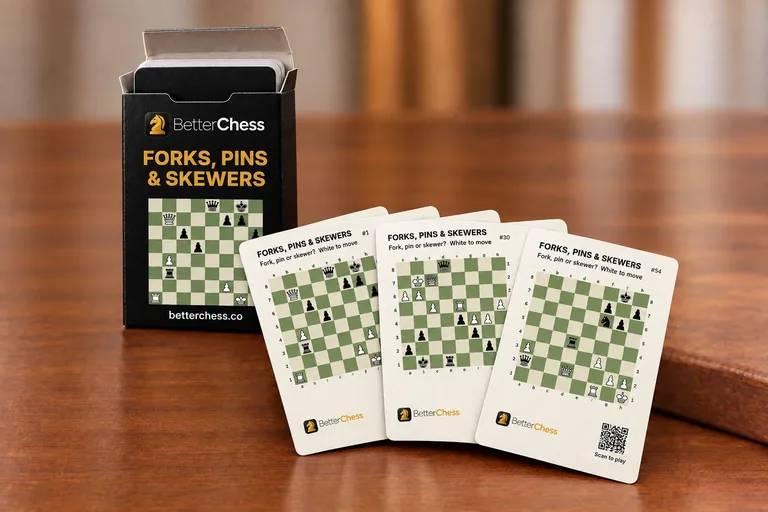
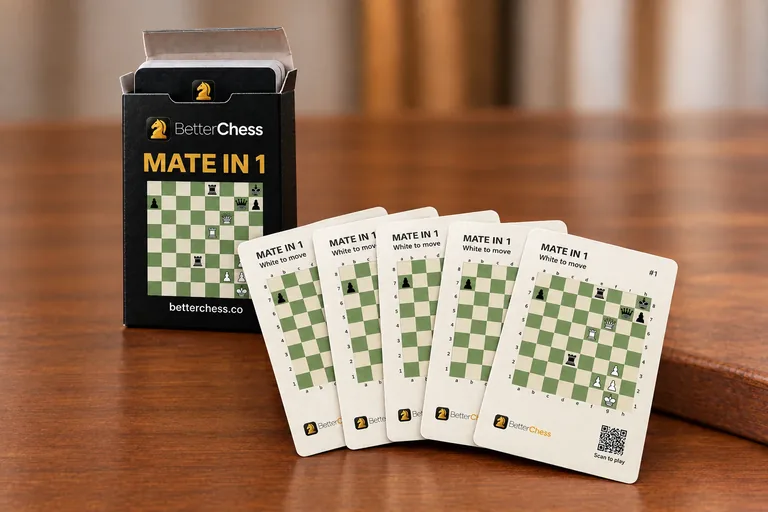
PRINTED CHESS PUZZLE CARDS
Chess puzzle playing card decks
54 poker-size cards in a tuck box. Puzzle on the front, solution on the back.