Chess960
Chess960, also called Fischer Random, is a variant where the back-rank pieces are shuffled into one of 960 possible starting positions, making memorized opening theory useless.
Bobby Fischer introduced the variant in 1996 with one goal: remove memorized opening theory and force players to think from move one. Pawns start normally, but the pieces on each player's first rank are shuffled, with two constraints: the bishops must sit on opposite colors, and the king must stand somewhere between the two rooks.
Those constraints allow exactly 960 distinct setups, one of which is the standard chess array, and Black's pieces mirror White's. Castling survives in adapted form: whatever the starting squares, the king and rook finish on the standard castling squares, g1 and f1 kingside or c1 and d1 queenside (mirrored for Black).
The variant has gone fully mainstream: FIDE recognizes it in the Laws of Chess, and Wesley So won the first official FIDE World Fischer Random Championship in 2019. For improvers it is superb training, because it isolates the skills that matter most at club level: development, king safety, and concrete calculation.
Frequently asked
Why is it called Chess960?
Because exactly 960 legal starting setups satisfy the two constraints: bishops on opposite colors and the king somewhere between the two rooks. The standard chess array is one of the 960.
How does castling work in Chess960?
The usual castling rights and restrictions apply, and the king and rook always land on the standard squares: g1 and f1 for kingside, c1 and d1 for queenside (mirrored for Black), no matter where they started.
Related terms
BetterChess is a practice tool — we make no guarantee you'll reach 1800 or any rating. Definitions are standard chess terminology; every diagram position is checked legal with the same engine the board runs.
PRINTED CHESS PUZZLE CARDS
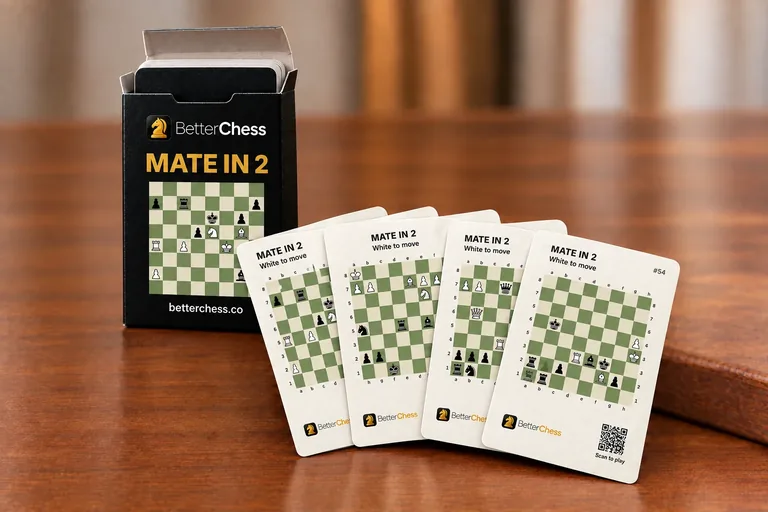
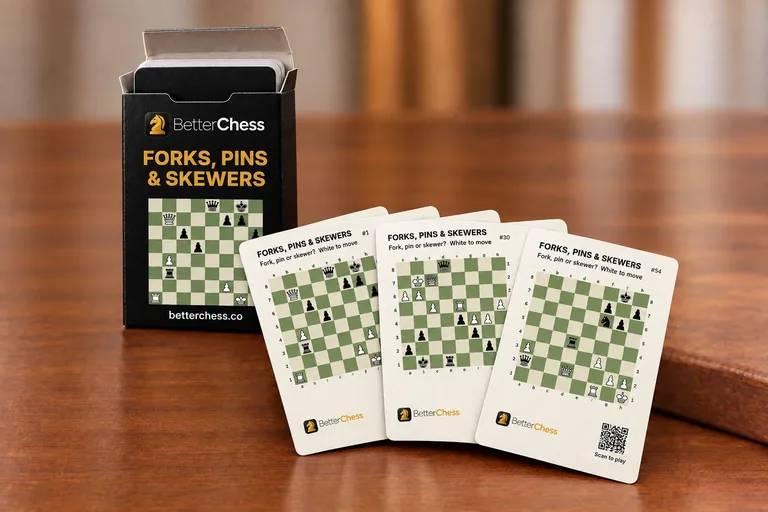
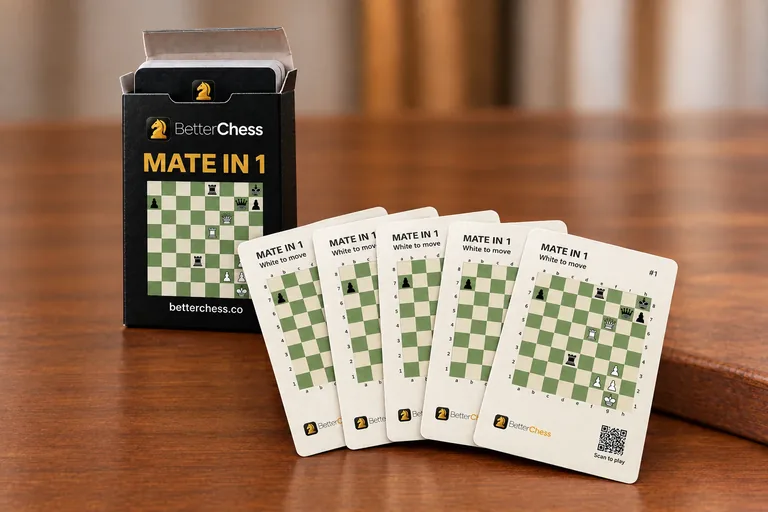
Chess puzzle playing card decks
54 poker-size cards in a tuck box. Puzzle on the front, solution on the back.