Pillsbury's Mate
Pillsbury's mate is a checkmate in which a rook mates down the open g-file while a bishop on the long diagonal covers the corner escape square.
Named after the American star Harry Nelson Pillsbury, this pattern is the mirror twin of Morphy's mate: the same rook, bishop and open g-file, but with the jobs swapped. Here the rook lands the killing check on the g-file while the bishop denies the king its corner.
The setup usually follows a demolition of the castled king's cover: a capture or sacrifice on g7 tears the file open, the king is left on g8, and the rook checks down the file. With the bishop slicing through f6 or the long diagonal to cover h8, and the king's own rook and pawns filling f8, f7 and h7, the check is mate.
Because the two mates share the same furniture, calculate both versions whenever you assault a fianchetto king: if the bishop check does not finish (Morphy's mate), the rook check often does (Pillsbury's), and vice versa. The attacking duo of open g-file plus long diagonal is among the most lethal in chess.
Frequently asked
What is the difference between Pillsbury's mate and Morphy's mate?
They use the same pieces on the same lines. In Pillsbury's mate the rook delivers mate on the g-file and the bishop covers the corner; in Morphy's mate the bishop delivers mate on the diagonal and the rook seals the file.
How do I set up Pillsbury's mate?
Open the g-file against a castled king, usually with a capture or sacrifice on g7, and post a bishop on the a1 to h8 diagonal. When the king cannot leave the g-file area, the rook check down the file is mate.
Related terms
BetterChess is a practice tool — we make no guarantee you'll reach 1800 or any rating. Definitions are standard chess terminology; every diagram position is checked legal with the same engine the board runs.
PRINTED CHESS PUZZLE CARDS
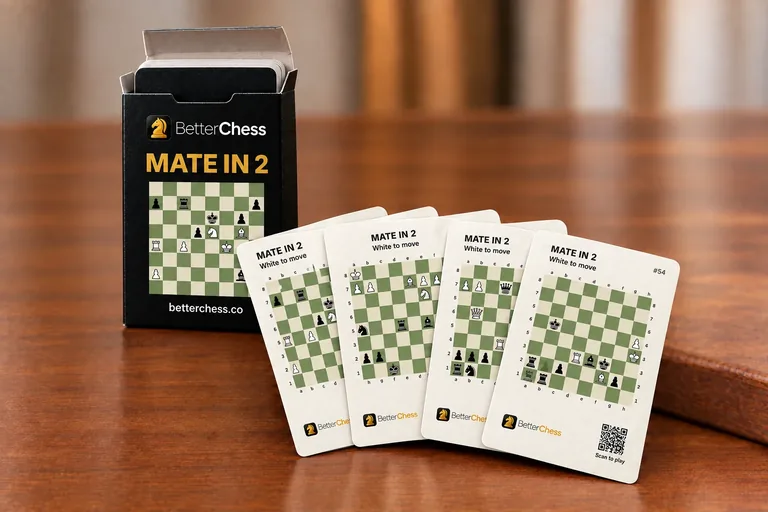
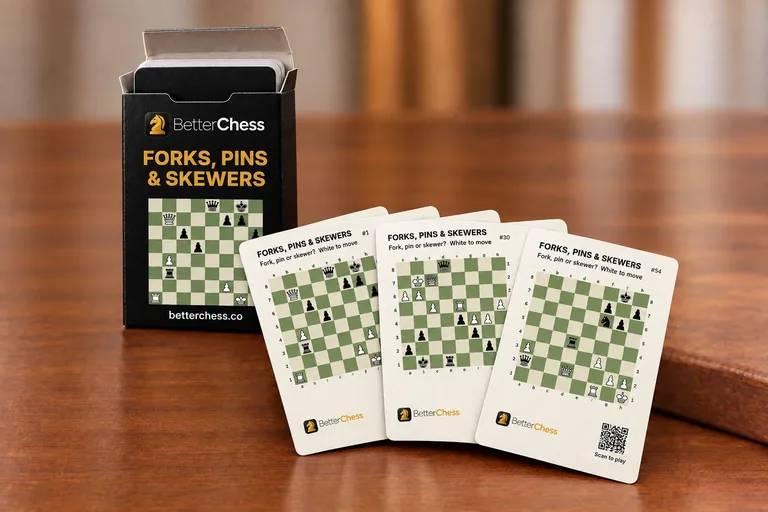
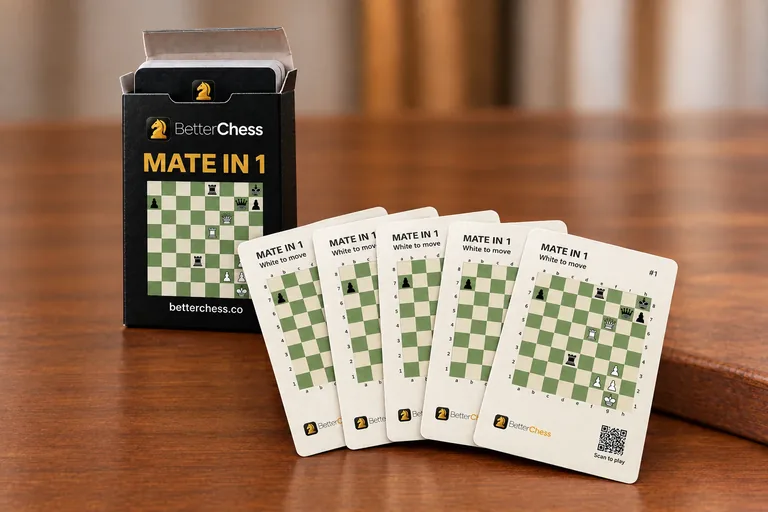
Chess puzzle playing card decks
54 poker-size cards in a tuck box. Puzzle on the front, solution on the back.