J'adoube
J'adoube is French for 'I adjust': announce it before straightening a piece on its square, and the touch-move rule does not apply to that touch.
The touch-move rule has exactly one escape hatch. If a piece is sitting untidily on its square, you may straighten it without having to move it, provided you first announce your intention, traditionally with the French 'j'adoube', though 'I adjust' in your own language works just as well.
The conditions are strict: you may only adjust when you have the move, the announcement must come before you touch anything, and adjusting means centering a piece on the square where it already stands. Saying j'adoube after your fingers have landed on a piece changes nothing; the touch-move rule already applies.
Use it sparingly and deliberately. Players who constantly fuss with the pieces invite suspicion that they are testing moves with their hands, and using j'adoube as cover for hovering over candidate squares is a violation the arbiter can penalize. Straighten what needs straightening, announce it clearly, and get back to thinking.
Frequently asked
When am I allowed to say j'adoube?
Only when you have the move. Announce it first, then straighten the piece on its square. Saying it after you have already touched a piece does not undo the touch-move rule.
Does j'adoube let me try a move and take it back?
No. Adjusting means centering a piece on the square where it already stands. Using j'adoube to test squares or hover a piece over the board is a violation the arbiter can penalize.
Related terms
BetterChess is a practice tool — we make no guarantee you'll reach 1800 or any rating. Definitions are standard chess terminology; every diagram position is checked legal with the same engine the board runs.
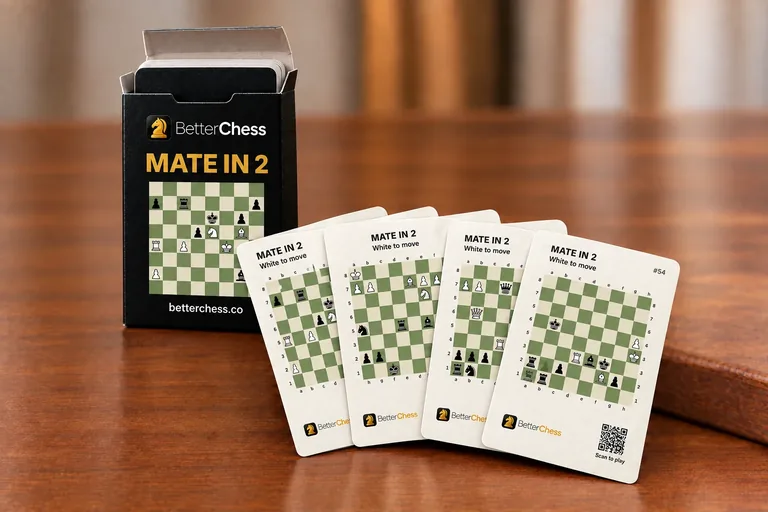
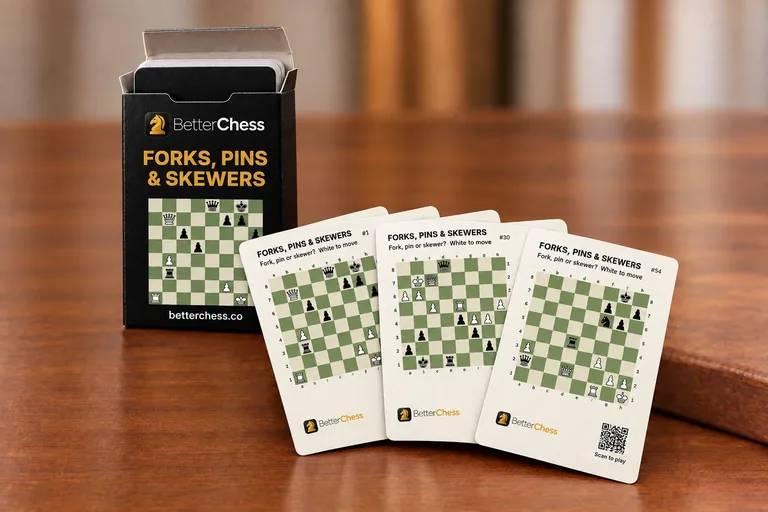
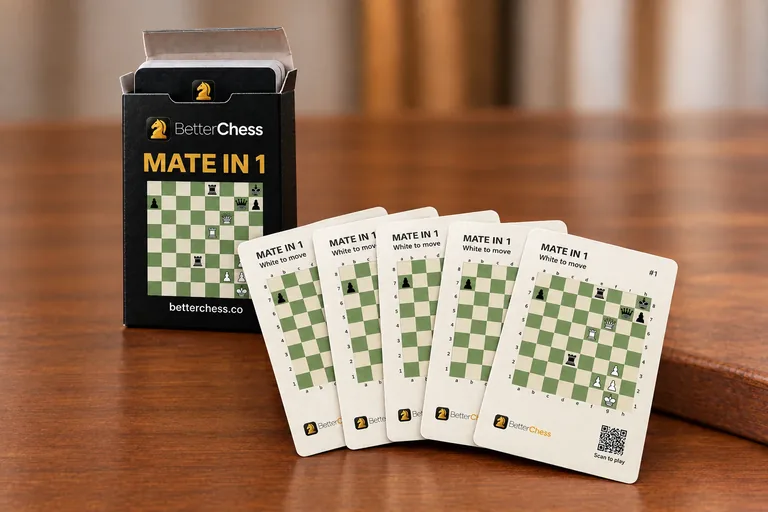
PRINTED CHESS PUZZLE CARDS
Chess puzzle playing card decks
54 poker-size cards in a tuck box. Puzzle on the front, solution on the back.