Elo Rating
An Elo rating is a number that measures a player's strength from results; the gap between two ratings predicts how often the stronger player should score.
The Elo system, designed by the Hungarian American physics professor Arpad Elo, was adopted by the US Chess Federation in 1960 and by FIDE in 1970. After every rated game, points flow from the loser to the winner, and the amount depends on how surprising the result was.
The gap between two ratings predicts the score. A player rated 100 points higher is expected to score about 64 percent; at 200 points the expectation is about 76 percent. Beat a stronger player and you gain a lot of points; beat a much weaker one and you gain almost nothing.
As rough landmarks: 800 is a beginner finding their feet, 1200 to 1800 covers most club players, 2200 is master territory, and 2500 is grandmaster level. The highest official FIDE rating ever recorded is Magnus Carlsen's 2882.
Frequently asked
How many points do I win or lose per game?
It depends on the rating gap and your K-factor, a multiplier that is larger for new players. With a K-factor of 20, beating an equal opponent gains about 10 points, while beating someone much stronger can gain nearly the full 20.
Are online and FIDE ratings comparable?
No. Each site is a separate pool, and the online sites actually use Glicko systems built on Elo's idea. Lichess ratings typically run the highest of the big sites, and online ratings usually run higher than a player's FIDE rating.
Related terms
BetterChess is a practice tool — we make no guarantee you'll reach 1800 or any rating. Definitions are standard chess terminology; every diagram position is checked legal with the same engine the board runs.
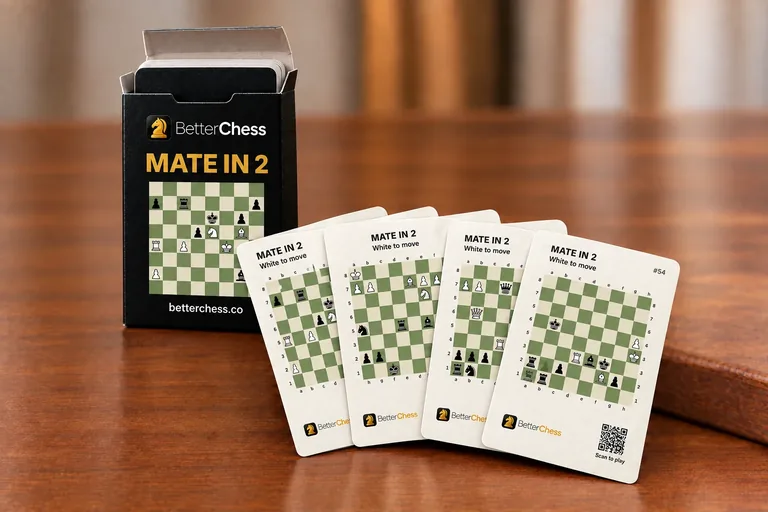
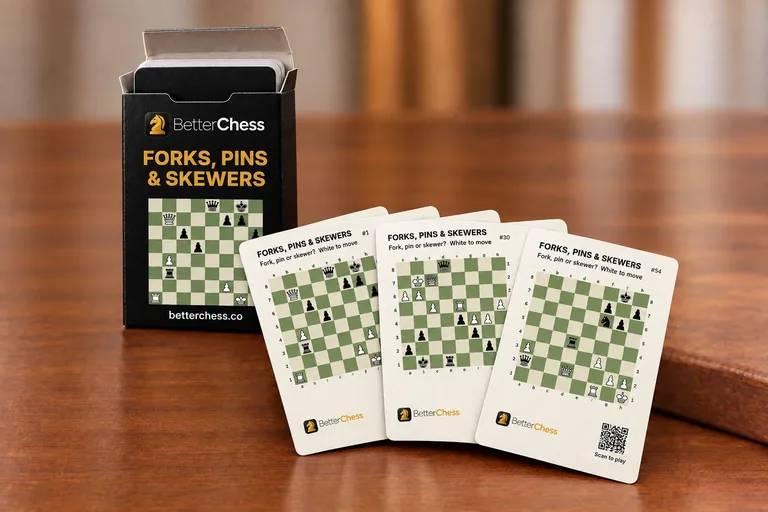
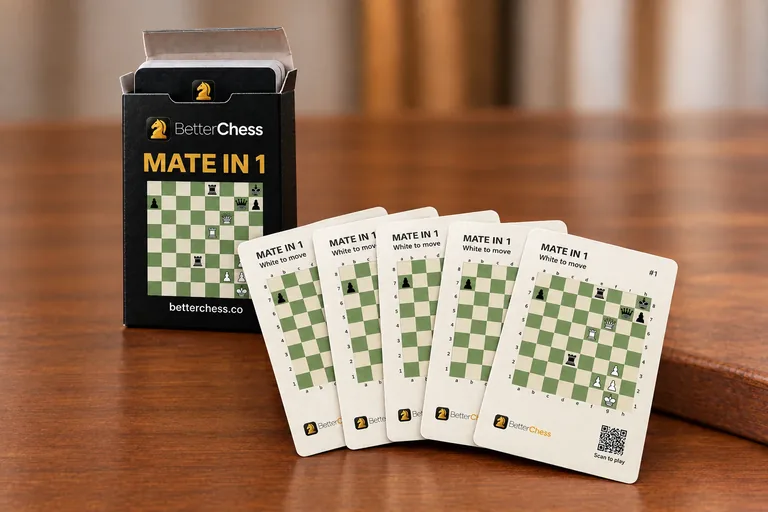
PRINTED CHESS PUZZLE CARDS
Chess puzzle playing card decks
54 poker-size cards in a tuck box. Puzzle on the front, solution on the back.