PGN
PGN (Portable Game Notation) is the standard text format for recording chess games: header tags in square brackets, followed by the moves in algebraic notation.
A PGN game has two parts. First come the header tags in square brackets; the required seven, known as the Seven Tag Roster, are Event, Site, Date, Round, White, Black, and Result. Then comes the movetext in standard algebraic notation, ending with the result token (1-0, 0-1, or 1/2-1/2).
Steven J. Edwards designed the format in the early 1990s to be readable by both humans and machines, and it won completely: every serious chess site, database, and engine interface imports and exports PGN. The format also supports comments in curly braces, alternative variations in parentheses, and numeric annotation glyphs.
For an improving player PGN is the container your chess lives in. Export your games from any platform as PGN, load them into an analysis board, and annotate them; build a file of your own games in one place. A whole tournament, or a million-game database, is just more games in the same plain text format.
Frequently asked
What are the seven standard PGN tags?
Event, Site, Date, Round, White, Black, and Result, together known as the Seven Tag Roster. They appear in square brackets before the moves, and the result token also closes the movetext.
How is PGN different from FEN?
PGN records a whole game, moves and metadata included. FEN captures a single position in one line of text. Use PGN to store games and FEN to share or set up a specific position.
Related terms
BetterChess is a practice tool — we make no guarantee you'll reach 1800 or any rating. Definitions are standard chess terminology; every diagram position is checked legal with the same engine the board runs.
PRINTED CHESS PUZZLE CARDS
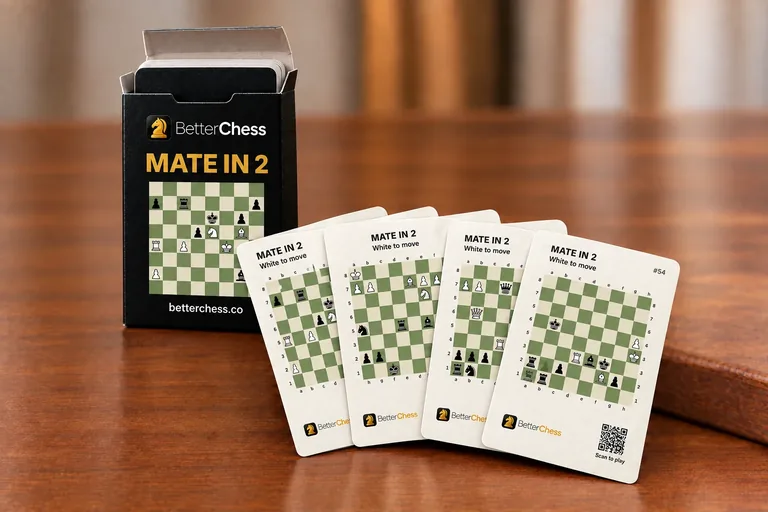
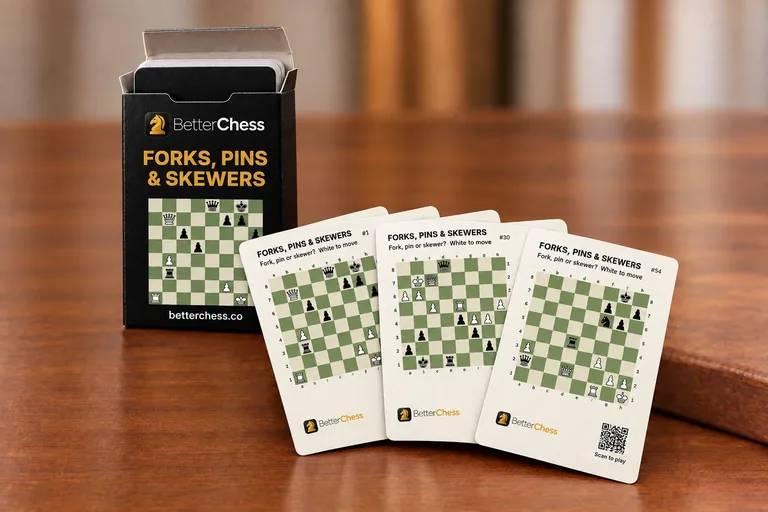
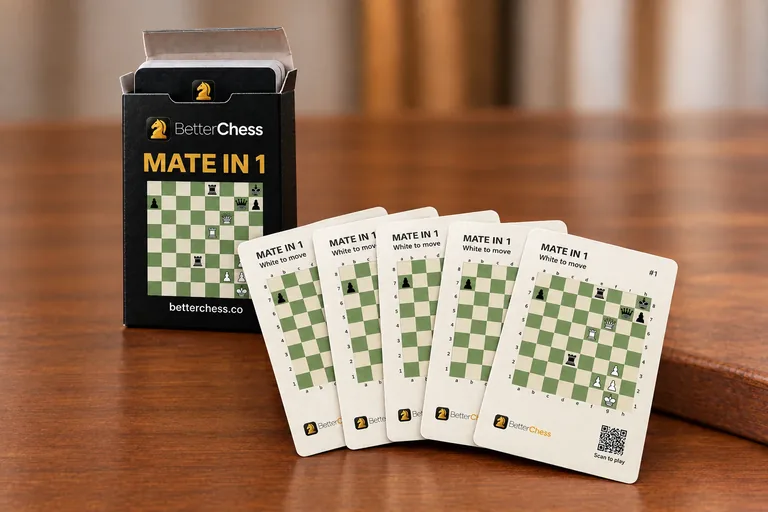
Chess puzzle playing card decks
54 poker-size cards in a tuck box. Puzzle on the front, solution on the back.