Dead Position
A dead position is one where no sequence of legal moves could ever produce checkmate for either side. The game is drawn the moment such a position arises.
The Laws of Chess end the game automatically when checkmate has become impossible: if no series of legal moves, however absurd or cooperative, could ever mate either king, the position is dead and the game is drawn on the spot. King against king, king and bishop against king, and king and knight against king are the textbook cases, along with fully blocked positions where no piece can ever break through.
The rule matters most at the clock. Normally a flag fall loses, but if your opponent could not checkmate you by any possible series of legal moves, your flag falling makes no difference: the game is drawn. In a dead position the game has already ended, so nothing that happens afterwards, time included, can change the result.
Mind the fine print: the test is whether mate is possible at all, not whether it can be forced. King and two knights against a bare king is not a dead position, because a cooperative mate exists even though it cannot be forced. That distinction decides real games when flags fall.
Frequently asked
What happens if my flag falls in a dead position?
Nothing changes: the game was already drawn the moment the dead position arose. More generally, a flag fall only loses if your opponent could checkmate you by some series of legal moves; otherwise it is a draw.
Is king and two knights against a bare king a dead position?
No. Mate cannot be forced, but a checkmate is still constructible if the defender cooperates, so the position is not dead, the game continues, and a flag fall there would still lose.
Related terms
BetterChess is a practice tool — we make no guarantee you'll reach 1800 or any rating. Definitions are standard chess terminology; every diagram position is checked legal with the same engine the board runs.
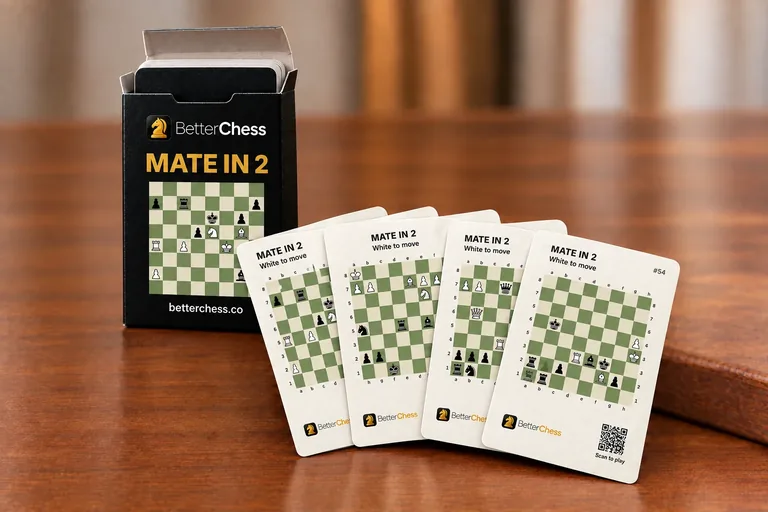
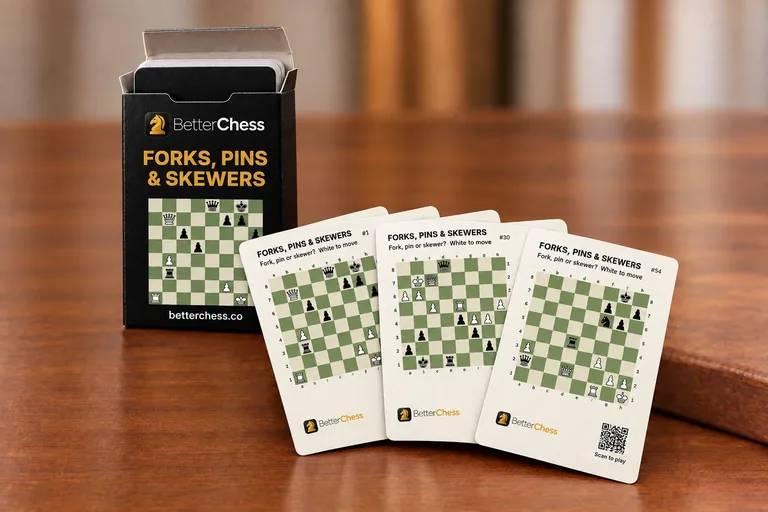
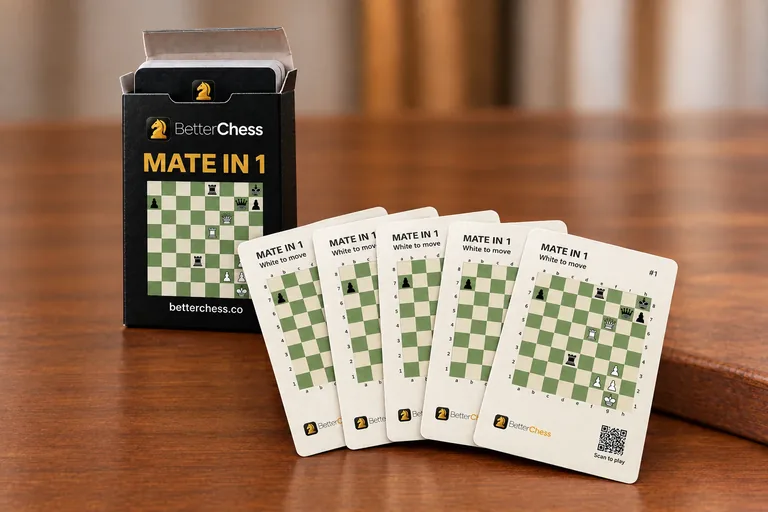
PRINTED CHESS PUZZLE CARDS
Chess puzzle playing card decks
54 poker-size cards in a tuck box. Puzzle on the front, solution on the back.