Liquidation
Liquidation is a deliberate, usually forcing series of exchanges that transforms the position into a simpler endgame you have already judged as won or drawn.
Where simplification is a general policy of trading, liquidation is a concrete operation: a short forcing sequence of captures that converts one type of position into another, most often a piece endgame into a pawn endgame.
The key is that you evaluate the target position before you start. Trading into a king and pawn endgame is the most committal decision in chess, since there is no going back, so you calculate the resulting pawn race or opposition to the end first. Done right, liquidation is the cleanest conversion there is.
Defenders liquidate too: giving back an extra pawn to reach a known theoretical draw, like a wrong-bishop endgame, is a standard save. The habit to build: whenever a forced sequence of trades is available, evaluate the far end of it before touching a piece.
Frequently asked
What is the difference between liquidation and simplification?
Simplification is the general strategy of trading pieces when it favors you. Liquidation is a concrete forcing sequence of trades aimed at one specific target position, usually a calculated endgame.
Why is liquidating into a pawn endgame risky?
Because it is irreversible. King and pawn endgames are brutally concrete: one tempo or one square decides. You must calculate the resulting position to the very end, not just judge that you are a pawn up.
Related terms
BetterChess is a practice tool — we make no guarantee you'll reach 1800 or any rating. Definitions are standard chess terminology; every diagram position is checked legal with the same engine the board runs.
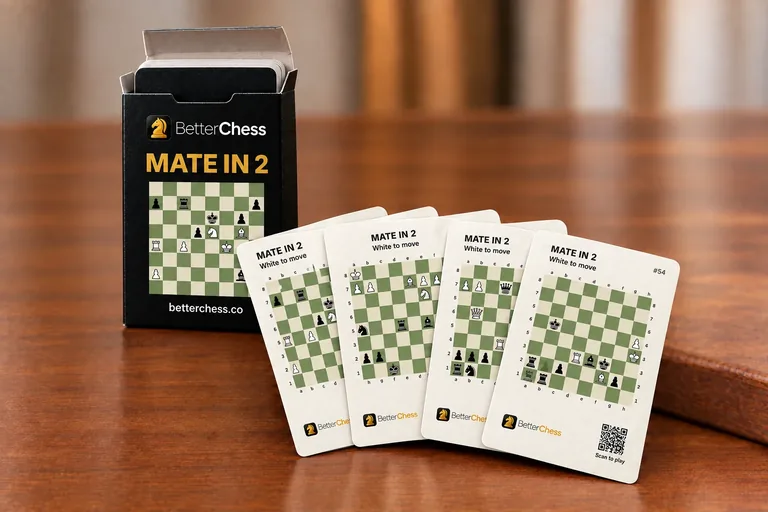
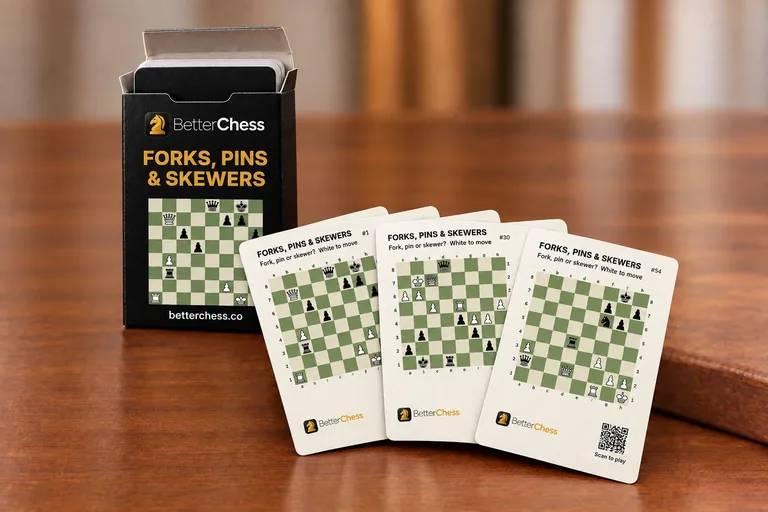
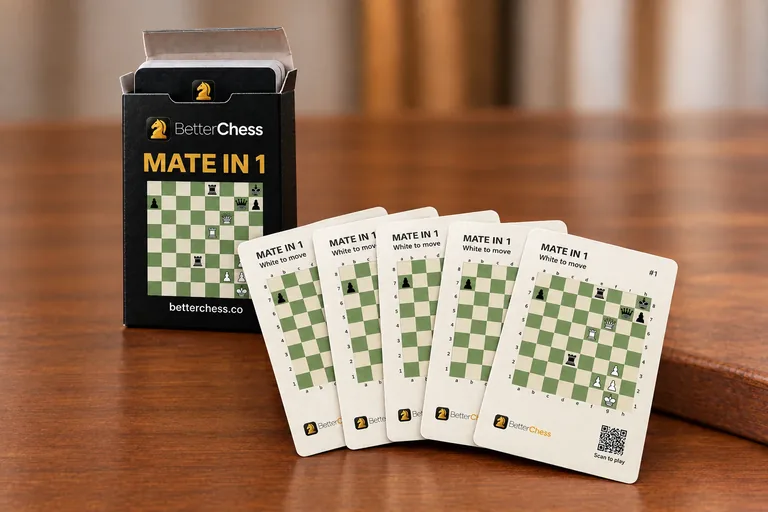
PRINTED CHESS PUZZLE CARDS
Chess puzzle playing card decks
54 poker-size cards in a tuck box. Puzzle on the front, solution on the back.