Closed Game
The Closed Game is the family of openings beginning 1.d4 d5, the double queen pawn openings headed by the Queen's Gambit and the Slav.
After 1.d4 d5 the central pawns block each other and both are defended by their queens, so neither can be won by a quick raid. The flagship continuation is the Queen's Gambit with 2.c4, leading to the Queen's Gambit Declined, the Slav, and the various Exchange structures that have anchored world championship matches for a century.
The character differs sharply from 1.e4 e5. Tension builds instead of exploding: play revolves around pawn breaks like c4, e4 and c5, minor piece placement, and long-term structural assets such as the queenside majority or the hanging pawns. Attacks certainly happen, but they are usually earned through slow buildup rather than an opening skirmish.
Do not confuse the classification with the position type. The Closed Game names the first moves 1.d4 d5; a closed position means locked pawn chains, wherever they arise. Plenty of Closed Games open up completely, and the Exchange QGD in particular produces open files and minority attacks that feel anything but quiet.
Frequently asked
Is the Closed Game the same thing as a closed position?
No. The Closed Game is a classification of first moves, 1.d4 d5, while a closed position describes locked pawn structure anywhere in a game. Many Closed Games become quite open in the middlegame.
Is 1.d4 d5 more solid than 1.e4 e5?
Broadly yes for the second player: the d5 pawn is protected by the queen from the start, so Black avoids the sharpest early attacks. The trade-off is that Black must handle subtler positional problems, like the c8 bishop's development in the Queen's Gambit Declined.
Related terms
BetterChess is a practice tool — we make no guarantee you'll reach 1800 or any rating. Definitions are standard chess terminology; every diagram position is checked legal with the same engine the board runs.
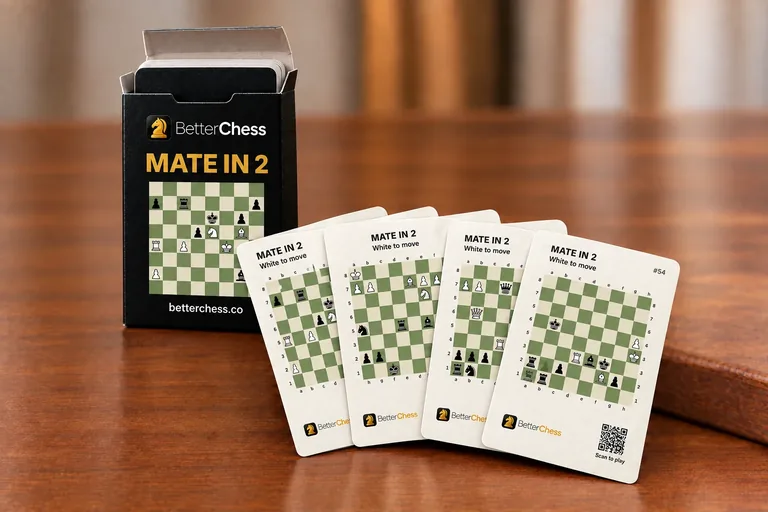
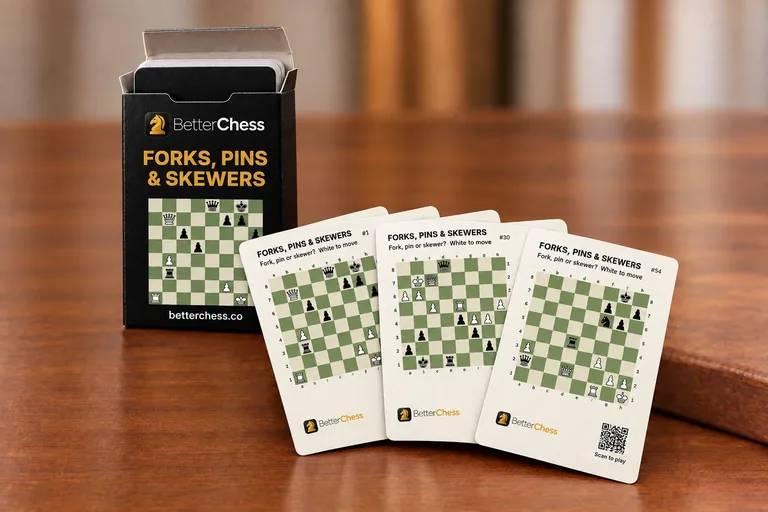
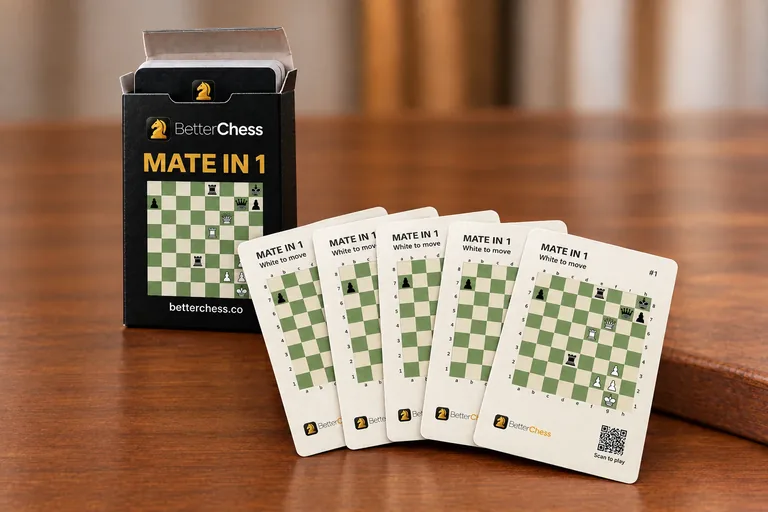
PRINTED CHESS PUZZLE CARDS
Chess puzzle playing card decks
54 poker-size cards in a tuck box. Puzzle on the front, solution on the back.