Anderssen's Mate
Anderssen's mate is a checkmate on the eighth rank in which the mating rook or queen on the corner square is supported diagonally, classically by a pawn on g7.
Named after the great German attacker Adolf Anderssen, this mate finishes on the corner square: a rook or queen lands on h8 next to the castled king, and a humble pawn on g7 protects it. The same pawn also covers f8, so one foot soldier does two defensive jobs for the attack.
The g7 pawn itself must be guarded, typically by another pawn on f6 or by a bishop, so the king cannot simply capture its tormentor. That little chain, f6 pawn supporting g7 pawn supporting a rook on h8, is one of the prettiest structures in attacking chess and usually grows out of a pawn storm or a piece sacrifice that let the pawns run.
When the supporting piece is a distant bishop on the long diagonal instead of a pawn, the pattern is usually called Mayet's mate. Either way the defensive cure is the same: never let an attacking pawn take root on g7 (or g2), because every heavy piece check on the back rank then threatens instant mate.
Frequently asked
What supports the mating piece in Anderssen's mate?
A diagonal supporter one square away: classically a pawn on g7, itself defended by a pawn or piece on f6. When a faraway bishop on the long diagonal does the supporting instead, the pattern is normally called Mayet's mate.
How does the g7 pawn get there?
Usually a pawn storm: the g- and h-pawns advance against the castled king, and a capture or sacrifice lets a pawn reach g7 supported. Once that wedge exists, any rook or queen check on the h-file or back rank threatens this mate.
Related terms
BetterChess is a practice tool — we make no guarantee you'll reach 1800 or any rating. Definitions are standard chess terminology; every diagram position is checked legal with the same engine the board runs.
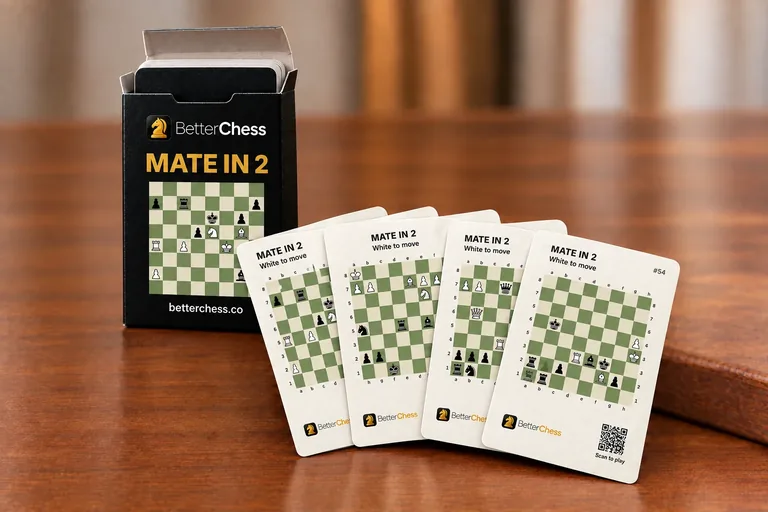
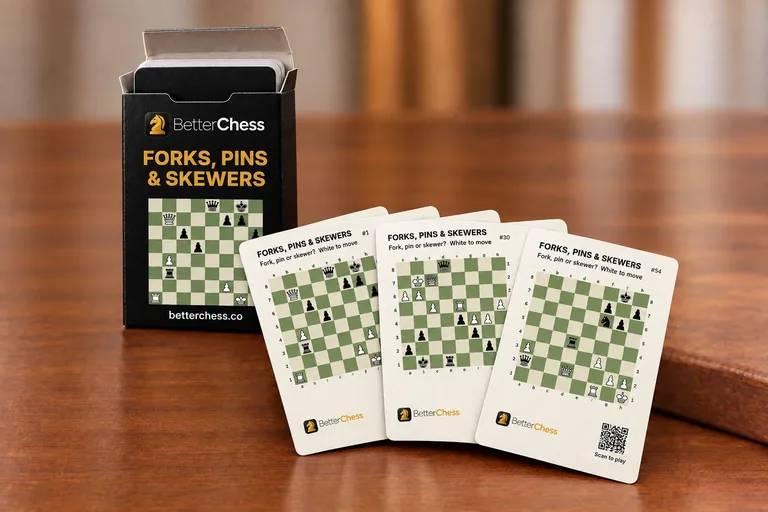
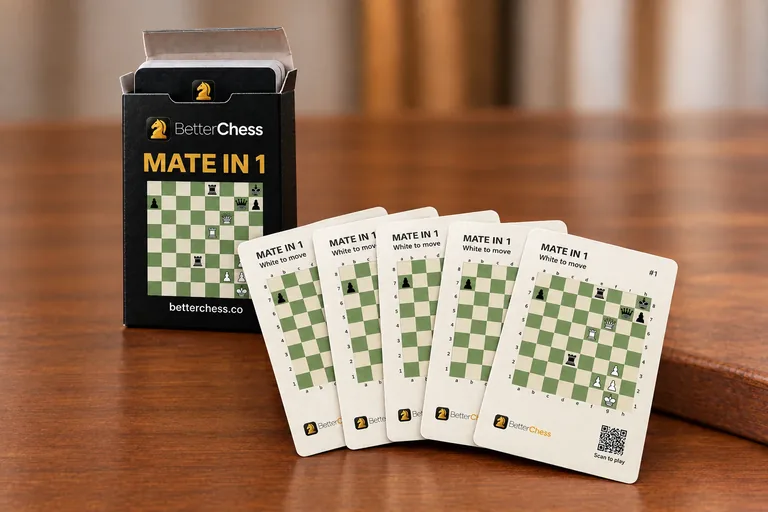
PRINTED CHESS PUZZLE CARDS
Chess puzzle playing card decks
54 poker-size cards in a tuck box. Puzzle on the front, solution on the back.