Round-Robin
A round-robin is an all-play-all tournament: every participant faces every other participant, usually once, or twice with colors reversed in a double round-robin.
In a round-robin the schedule is fixed before the first move: everyone plays everyone. A field of ten needs nine rounds, and published pairing tables decide who has White in each game so that colors come out as even as possible.
The format's strength is fairness: there is no pairing luck, no dodging dangerous opponents, and the winner has faced the entire field. That is why elite invitationals and the Candidates Tournament (a double round-robin, with each pair meeting once per color) use it, and why norm events are usually small round-robins.
The weakness is size: the format only works for small fields, since a single round-robin with n players needs a round for every opponent. Large opens use the Swiss system instead, and round-robins can also suffer late-round games with nothing at stake for one side.
Frequently asked
What is a double round-robin?
A round-robin in which every pair of players meets twice, once with each color. Elite events like the Candidates Tournament use it to remove color luck from the equation.
Why not use a round-robin for every event?
Size. A ten-player round-robin already needs nine rounds, so the format only works for small fields. Large opens use the Swiss system to sort hundreds of players in the same number of rounds.
Related terms
BetterChess is a practice tool — we make no guarantee you'll reach 1800 or any rating. Definitions are standard chess terminology; every diagram position is checked legal with the same engine the board runs.
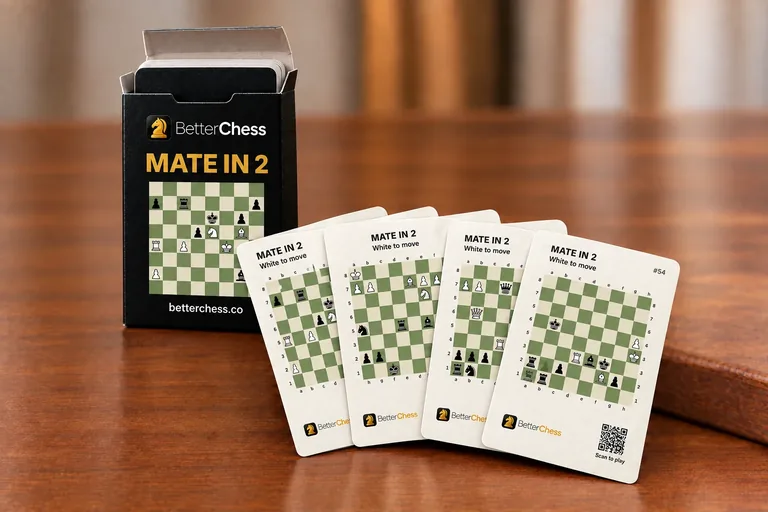
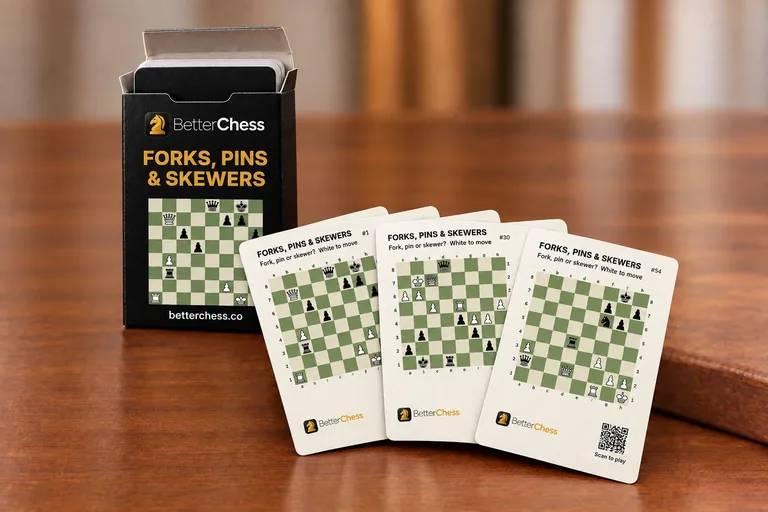
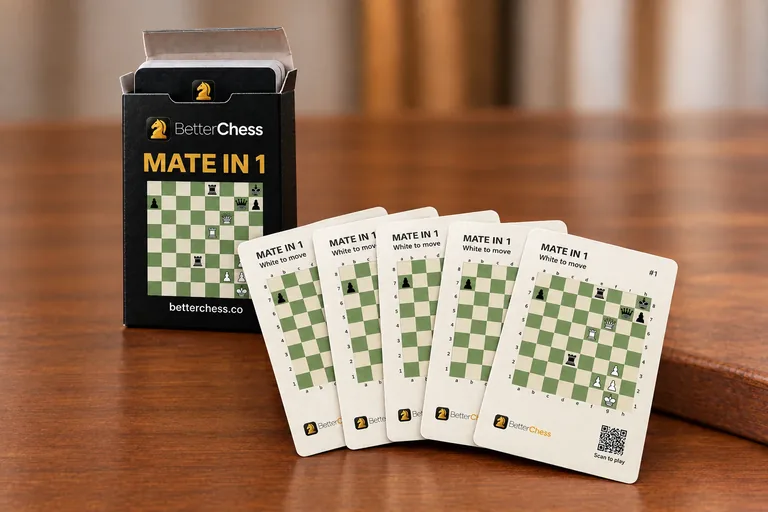
PRINTED CHESS PUZZLE CARDS
Chess puzzle playing card decks
54 poker-size cards in a tuck box. Puzzle on the front, solution on the back.