King Walk
A king walk is a deliberate multi-move march of the king across the board, either to escape danger, to support an endgame plan, or even to join an attack.
The king is a fighting piece; it just needs the right conditions. A king walk is any planned march over several moves: sliding out of a danger zone before a storm hits, walking toward the queenside to eat pawns in an endgame, or, most spectacularly, strolling up the board to help mate the enemy king.
The attacking king walk is chess theater. The most famous modern example is Short against Timman, Tilburg 1991, where White's king marched from g1 up to g5 in front of its own pawns, heading for h6, because Black's pieces could not create a single check. The king became the extra attacker that made mate unstoppable.
The conditions must be exact: the position closed or the enemy pieces tied up, the path free of checks, and every step calculated. In endgames the walk is routine rather than romantic; king activity is often worth more than a pawn, and the side whose king arrives first usually wins.
Frequently asked
When is a king walk safe?
When the opponent cannot generate checks: the position is closed, the enemy pieces are passive or buried, and every square on the route is covered. One overlooked check can turn the hero king into a target.
What is the most famous king walk?
Short against Timman, Tilburg 1991: Nigel Short walked his king from g1 to g5 in front of his own pawns, intending Kh6 and mate on g7. Timman resigned; the king march has been celebrated ever since.
Related terms
BetterChess is a practice tool — we make no guarantee you'll reach 1800 or any rating. Definitions are standard chess terminology; every diagram position is checked legal with the same engine the board runs.
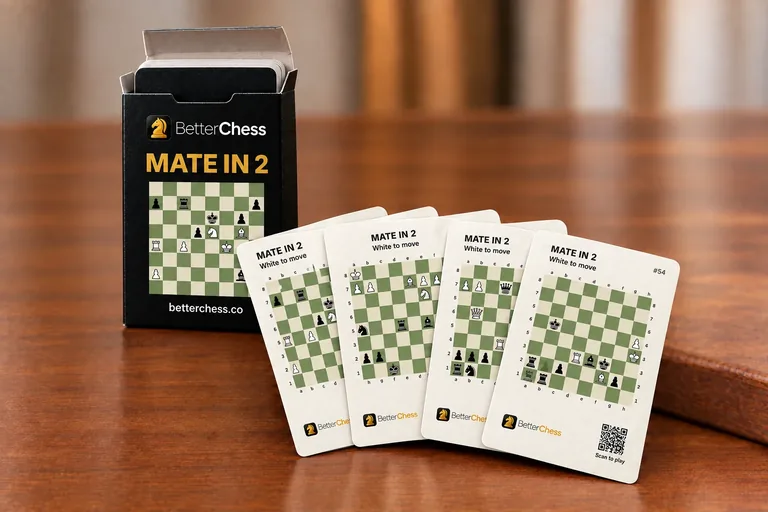
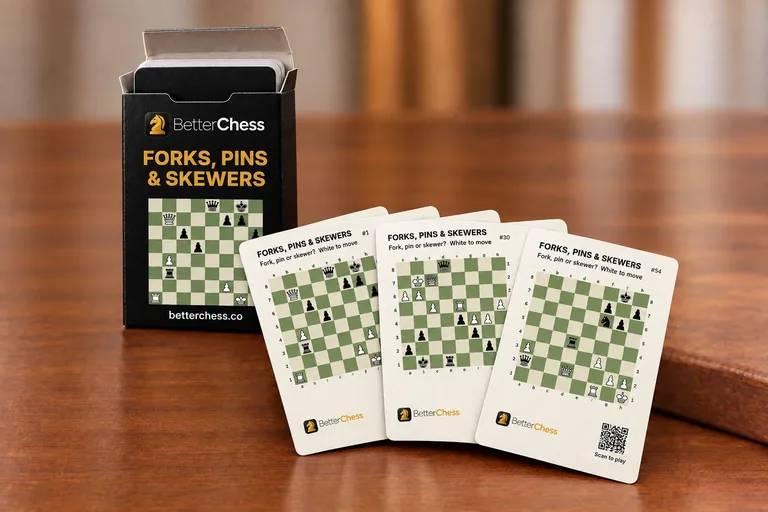
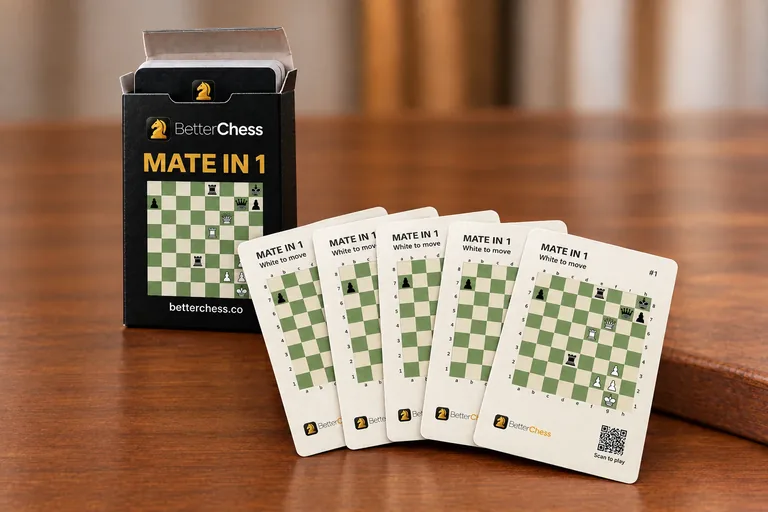
PRINTED CHESS PUZZLE CARDS
Chess puzzle playing card decks
54 poker-size cards in a tuck box. Puzzle on the front, solution on the back.