FEN
FEN (Forsyth-Edwards Notation) is a one-line text format that describes a chess position exactly: piece placement plus five short fields covering whose move it is and the game state.
A FEN string has six space-separated fields. The first describes the pieces rank by rank from rank 8 down to rank 1, with uppercase letters for White, lowercase for Black, digits for runs of empty squares, and a slash between ranks. Then come the side to move (w or b), castling rights, the en passant target square, the halfmove clock for the fifty-move rule, and the fullmove number.
The name honors David Forsyth, a nineteenth-century Scottish journalist who popularized a compact way of printing positions, and Steven J. Edwards, who extended the idea for computer use as part of the PGN standard. Every field exists so that a program can resume the game exactly, including draw claims and castling.
You will use FEN constantly once you know it exists: it is how you copy a position out of an analysis board, set up a puzzle, or ask an engine about a specific moment. Where PGN stores the whole story of a game, FEN is a single frame from the film.
Frequently asked
What are the six fields of a FEN string?
Piece placement from rank 8 down to rank 1, the side to move, castling rights, the en passant target square, the halfmove clock for the fifty-move rule, and the fullmove number.
Why are some FEN letters uppercase and some lowercase?
Uppercase letters are White's pieces and lowercase are Black's: K, Q, R, B, N and P for king, queen, rook, bishop, knight, and pawn. Digits count consecutive empty squares.
Related terms
BetterChess is a practice tool — we make no guarantee you'll reach 1800 or any rating. Definitions are standard chess terminology; every diagram position is checked legal with the same engine the board runs.
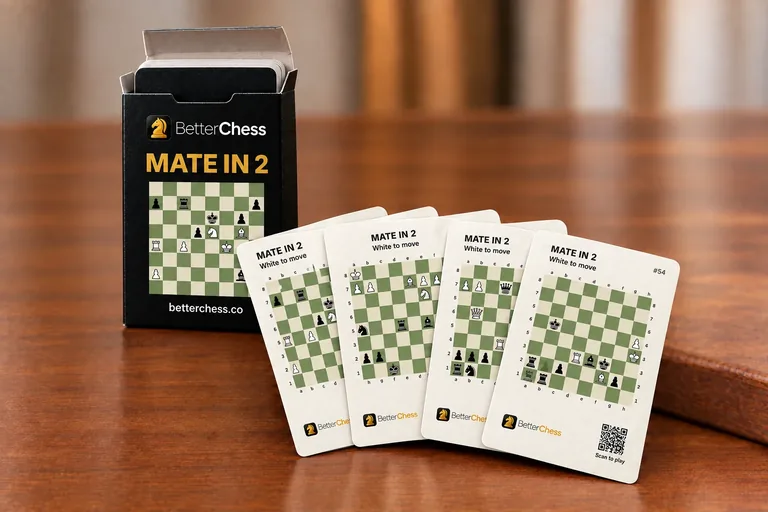
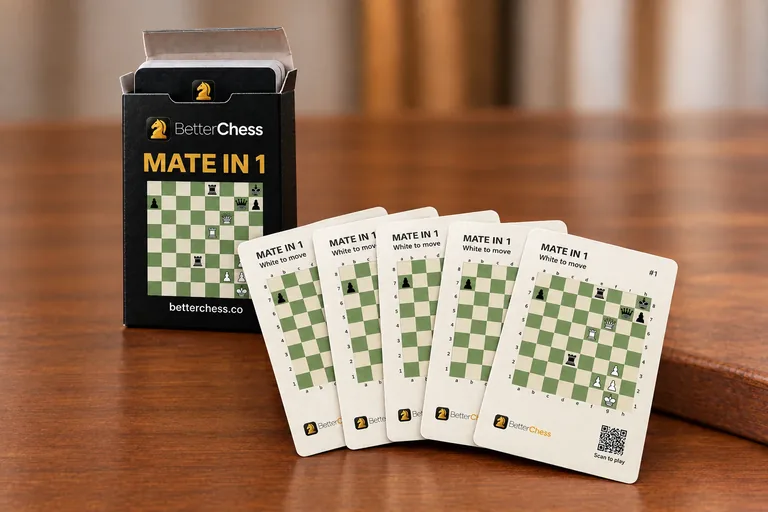
PRINTED CHESS PUZZLE CARDS
Chess puzzle playing card decks
54 poker-size cards in a tuck box. Puzzle on the front, solution on the back.