Pawn Storm
A pawn storm is the advance of two or more pawns toward the enemy king, aiming to trade themselves off and rip open files for the pieces behind them.
Pawns are the cheapest wrecking tools in chess. In a pawn storm you march them at the enemy king's shelter, not to promote, but to force pawn trades that tear open files and diagonals. Every exchange strips a defender from in front of the king and hands your rooks a highway.
Storms are the trademark of opposite-side castling: with the kings on different wings, both sides can hurl pawns forward without exposing their own monarch, and the game becomes a pure race. Tempo is everything: a storm that arrives two moves late usually means you get mated first.
Two practical rules make storms work. First, advance the pawns that face the enemy king, and meet a wing attack with play in the center. Second, as a defender avoid moving the pawns in front of your king voluntarily: every pawn you push gives the storm a hook to attack, the way a pawn on g6 invites h4 to h5.
Frequently asked
When is a pawn storm a good idea?
Mainly when the kings are castled on opposite wings, or when the center is locked so your own king cannot be counterattacked. Storming with the pawns in front of your own king is usually suicide unless the position is completely closed.
How do I defend against a pawn storm?
Keep the pawns in front of your king unmoved so the storm has no hook, trade off the attacker's most dangerous pieces, and strike back in the center: an open center is the classic antidote to a wing pawn storm.
Related terms
BetterChess is a practice tool — we make no guarantee you'll reach 1800 or any rating. Definitions are standard chess terminology; every diagram position is checked legal with the same engine the board runs.
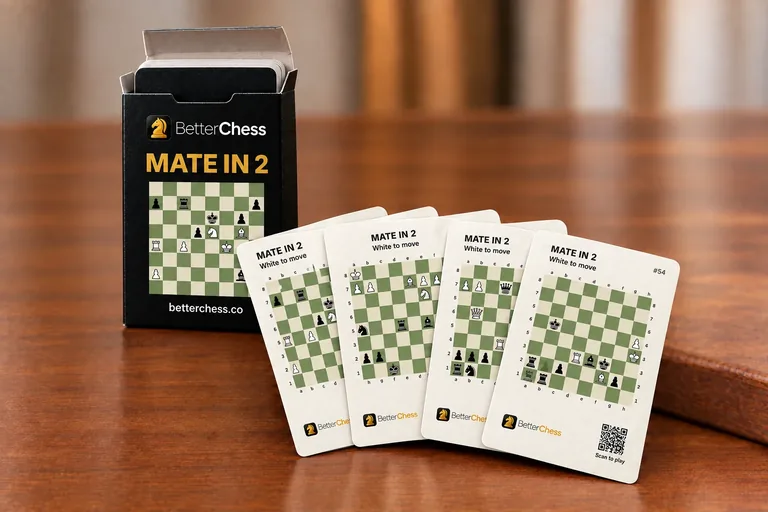
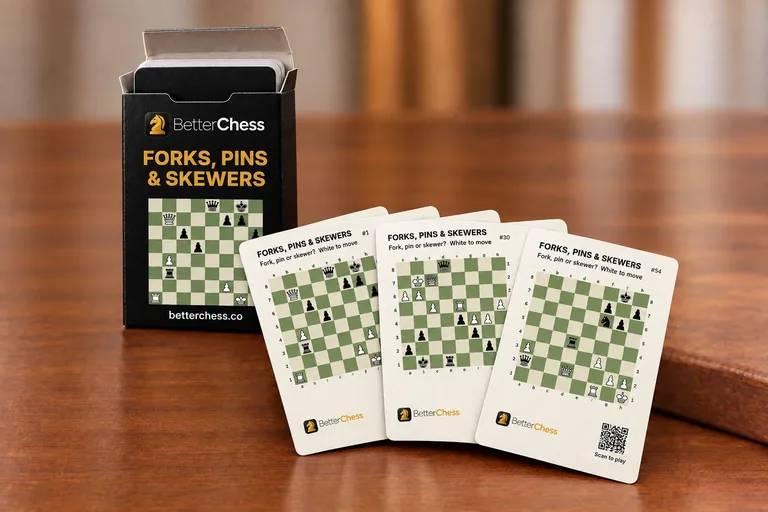
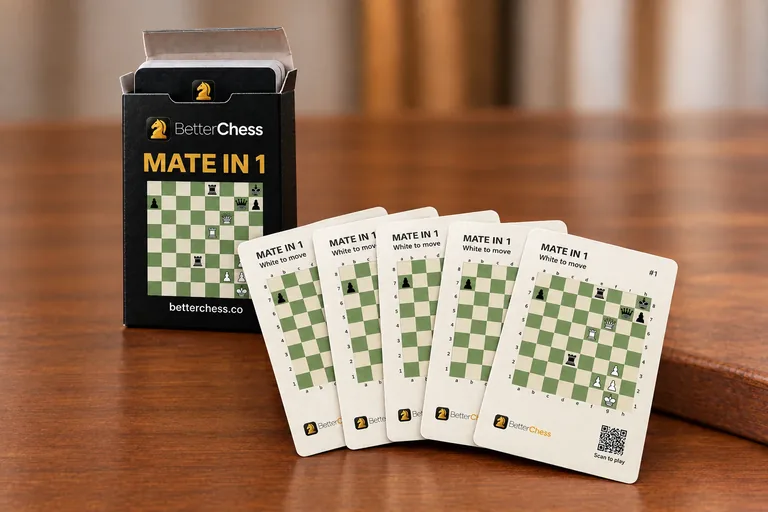
PRINTED CHESS PUZZLE CARDS
Chess puzzle playing card decks
54 poker-size cards in a tuck box. Puzzle on the front, solution on the back.