Mayet's Mate
Mayet's mate is a checkmate in which a rook mates on the corner square h8, protected from capture by a distant bishop on the long diagonal.
Named after the 19th century German master Carl Mayet, this is the long-range version of Anderssen's mate: the rook lands on h8 beside the king, and its bodyguard is not a pawn but a bishop watching the corner all the way from b2 or a1.
The bishop is the soul of the pattern. It defends the mating rook, and it covers g7 at the same time, so the king can neither capture nor step diagonally forward. The victim is very often a kingside fianchetto whose dark-squared bishop has been traded off: the pawns on f7, g6 and h7 then wall in their own king while the b2 bishop owns the empty diagonal.
Attacks producing this mate usually begin with a sacrifice on the h-file to drag it open. If you play fianchetto systems, treasure your g7 bishop; if you attack them, trade that bishop off and aim a rook at the h-file with the long diagonal loaded behind it.
Frequently asked
What is the difference between Mayet's mate and Anderssen's mate?
The supporter. In Anderssen's mate the rook on h8 is protected by a pawn on g7; in Mayet's mate the protection comes from a distant bishop on the long diagonal, which also covers the g7 square.
Why are fianchetto positions vulnerable to Mayet's mate?
Once the fianchetto bishop is traded, the long diagonal and the dark squares around the king belong to the attacker. The king's own pawns on f7, g6 and h7 then block its escape, so a single rook check on the h-file or back rank can be mate.
Related terms
BetterChess is a practice tool — we make no guarantee you'll reach 1800 or any rating. Definitions are standard chess terminology; every diagram position is checked legal with the same engine the board runs.
PRINTED CHESS PUZZLE CARDS
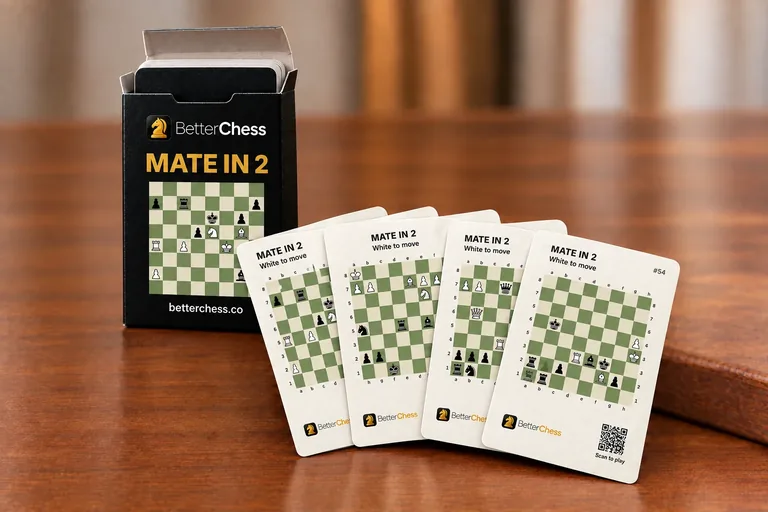
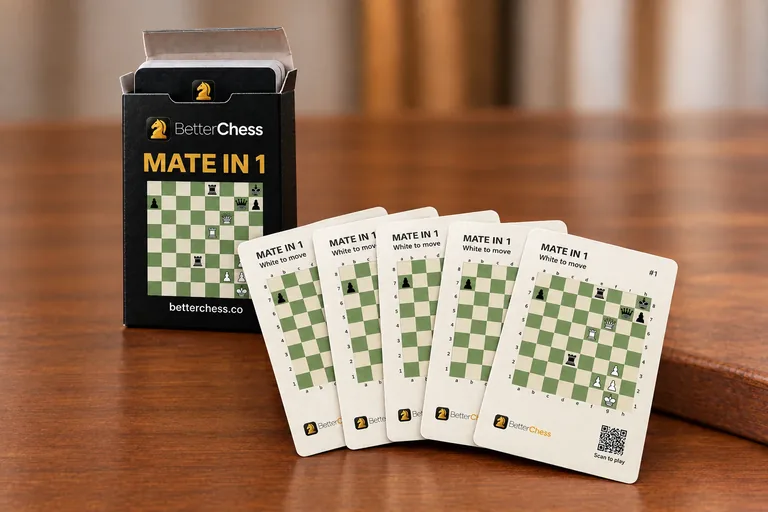
Chess puzzle playing card decks
54 poker-size cards in a tuck box. Puzzle on the front, solution on the back.