Réti Mate
The Réti mate is a checkmate in which a bishop, protected by a rook or queen, mates a king whose escape squares are all occupied by its own pieces.
Richard Réti produced the pattern in an eleven move miniature against Savielly Tartakower in Vienna in 1910. After a queen sacrifice on d8, a double check from bishop and rook forced the black king to c7, and Réti's bishop slid back to d8 for one of the most elegant mates ever played.
The pattern's signature is self-suffocation: the mated king is surrounded by four of its own pieces sitting on its flight squares. The bishop delivers the check, a rook or queen behind it guards the mating square and the open file, and the king's own army does the rest.
The deeper lesson is about double check, the engine that sets this mate up: because both checking pieces attack at once, the king must move, and it can be steered onto exactly the square the attacker wants. When your opponent's king is stuck in the center on a half-open file, sacrifices that force it forward often end in a Réti style finish.
Frequently asked
How did the original Réti mate happen?
Réti played 9.Qd8+, sacrificing his queen; after Kxd8 the bishop move 10.Bg5+ gave double check from bishop and rook, forcing the king to c7, and 11.Bd8 delivered mate, guarded by the rook on d1.
What makes the Réti mate work?
Two things: a double check that forces the king onto the mating net, and the king's own pieces sitting on all its escape squares. The bishop only has to attack one square because the victim's army blocks the others.
Related terms
BetterChess is a practice tool — we make no guarantee you'll reach 1800 or any rating. Definitions are standard chess terminology; every diagram position is checked legal with the same engine the board runs.
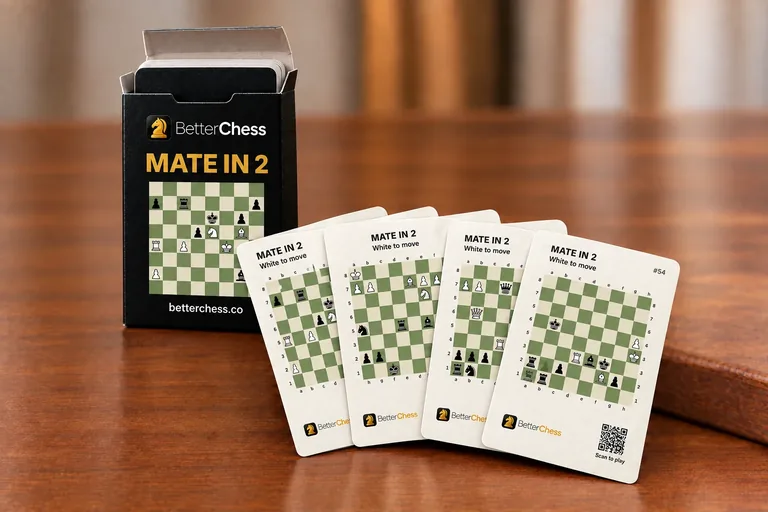
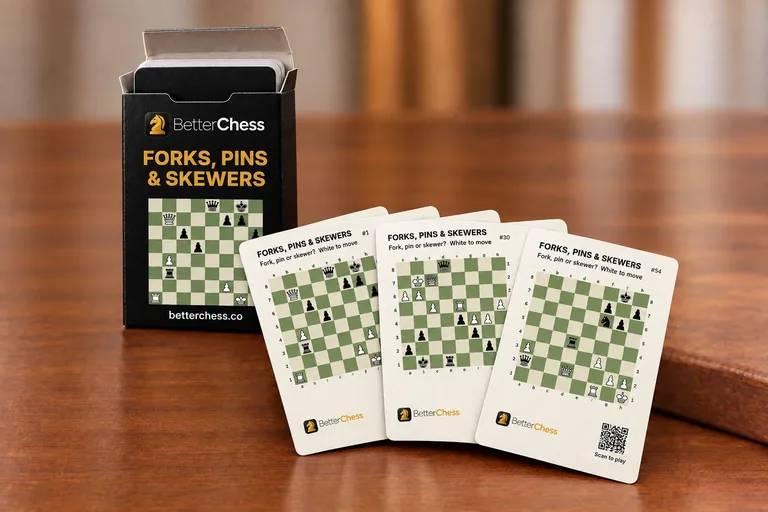
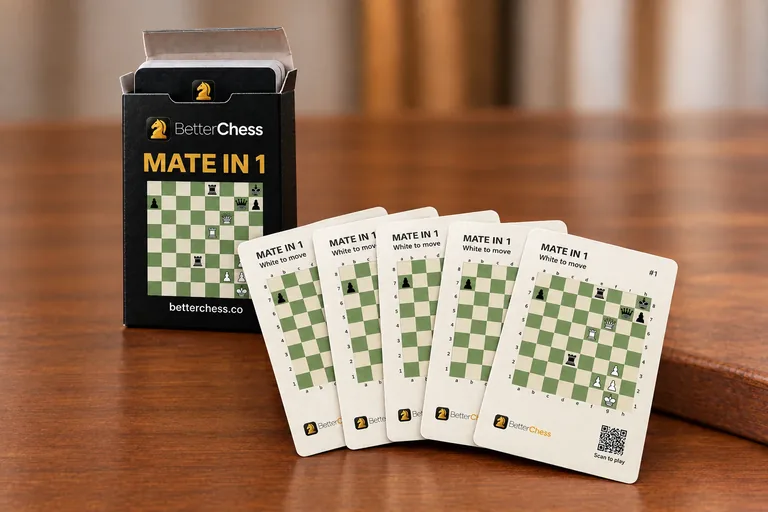
PRINTED CHESS PUZZLE CARDS
Chess puzzle playing card decks
54 poker-size cards in a tuck box. Puzzle on the front, solution on the back.