Blind Swine Mate
The blind swine mate is delivered by two rooks doubled on the seventh rank: they devour the pawns in front of the castled king and then mate it in the corner.
The name comes from the Polish master Dawid Janowski, who called rooks doubled on the seventh rank 'swine' for the way they gobble everything in reach. When the pigs find the king, the typical sequence is Rxg7+, Kh8, Rxh7+, Kg8, and the rear rook returns with Rg7 mate.
In the final position one rook checks on the g-file while its partner on h7 both protects it and covers the h8 corner. The defender's own rook on f8, still standing guard after castling, turns traitor by blocking the king's last flight square.
Two connected rooks on the seventh are one of the biggest positional prizes in chess; Nimzowitsch called the state where they can take everything 'the seventh rank, absolute'. If your opponent is about to double rooks on your seventh, count the mating sequence before allowing it: the pigs are only blind until they smell the king.
Frequently asked
Why are the rooks called blind swine?
Dawid Janowski described doubled seventh-rank rooks as swine because they eat every pawn in their path. They are 'blind' when they can only grab material without finding mate; the blind swine mate is the case where they do find it.
When does the blind swine mate work?
When both rooks reach the seventh rank, the king sits on g8 or h8, and a friendly or enemy piece stops the king escaping via f8. If the king has a clean flight square, the rooks may win pawns but not the game.
Related terms
BetterChess is a practice tool — we make no guarantee you'll reach 1800 or any rating. Definitions are standard chess terminology; every diagram position is checked legal with the same engine the board runs.
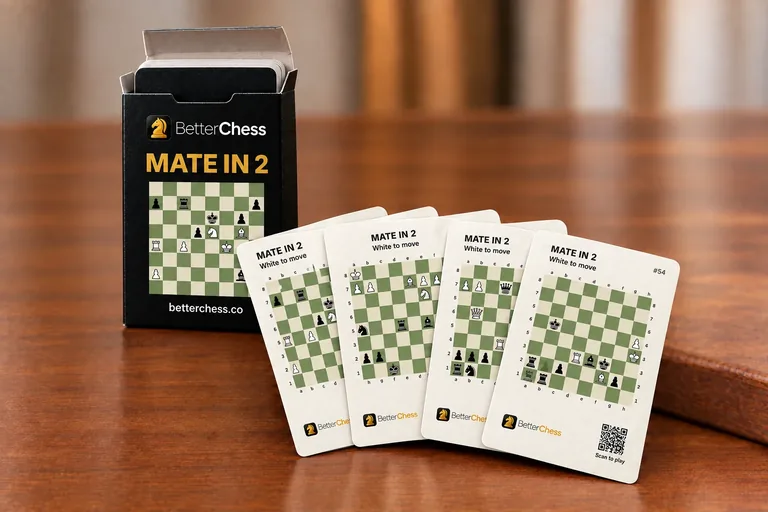
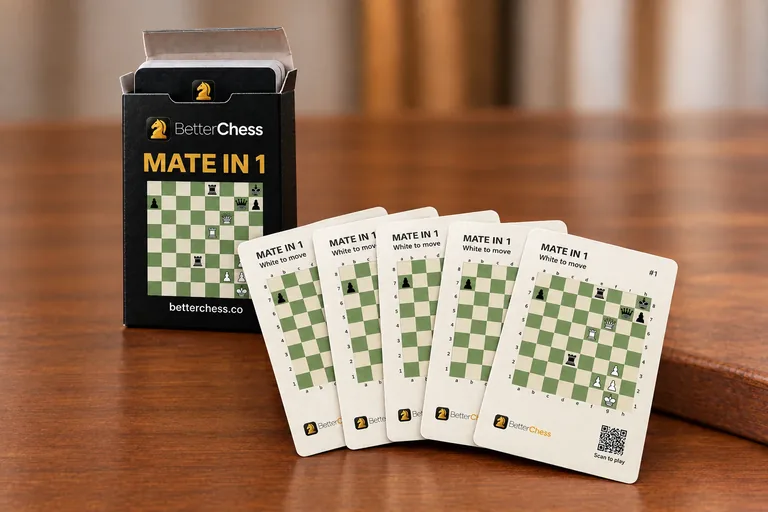
PRINTED CHESS PUZZLE CARDS
Chess puzzle playing card decks
54 poker-size cards in a tuck box. Puzzle on the front, solution on the back.