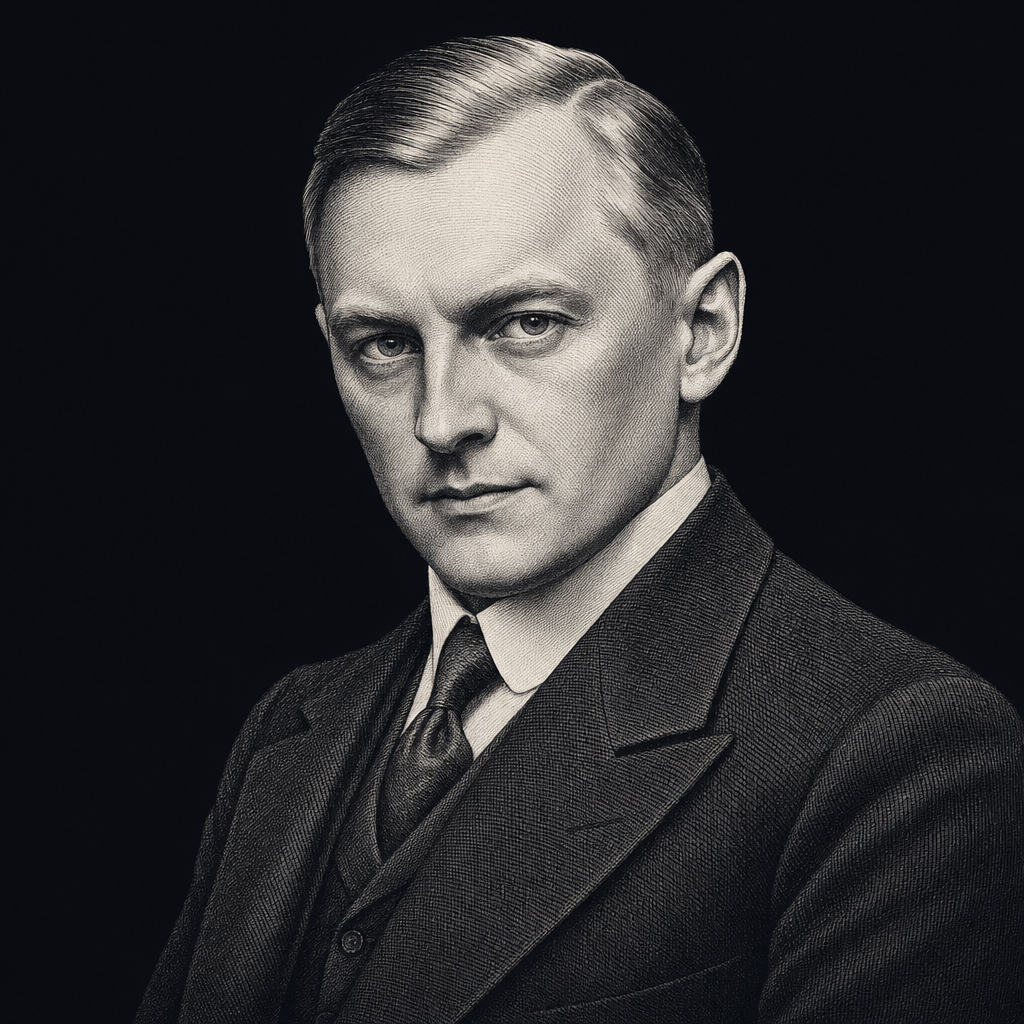
Max Euwe
“The scholar who dethroned Alekhine”
Defeating Alexander Alekhine to become the only Dutch World Chess Champion, and later leading FIDE
2750Peak ratingChessmetrics historical estimate
World #11935–1937 (as World Champion)
Born–died1901–1981
CountryNetherlands
Active era1920–1958
Title5th World Champion (1935–1937); FIDE President (1970–1978)
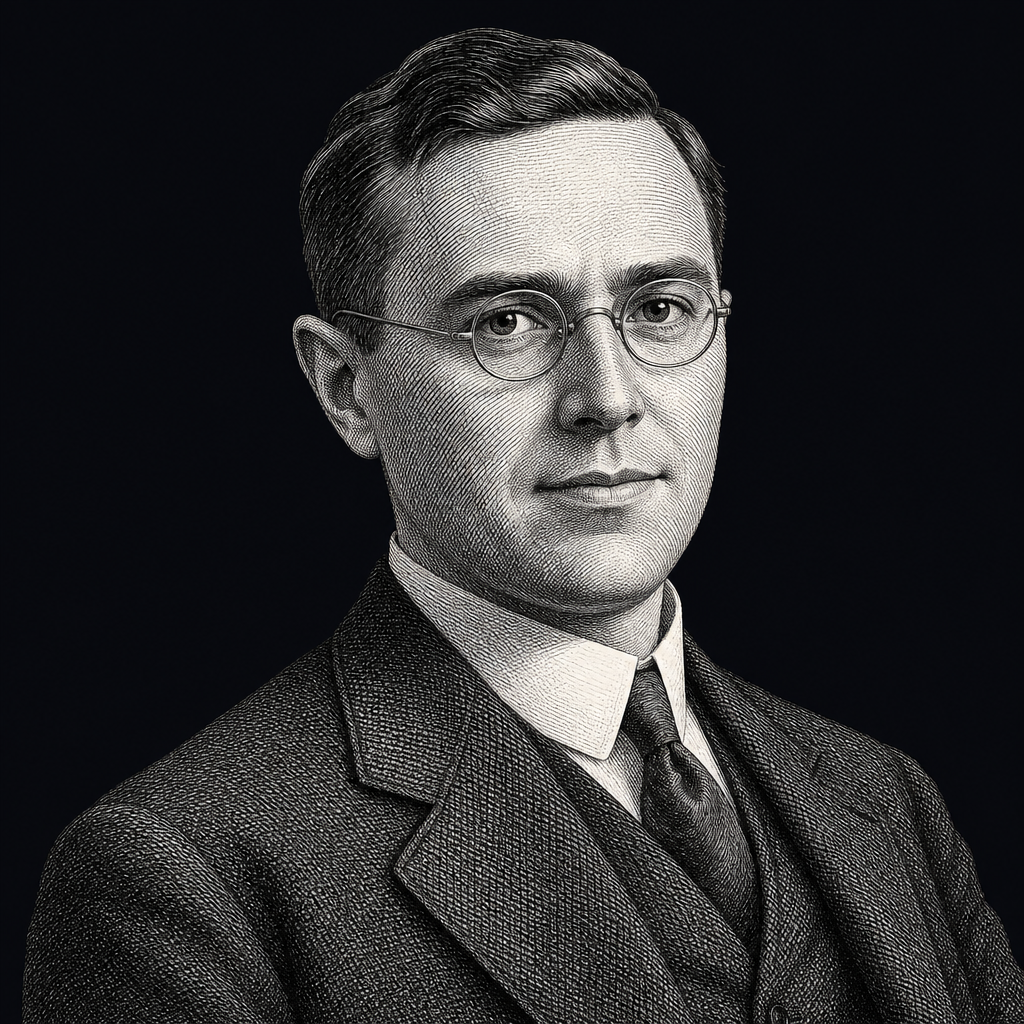
Machgielis 'Max' Euwe was born on May 20, 1901, in Watergraafsmeer, near Amsterdam. A brilliant student, he studied mathematics at the University of Amsterdam, earned his doctorate in 1926, and spent most of his life as a mathematics teacher — chess, for him, always remained in principle an amateur's pursuit alongside a serious academic career. This combination of scholarly rigour and sporting excellence defined him.
Euwe developed into one of the world's leading players through the 1920s and early 1930s, with a reputation for deep, scientific preparation and exceptional theoretical knowledge. He played matches against the very best, including a narrow loss to Capablanca and hard-fought encounters with Alekhine, steadily closing the gap on the established elite through sheer diligence and study.
His crowning achievement came in 1935. Few expected him to defeat the formidable Alexander Alekhine, but in a long and dramatic match Euwe prevailed, with the 26th game — the celebrated 'Pearl of Zandvoort' — among its turning points. He became the fifth World Chess Champion and the only Dutchman ever to hold the title, sparking a national chess boom in the Netherlands. He held the championship for two years before losing the 1937 rematch, having sportingly granted Alekhine his right to it.
Euwe remained a top player and an even more influential figure off the board. He was a prolific and lucid author, writing dozens of books on openings, middlegames and endgames that taught the game to generations, and his clear, methodical style made him one of the great chess educators of the twentieth century. After the war he turned increasingly to administration and to the new field of computer programming, becoming a professor in the subject.
From 1970 to 1978 Euwe served as President of FIDE, the World Chess Federation, steering the game through the turbulent era of the 1972 Fischer–Spassky match and the rise of a new generation. Respected universally for his integrity and fairness, he was a stabilising presence in a politically fraught period. Max Euwe died in Amsterdam on November 26, 1981, remembered as a champion, a teacher and a statesman of chess.
Playing style
Euwe was a supremely well-rounded, scientific player whose greatest strength was preparation and clarity of method. Deeply versed in opening theory and a brilliant analyst, he played logical, classically sound chess and was a formidable calculator in the sharp tactical positions his preparation often produced. He lacked the raw aggression of an Alekhine, but his thoroughness, objectivity and stamina let him outplay the very best when his homework paid off — never more so than in his 1935 title match.
Signature openings
“Strategy requires thought; tactics require observation.”
— Max Euwe, widely attributed in chess literature
Rivalries & key opponents
- Alexander Alekhine
- José Raúl Capablanca
- Salo Flohr
- Reuben Fine
Career highlights
- Defeated Alexander Alekhine to become the 5th World Chess Champion (1935)
- The only Dutch player ever to hold the World Championship
- Won the famous 'Pearl of Zandvoort' game in the 1935 title match
- Held the World Championship from 1935 to 1937
- Earned a doctorate in mathematics (1926) while competing at the top
- Authored dozens of influential instructional books on every phase of the game
- Served as President of FIDE (1970–1978)
- Among the inaugural International Grandmasters named by FIDE (1950)
Famous games on BetterChess
More players
Biographical summary compiled by BetterChess. BetterChess is a practice tool — we make no guarantee you'll reach 1800 or any rating.
PRINTED CHESS PUZZLE CARDS
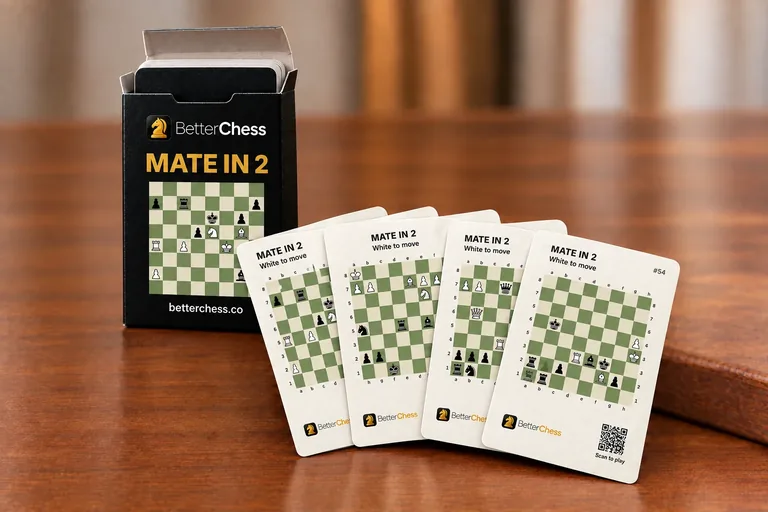
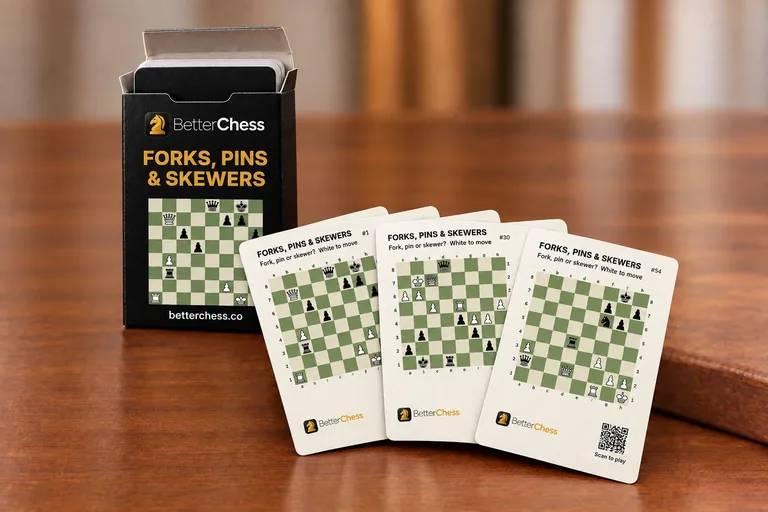
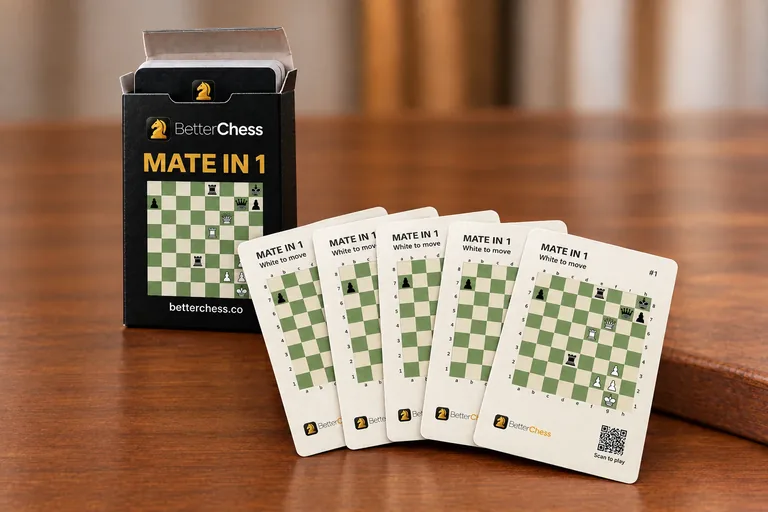
Chess puzzle playing card decks
54 poker-size cards in a tuck box. Puzzle on the front, solution on the back.