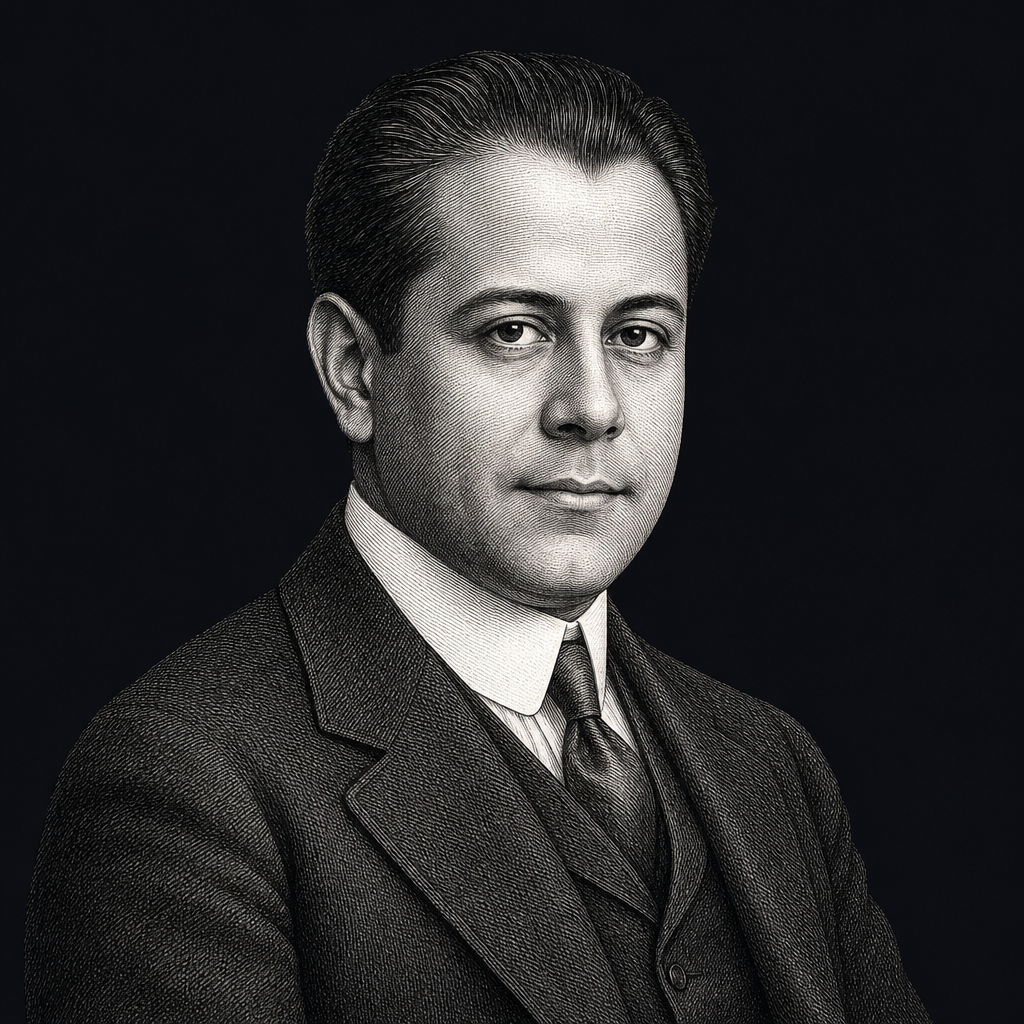
José Raúl Capablanca
“The Human Chess Machine”
Effortless, near-flawless technique and one of the lowest loss rates in the history of elite chess.
2921Peak ratingChessmetrics historical estimate
World #1World Champion 1921–1927
Born–died1888–1942
CountryCuba
Active erac. 1901–1942
Title3rd World Champion (1921–1927)
José Raúl Capablanca y Graupera was born on 19 November 1888 in Havana, Cuba. According to the famous account, he learned the moves at the age of four simply by watching his father play, and within days was correcting his father's illegal moves. A genuine prodigy, he defeated the Cuban champion Juan Corzo in a match in 1901, when he was just twelve years old. He later studied at Columbia University in New York, though chess increasingly took precedence over his formal education.
Capablanca announced himself to the wider world at San Sebastián 1911, one of the strongest tournaments of the era, which he won at his first attempt against a field of established masters. His effortless, lucid style and extraordinary speed of play — he seemed to find the right move instantly and almost never blundered — earned him the nickname 'the Human Chess Machine'. From 1916 to 1924 he did not lose a single tournament or match game, an eight-year span of invincibility almost without parallel.
He finally won the World Championship in 1921, defeating the long-reigning Emanuel Lasker in Havana. Lasker resigned the match while trailing, and remarkably Capablanca won the title without losing a single game — the first challenger ever to take the crown in an unbeaten match. As champion he was widely regarded as virtually unbeatable, and many contemporaries feared the game itself might be played out at the top level, prompting his own proposals for variant rules.
Capablanca's reign ended in one of the great upsets in 1927, when Alexander Alekhine defeated him in Buenos Aires over a marathon match of 34 games. Alekhine, who had prepared meticulously, won 6–3 with 25 draws; it was the longest formal World Championship match until Karpov–Kasparov in 1984. To Capablanca's lasting frustration, Alekhine never granted him a rematch, and the two became bitter enemies.
Despite losing the title, Capablanca remained among the world's strongest players into the 1930s, winning major events and representing Cuba at the chess Olympiads, where his board results were exceptional. He suffered from high blood pressure in his later years and died of a cerebral haemorrhage in New York on 8 March 1942, at the age of 53. His clarity of thought and pure positional technique remain a model for students, and his book 'Chess Fundamentals' is still recommended a century after publication.
Playing style
Capablanca was the great apostle of simplicity and clarity. He preferred clean, harmonious positions, exchanged into favourable endgames with peerless judgement, and won through precise technique rather than wild complications. His play looked effortless because he avoided unnecessary risk and grasped the essence of a position at a glance; his endgame mastery in particular set a standard that has rarely been equalled.
Signature openings
Queen's Gambit Declined (both colours)Ruy LopezNimzo-Indian and Orthodox defences as BlackSolid, classical 1.d4 and 1.e4 systems as White
“In order to improve your game, you must study the endgame before everything else, for whereas the endings can be studied and mastered by themselves, the middle game and the opening must be studied in relation to the endgame.”
— José Raúl Capablanca, 'Chess Fundamentals' (1921)
Rivalries & key opponents
- Emanuel Lasker
- Alexander Alekhine
Career highlights
- Defeated the Cuban champion Juan Corzo in a match at age 12 (1901)
- Won the elite San Sebastián tournament at his first attempt (1911)
- Went undefeated in tournament and match play from 1916 to 1924
- Won the World Championship from Emanuel Lasker without losing a game (1921)
- Held the title until losing to Alexander Alekhine in Buenos Aires (1927)
- Authored the classic instructional book 'Chess Fundamentals' (1921)
- Posted outstanding results for Cuba at the chess Olympiads of the 1930s
Famous games on BetterChess
Lasker's Strategic Masterpiece (1914)
Emanuel Lasker vs Jose Raul Capablanca · 1914 · Ruy Lopez, Exchange
Replay & play ›Capablanca Refutes the Marshall (1918)
Jose Raul Capablanca vs Frank Marshall · 1918 · Ruy Lopez, Marshall Attack
Replay & play ›Capablanca's Rook Endgame (1924)
José Raúl Capablanca vs Savielly Tartakower · 1924 · Dutch Defence
Replay & play ›Botvinnik's AVRO Masterpiece (1938)
Mikhail Botvinnik vs José Raúl Capablanca · 1938 · Nimzo-Indian Defence
Replay & play ›More players
Biographical summary compiled by BetterChess. BetterChess is a practice tool — we make no guarantee you'll reach 1800 or any rating.
PRINTED CHESS PUZZLE CARDS
Chess puzzle playing card decks
54 poker-size cards in a tuck box. Puzzle on the front, solution on the back.