Nimzo-Indian Defense
Starting position
Engine ready — step through to see live evals.
Press ▶ Watch to play the line out, or Next to step through it — the engine evaluates every position.
The Nimzo-Indian is one of the most respected defences in all of chess, played at the highest level for a century. Instead of meeting White's centre with pawns, Black pins the c3-knight with ...Bb4 and fights with pieces. The recurring trade — give up the bishop for the knight to saddle White with doubled c-pawns — is a strategic motif every improving player should know.
The idea in one line
Pin White's c3-knight with ...Bb4, control the e4 square, and be ready to trade the bishop for the knight to leave White with doubled, vulnerable c-pawns in return for the bishop pair.
Key ideas
- ...Bb4 pins the c3-knight, the main piece defending the e4 square — so White can't easily push e4 and build the broad centre.
- The signature trade is ...Bxc3: Black surrenders the dark-squared bishop to inflict doubled c-pawns on White, a long-term structural target.
- Black plays a piece-and-pawn game against the centre — ...d5, ...c5 and ...b6 with ...Bb7 all fight for e4 rather than occupying the centre directly.
- It's a balanced, strategic defence: sound, flexible, and rich in the classic struggle of bishop pair versus pawn structure.
Plans for each side
White: Develop, castle, and aim to break the pin and play e4 for a strong centre — often accepting doubled c-pawns in exchange for the bishop pair and central space, then using that pair actively.
Black: Keep the pin and the clamp on e4, decide when ...Bxc3 best damages White's structure, and counter the centre with ...d5, ...c5 and ...b6/...Bb7.
Common mistakes to avoid
- Don't trade ...Bxc3 automatically — only do it when the doubled pawns are a real, lasting weakness, or you just hand White the bishop pair for nothing.
- Letting White play e4 unhindered surrenders the whole point of the pin; keep the pressure on that square.
- If you damage White's pawns but then let the centre open for the bishop pair, the two bishops can outweigh the structural defect — keep the position controlled.
The main line, explained
1… Nf6...Nf6 — the flexible Indian move, contesting e4 without committing a central pawn.
2… e6...e6 — opens the f8-bishop's path and prepares both ...Bb4 and a later ...d5. Solid and purposeful.
3… Bb4...Bb4 — the Nimzo-Indian bishop. It pins the c3-knight, the key defender of e4, and may later swap to double White's c-pawns.
4. e3e3 — the Rubinstein, White's most popular and flexible reply, calmly developing before deciding on a plan.
4… O-O...O-O — king safety, keeping every option open: ...d5, ...c5, ...b6 and the ...Bxc3 idea are all still on the table.
Frequently asked
Why is the Nimzo-Indian so highly regarded?
Because it's strategically rich and rock-solid. Black fights the centre with pieces instead of pawns, and the recurring bishop-for-knight trade teaches a core idea: damaging structure can be worth giving up a bishop. Top players have trusted it for over a hundred years.
What are the doubled c-pawns all about?
After ...Bxc3 bxc3, White's pawns on c3 and c4 are doubled. They can become a long-term weakness for Black to target — but in return White gets the bishop pair, so the trade is a judgement call, not automatic.
Do I need a second defence alongside it?
Often yes. The Nimzo only appears after 3.Nc3; if White avoids that with 3.Nf3, you'll meet a Queen's Indian or similar. Many players pair the Nimzo with one of those as a complete 1.d4 answer.
Famous games in the Nimzo-Indian Defense
- Botvinnik's AVRO Masterpiece (1938): Mikhail Botvinnik vs José Raúl Capablanca
More openings to explore
Queen's Gambit Declined
Black vs 1.d4 · D30–D69
Learn & play ›King's Indian Defense
Black vs 1.d4 · E60–E99
Learn & play ›Knowing the moves of the Nimzo-Indian Defense is not the same as knowing why they work. Use Claude? BetterChess gives it a real engine, so it explains this opening from the board in front of you instead of from memory.
BetterChess is a practice tool — we make no guarantee you'll reach 1800 or any rating. The lines here are standard, well-established opening theory, and every move is checked legal with the same engine the board runs.
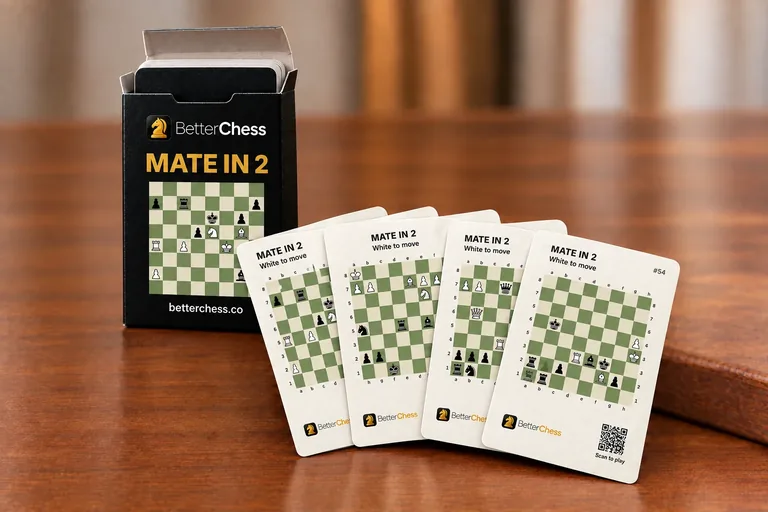
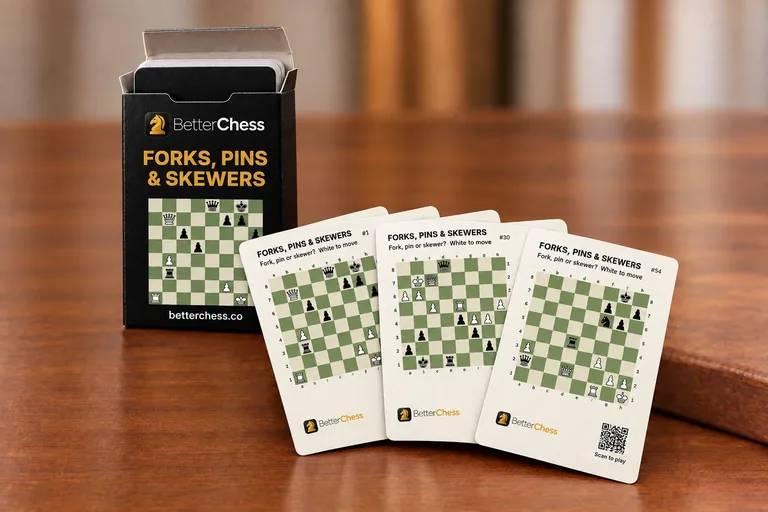
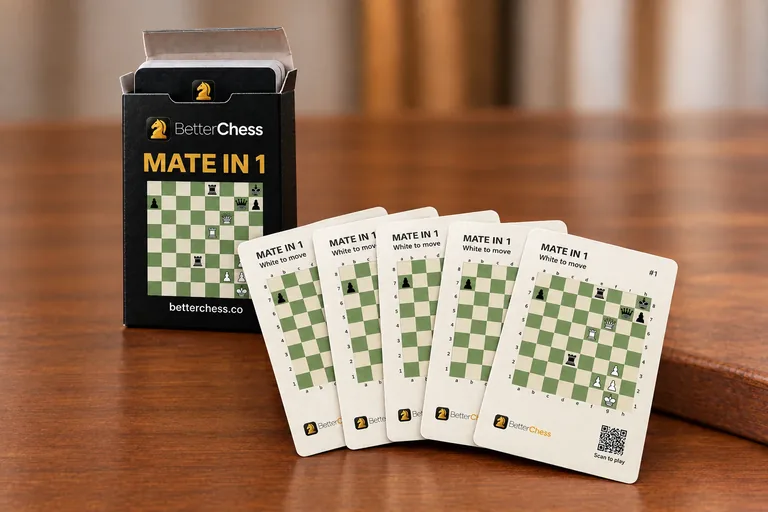
PRINTED CHESS PUZZLE CARDS
Chess puzzle playing card decks
54 poker-size cards in a tuck box. Puzzle on the front, solution on the back.