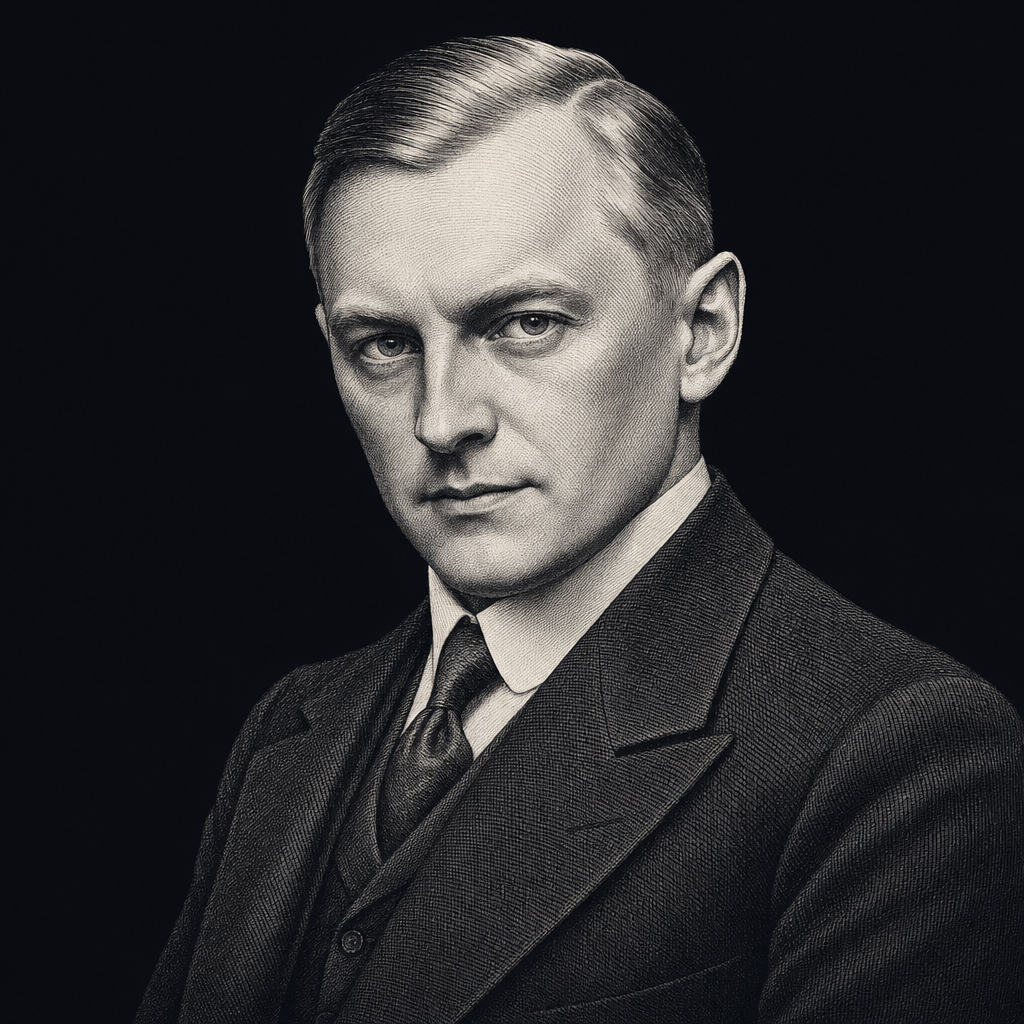
Alexander Alekhine
“Master of the attack”
Dazzling, deeply calculated attacking play and being the only champion to die holding the title.
2827Peak ratingChessmetrics historical estimate
World #1World Champion 1927–1935 and 1937–1946
Born–died1892–1946
CountryRussia / France
Active erac. 1907–1946
Title4th World Champion (1927–1935, 1937–1946)
Alexander Alexandrovich Alekhine was born on 31 October 1892 into a wealthy family in Moscow. He learned chess as a boy and developed quickly through correspondence play and local tournaments, earning a reputation as a brilliant and ambitious attacker while still a teenager. He survived the upheavals of the Russian Revolution — he was briefly imprisoned during the turmoil — and in 1921 emigrated to the West, eventually settling in France, whose citizenship he later took and whom he represented from 1925.
Through the early 1920s Alekhine established himself as the most dangerous challenger to José Raúl Capablanca, winning a string of major tournaments and producing some of the most spectacular attacking and combinational games in the literature. Unlike most of his rivals, he prepared for the Cuban champion with unprecedented seriousness, analysing Capablanca's games exhaustively to find a way past his seemingly impregnable technique.
His preparation paid off in one of the great upsets of chess history. In the 1927 World Championship match in Buenos Aires, Alekhine defeated the heavily favoured Capablanca over 34 games, winning 6–3 with 25 draws to become the fourth World Champion. It was the longest formal title match until the 1980s. As champion he then dominated the tournament circuit, producing crushing victories at San Remo 1930 and Bled 1931, where he finished far ahead of the world's elite and lost barely a game.
In a famous lapse, Alekhine lost the title in 1935 to the Dutch challenger Max Euwe, a result widely attributed to his lack of preparation and problems with alcohol. He took the defeat seriously, put his life in order, and decisively regained the crown in the 1937 rematch, winning by a clear margin. He thus became the first World Champion to lose and then recover the title in a match, holding it through the Second World War.
Alekhine's final years were clouded by controversy over antisemitic articles published under his name during the Nazi occupation, which he later disowned, and by declining health. He died alone in his hotel room in Estoril, Portugal, on 24 March 1946, in circumstances that have never been fully explained, while negotiations for a title match against Mikhail Botvinnik were under way. He remains the only World Champion to die while still holding the title. His brilliant games and his influential opening analysis — including the Alekhine Defence that bears his name — secure his place among the greatest attacking players of all time.
Playing style
Alekhine fused a romantic love of the attack with rigorous modern calculation. He sought rich, dynamic positions bristling with tactical possibilities, then conjured deep, multi-move combinations of dazzling complexity, often sacrificing material to expose the enemy king. Yet he was no mere swashbuckler: he possessed great positional and endgame skill and built his attacks on sound foundations, patiently accumulating advantages until the position was ripe for a decisive blow.
Signature openings
Alekhine's Defence (1.e4 Nf6)Queen's Gambit Declined and Slav structuresRuy Lopez and 1.e4 openings as WhiteNimzo-Indian and Queen's Indian defences
“During a chess tournament a master must envisage himself as a cross between an ascetic monk and a beast of prey.”
— Attributed to Alexander Alekhine (widely cited; primary source uncertain)
Rivalries & key opponents
- José Raúl Capablanca
- Max Euwe
- Efim Bogoljubov
Career highlights
- Defeated José Raúl Capablanca to win the World Championship in Buenos Aires (1927)
- Won San Remo 1930 and Bled 1931 by huge margins over the world's elite
- Defended the title twice against Efim Bogoljubov (1929, 1934)
- Lost the title to Max Euwe (1935) but decisively regained it in the rematch (1937)
- The only World Champion to die while holding the title (1946)
- Gave his name to the Alekhine Defence, a respected hypermodern opening
- Renowned for some of the most beautiful attacking combinations ever played
Famous games on BetterChess
Bogoljubov vs Alekhine (1922)
Efim Bogoljubov vs Alexander Alekhine · 1922 · Dutch Defence (Nimzo-Dutch)
Replay & play ›Réti vs Alekhine (1925)
Richard Réti vs Alexander Alekhine · 1925 · Réti Opening
Replay & play ›Alekhine vs Nimzowitsch (1930)
Alexander Alekhine vs Aron Nimzowitsch · 1930 · French Defence (Winawer)
Replay & play ›The Pearl of Zandvoort (1935)
Max Euwe vs Alexander Alekhine · 1935 · Dutch Defence (Nimzo-Dutch)
Replay & play ›More players
Biographical summary compiled by BetterChess. BetterChess is a practice tool — we make no guarantee you'll reach 1800 or any rating.
PRINTED CHESS PUZZLE CARDS
Chess puzzle playing card decks
54 poker-size cards in a tuck box. Puzzle on the front, solution on the back.