Dutch Defense
Starting position
Engine ready — step through to see live evals.
Press ▶ Watch to play the line out, or Next to step through it — the engine evaluates every position.
The Dutch Defense answers 1.d4 with the bold 1...f5, immediately staking out kingside space and the e4 square. It's the most aggressive of the major replies to the queen's pawn: Black plays for control of e4 and a direct kingside attack rather than quiet equality. The setup shown here — ...Nf6, ...e6, ...Be7 and ...O-O — is the classical, sound way into it.
The idea in one line
Grab kingside space with ...f5 to fight for e4, develop the classical way with ...Nf6, ...e6, ...Be7 and ...O-O, then build toward a kingside attack with ...d5 and piece pressure.
Key ideas
- ...f5 immediately contests the e4 square and claims kingside space — Black sets the tone instead of reacting to White's centre.
- The classical Dutch (the ...e6, ...Be7, ...d5 'Stonewall'-adjacent setups) gives Black a solid centre and clear attacking ambitions on the kingside.
- Black's typical plan is a kingside pawn-and-piece offensive: ...Qe8–h5, ...Ne4, and rooks swinging over toward the white king.
- It's a fighting, asymmetrical defence — Black accepts a slightly loosened kingside in exchange for space, the e4 square, and attacking chances.
Plans for each side
White: Fianchetto with g3 and Bg2 to pressure the long diagonal and the e4 square Black is fighting for, develop and castle, and probe the slightly weakened light squares and the e6/d5 break points in Black's camp.
Black: Set up the classical structure (...Nf6, ...e6, ...Be7, ...O-O, often ...d5), keep a grip on e4, and build a kingside attack with ...Qe8–h5, ...Ne4 and the rooks.
Common mistakes to avoid
- 1...f5 slightly loosens the kingside — develop and castle promptly, and watch the a2–g8 diagonal and the e6 square rather than charging forward unprepared.
- Beware sharp anti-Dutch tries on move two (gambits and Bg5 lines); the classical setup is sound, but you can't play it on autopilot against an early bishop sortie.
- Don't weaken e5 and the dark squares carelessly with ...f5 and ...e6 — if your central control slips, White's pieces flood the holes around your king.
The main line, explained
1… f5...f5 — the Dutch. Black grabs kingside space and fights for e4 from the very first move, the most aggressive answer to 1.d4.
2. g3g3 — White's most popular setup, fianchettoing to contest the long diagonal and the e4 square Black covets.
2… Nf6...Nf6 — develops and adds a second piece's worth of control over e4.
3… e6...e6 — opens the f8-bishop's path and prepares a classical centre with a later ...d5. The solid Dutch setup.
4… Be7...Be7 — quiet, classical development, getting ready to castle into safety.
5… O-O...O-O — both kings are tucked away; now Black turns to the kingside attacking plans the Dutch is built for.
Frequently asked
Is the Dutch Defense sound for club players?
Yes, played sensibly. The classical setup (...f5 with ...e6, ...Be7, ...O-O) is solid and gives Black a clear, aggressive plan — a kingside attack — which many players find easier to handle than passive equality. Just respect White's early anti-Dutch tries.
Doesn't 1...f5 weaken Black's king?
It loosens the kingside slightly and opens the a2–g8 diagonal, so quick development and castling matter. In return Black gets space, a grip on e4, and genuine attacking chances. It's a fair trade as long as you don't neglect king safety.
What attacking plans does the Dutch offer?
Classic kingside play: the queen often swings to h5 via e8, a knight lands on e4, and the rooks lift toward the white king. Black trades a little structural safety for the initiative on the kingside.
Famous games in the Dutch Defense
- Lasker vs Thomas: the king hunt (1912): Edward Lasker vs George Thomas
- Staunton vs Horwitz (1846): Howard Staunton vs Bernhard Horwitz
- Capablanca's Rook Endgame (1924): José Raúl Capablanca vs Savielly Tartakower
- Bogoljubov vs Alekhine (1922): Efim Bogoljubov vs Alexander Alekhine
- The Pearl of Zandvoort (1935): Max Euwe vs Alexander Alekhine
More openings to explore
King's Indian Defense
Black vs 1.d4 · E60–E99
Learn & play ›Queen's Gambit Declined
Black vs 1.d4 · D30–D69
Learn & play ›Knowing the moves of the Dutch Defense is not the same as knowing why they work. Use Claude? BetterChess gives it a real engine, so it explains this opening from the board in front of you instead of from memory.
BetterChess is a practice tool — we make no guarantee you'll reach 1800 or any rating. The lines here are standard, well-established opening theory, and every move is checked legal with the same engine the board runs.
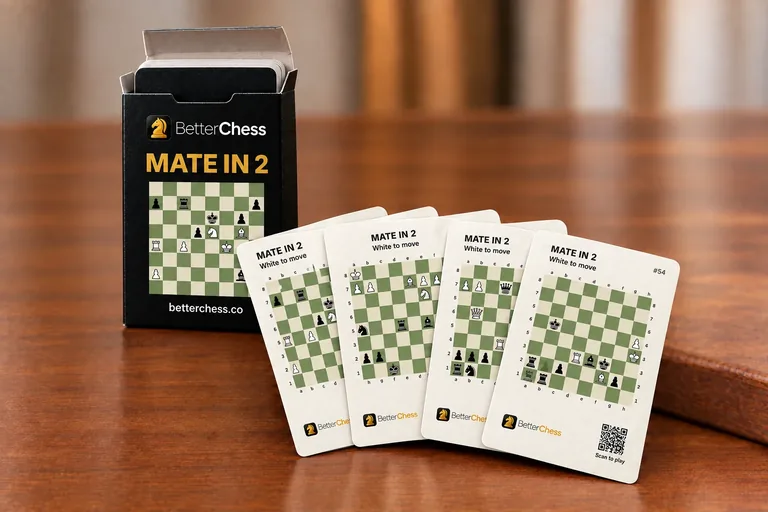
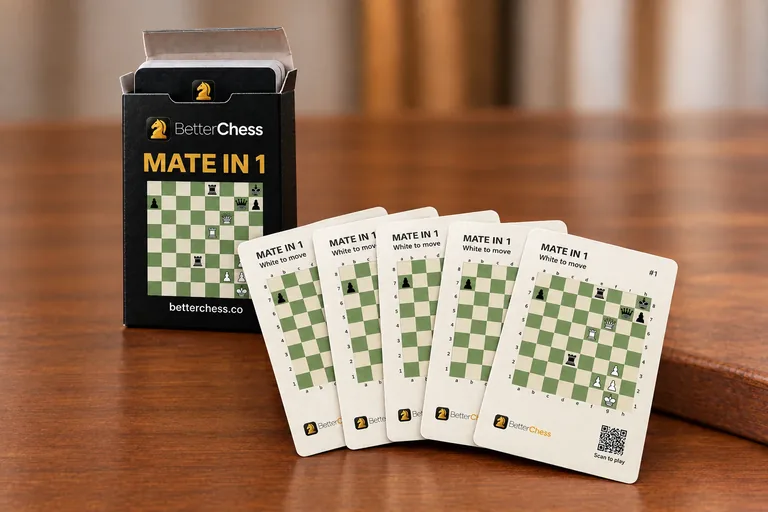
PRINTED CHESS PUZZLE CARDS
Chess puzzle playing card decks
54 poker-size cards in a tuck box. Puzzle on the front, solution on the back.