Wilhelm Steinitz
“The father of modern positional chess”
The first official World Chess Champion and the founder of scientific positional play
2834Peak ratingChessmetrics historical estimate
World #11870s–1894 (dominant for roughly two decades)
Born–died1836–1900
CountryAustria-Hungary / United States
Active era1859–1899
Title1st World Champion (1886–1894)
Wilhelm Steinitz was born on May 14, 1836, in the Jewish ghetto of Prague, then part of the Austrian Empire, the youngest of thirteen children in the family of a tailor. He learned the moves as a schoolboy and, after enrolling at the Vienna Polytechnic in 1858, abandoned his studies to devote himself to chess. He rose quickly through Viennese club play, finishing third in the 1859 city championship and winning it in 1861 with the crushing score of 30/31, which earned him selection as Austria's representative to the great London tournament of 1862.
Steinitz settled in London after that event and spent the 1860s building a fearsome reputation as an attacking player in the romantic, sacrificial style of the era. His 1866 match victory over Adolf Anderssen, the leading player after Paul Morphy's withdrawal from chess, established him as the strongest active master in the world. For nearly two decades thereafter he was effectively unbeaten in serious match play, a span of dominance that few champions have matched.
His true revolution, however, was intellectual rather than competitive. Through the 1870s and 1880s Steinitz rejected the prevailing cult of attack and developed the first coherent theory of positional chess. He taught that the attack should be launched only when justified by accumulated advantages, that defense was a legitimate and often decisive resource, and that the position itself dictates the correct plan. He propagated these ideas relentlessly in the chess press, most influentially in his magazine The International Chess Magazine and in his treatise The Modern Chess Instructor.
In 1886 Steinitz defeated Johannes Zukertort in a match staged across New York, St. Louis, and New Orleans, an event universally recognized as the first contest for the World Championship. He held the title for eight years, successfully defending it twice against Mikhail Chigorin and once against Isidor Gunsberg, before finally losing it in 1894 to the young Emanuel Lasker. A rematch in 1896–97 ended in another, more emphatic defeat.
Steinitz had become a United States citizen during his years in America, but his final years were marked by poverty and declining mental health, and he died on August 12, 1900, on Ward's Island, New York. Though he was buried in near-obscurity, his ideas reshaped the game completely. Every champion who followed built on the positional principles he was the first to articulate, and he is rightly remembered as the father of modern chess.
Playing style
Steinitz began his career as a fierce tactician in the Romantic mold, but he is remembered for the scientific positional method he pioneered in middle age. He held that small, permanent advantages — superior pawn structure, the bishop pair, control of key squares, a safer king — accumulate until they justify decisive action, and that a player without such advantages has no right to attack. He was also a pioneer of stubborn, resourceful defense, willing to accept cramped or ugly-looking positions in the belief that they were objectively sound. This rule-based, accumulation-of-advantage philosophy became the foundation of all modern strategic thought.
Signature openings
“A win by an unsound combination, however showy, fills me with artistic horror.”
— Wilhelm Steinitz, widely attributed in chess literature
Rivalries & key opponents
- Johannes Zukertort
- Mikhail Chigorin
- Adolf Anderssen
- Emanuel Lasker
Career highlights
- Won the Vienna City Championship with 30/31 (1861)
- Defeated Adolf Anderssen in a match to become the world's leading player (1866)
- Won the first official World Chess Championship match, defeating Johannes Zukertort (1886)
- Successfully defended the title against Mikhail Chigorin (1889 and 1892)
- Successfully defended the title against Isidor Gunsberg (1890–91)
- Founded and edited The International Chess Magazine, propagating positional theory (1885–1891)
- Published The Modern Chess Instructor, codifying his scientific approach (1889)
- Held the World Championship for eight years, from 1886 to 1894
Famous games on BetterChess
Steinitz vs von Bardeleben (1895)
Wilhelm Steinitz vs Curt von Bardeleben · 1895 · Italian Game
Replay & play ›Chigorin's King's Gambit (1892)
Mikhail Chigorin vs Wilhelm Steinitz · 1892 · King's Gambit
Replay & play ›More players




Biographical summary compiled by BetterChess. BetterChess is a practice tool — we make no guarantee you'll reach 1800 or any rating.
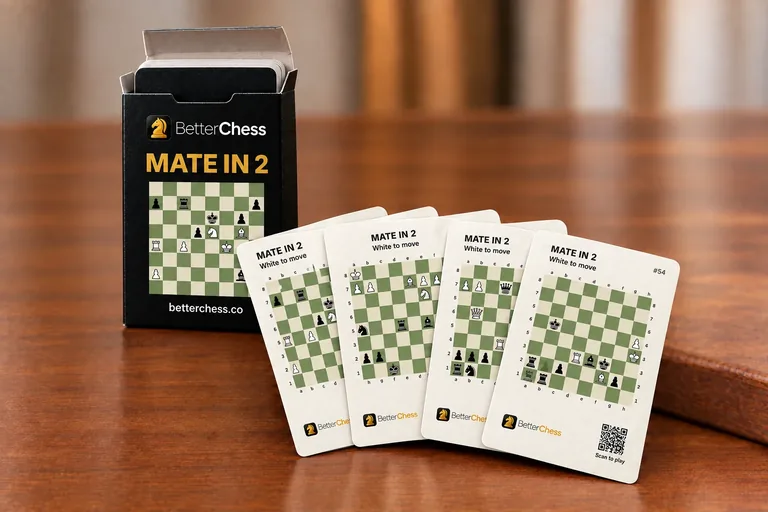
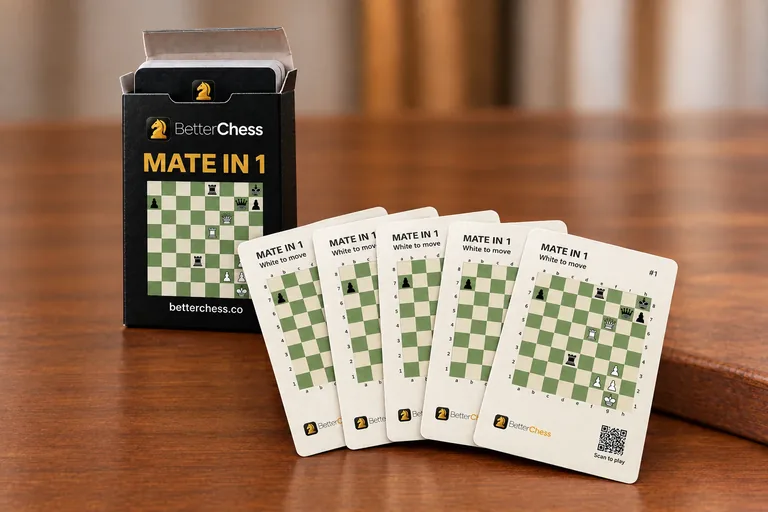
PRINTED CHESS PUZZLE CARDS
Chess puzzle playing card decks
54 poker-size cards in a tuck box. Puzzle on the front, solution on the back.