Queen's Gambit Declined
Starting position
Engine ready — step through to see live evals.
Press ▶ Watch to play the line out, or Next to step through it — the engine evaluates every position.
The Queen's Gambit Declined is the classical, time-tested way to meet 1.d4. Black supports the d5 pawn with ...e6 — politely declining the c4 'gambit' — and builds one of the soundest structures in chess. It has anchored countless World Championship matches and remains the gold standard for solid, principled play with Black.
The idea in one line
Hold the centre with ...d5 backed by ...e6, develop classically with ...Nf6, ...Be7 and ...O-O, then free the position with the right break: usually ...c5, sometimes ...e5.
Key ideas
- Declining with ...e6 keeps a firm pawn on d5 and a sound chain — Black trades a little space for great solidity.
- The whole middlegame revolves around Black's freeing breaks: ...c5 to challenge d4, or ...e5 when it can be prepared.
- Black's main practical task is the light-squared bishop on c8, hemmed in by ...e6 — develop it to b7 (after ...b6) or trade it off after a timely ...dxc4.
- It's a complete, principled system: easy to understand, hard to break, and a foundation that improves your whole positional game.
Plans for each side
White: Develop with Nc3, Bg5 and e3, complete the kingside, and pressure the centre and the pin on f6 — often steering toward a minority attack with b4–b5 on the queenside.
Black: Build the classical setup (...Nf6, ...Be7, ...O-O), solve the c8-bishop, and time the freeing break ...c5 (or ...e5) to equalise and seize the initiative.
Common mistakes to avoid
- Don't leave the c8-bishop buried — without a plan to free it (...b6 and ...Bb7, or ...dxc4 and ...b5) it stays the 'problem bishop' all game.
- Sitting passively invites White's minority attack (b4–b5) to chew up your queenside; you need an active break of your own.
- Releasing the central tension with an early ...dxc4 without a follow-up just hands White a free, strong centre — time that capture carefully.
The main line, explained
1… d5...d5 — Black stakes a claim in the centre at once, meeting 1.d4 head-on.
2… e6...e6 — the move that declines the gambit, propping up d5 and opening the f8-bishop's path. Solidity over space.
3… Nf6...Nf6 — natural development, fighting for e4 and the centre.
4. Bg5Bg5 — White pins the f6-knight to pile pressure on d5, a hallmark of the classical Queen's Gambit Declined.
4… Be7...Be7 — quietly breaking the pin's sting and preparing to castle. Calm, classical development.
5… O-O...O-O — king tucked away. Black is fully developed and ready to free the game with ...c5 or ...e5.
Frequently asked
Is the Queen's Gambit Declined good for improving players?
Excellent. It's one of the soundest openings in chess and teaches core skills — holding a pawn chain, classical development, and timing the freeing break. The lessons transfer to almost every position you'll play.
What's the difference between declining and accepting the gambit?
Declining with ...e6 keeps a pawn on d5 and a solid structure, conceding a little space. Accepting with ...dxc4 gives up the centre to grab the pawn temporarily and play for quick piece activity. The QGD is the more strategic, lower-risk path.
How does Black break free in the QGD?
With pawn breaks. The main one is ...c5, challenging White's d4 pawn; sometimes ...e5 is prepared instead. Solving the light-squared bishop on c8 — often via ...b6 and ...Bb7 — is the other key freeing task.
Traps in the Queen's Gambit Declined
- Elephant Trap: wins a piece
- Rubinstein Trap: wins the queen
- Cambridge Springs Trap: wins a piece
Famous games in the Queen's Gambit Declined
- Rubinstein's Endgame Clinic (1912): Akiba Rubinstein vs Carl Schlechter
- Lasker's Counterattack (1896): Harry Nelson Pillsbury vs Emanuel Lasker
- The Pipe Game (1900): Frank Marshall vs Amos Burn
- Fischer's Positional Masterpiece (1972): Bobby Fischer vs Boris Spassky
More openings to explore
Slav Defense
Black vs 1.d4 · D10–D19
Learn & play ›Nimzo-Indian Defense
Black vs 1.d4 · E20–E59
Learn & play ›Knowing the moves of the Queen's Gambit Declined is not the same as knowing why they work. Use Claude? BetterChess gives it a real engine, so it explains this opening from the board in front of you instead of from memory.
BetterChess is a practice tool — we make no guarantee you'll reach 1800 or any rating. The lines here are standard, well-established opening theory, and every move is checked legal with the same engine the board runs.
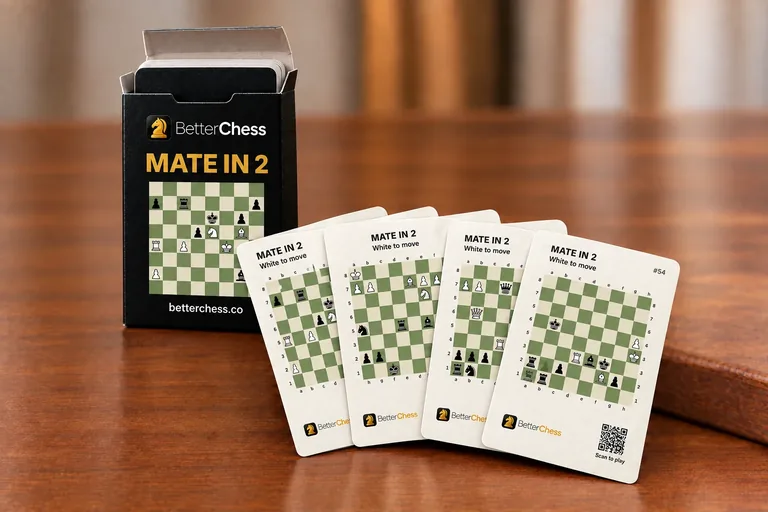
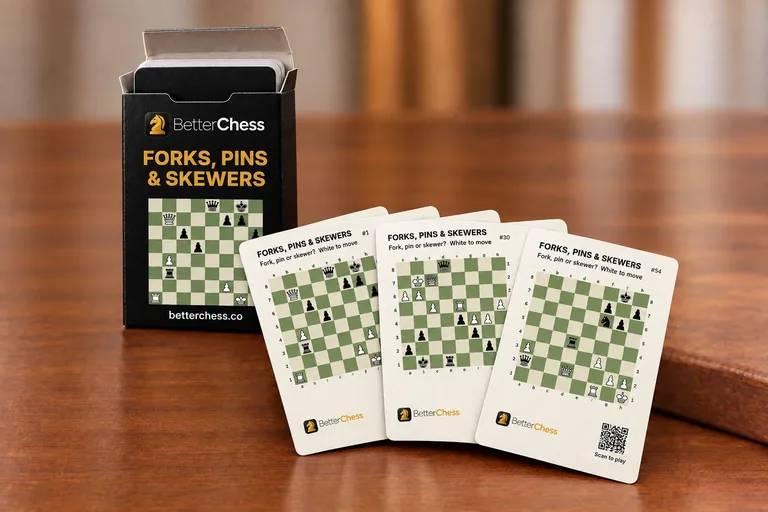
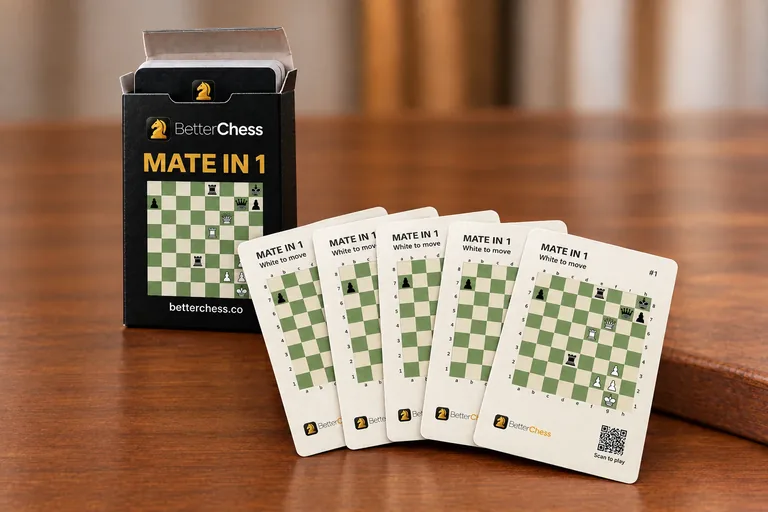
PRINTED CHESS PUZZLE CARDS
Chess puzzle playing card decks
54 poker-size cards in a tuck box. Puzzle on the front, solution on the back.