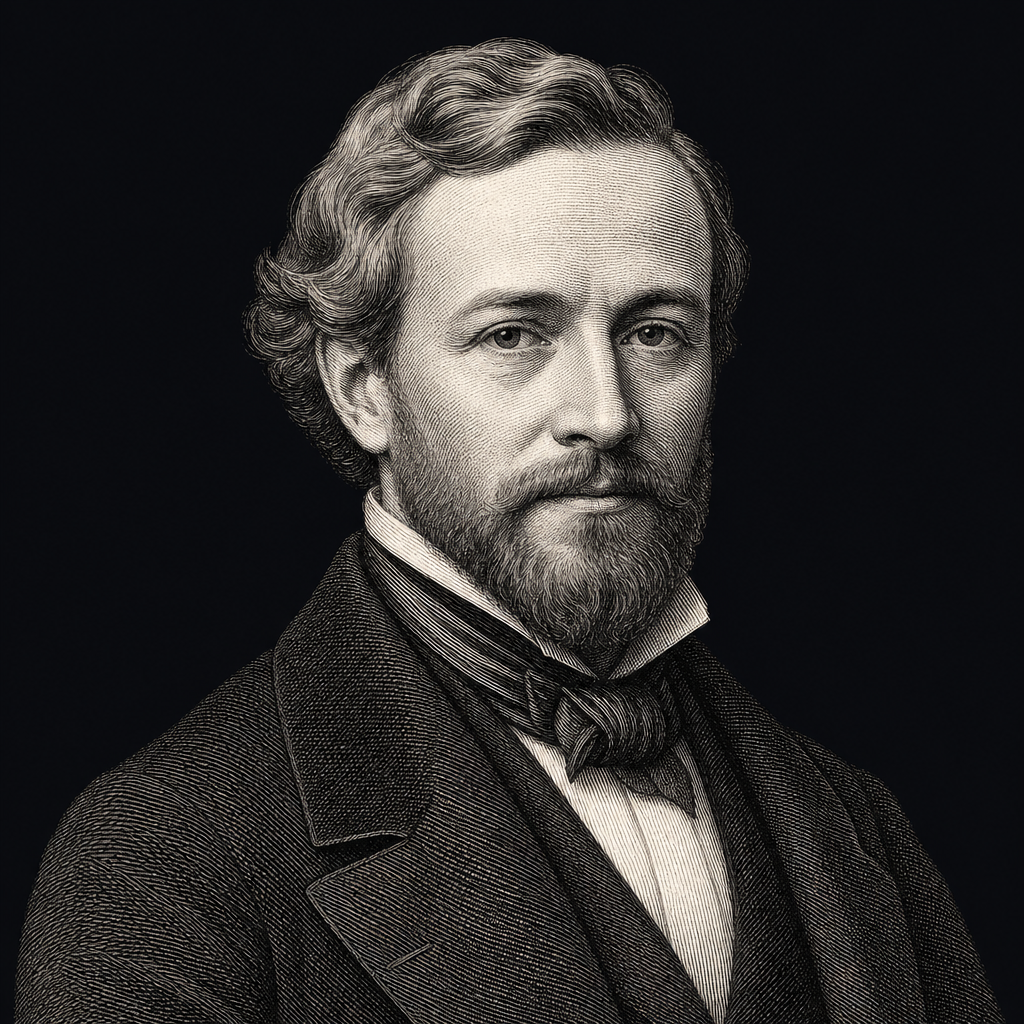
Louis Paulsen
“The pioneer of patient defence and modern openings”
Pioneering sound defence and the Sicilian, and his great 1857 match with Morphy
2766Peak ratingChessmetrics historical estimate (peak, 1865)
Born–died1833–1891
CountryGermany
Active erac. 1854–1891
TitleWorld top player (1860s–1870s)
Louis Paulsen was born on 15 January 1833 at Gut Nassengrund, near Blomberg in the small German principality of Lippe, into a family of keen chess players. Together with his brothers he learned the game young, and the household produced more than one strong player. In the 1850s he emigrated to the United States, where he settled in the Midwest and worked in business while building a formidable reputation across the American chess scene.
Paulsen first became widely known for his extraordinary blindfold play. In an era when such feats were rare, he gave displays against many opponents simultaneously without sight of the boards, playing as many as ten games at once with very few errors — performances that astonished audiences and helped popularise the game in America. He and Paul Morphy were the outstanding blindfold players of their generation.
His most famous competitive moment came at the First American Chess Congress in New York in 1857, the first major tournament held in the United States. Paulsen reached the final, where he met the young Morphy and lost a hard-fought match by five games to one with two draws. The encounter produced one of the most celebrated games in chess history — Morphy's queen sacrifice — but it also showed Paulsen as a defender of remarkable tenacity, capable of holding difficult positions against the greatest attacker of the age.
Returning to Europe, Paulsen spent the 1860s and 1870s among the very strongest players in the world, scoring fine results in the major international tournaments and winning matches against leading masters. He was a regular rival of Anderssen and others, and although he never won a clear claim to be the world's best, he was consistently ranked near the top for two decades, with a peak strength placing him among the elite of his time.
Paulsen's deepest contribution was to chess thought. He openly challenged the Romantic dogma that attack was paramount, arguing that a brilliant assault would fail against correct defence — an idea that pointed directly toward the scientific school of Steinitz. He was a pioneer of patient, resourceful defensive play and a great theoretician of the openings, developing the Paulsen Variation of the Sicilian, an early form of the Dragon, the Paulsen Attack in the Scotch and the Paulsen Variation of the Vienna Game.
He continued to play and analyse for the rest of his life, remaining a respected figure in German chess. Louis Paulsen died on 18 August 1891. He is remembered as a player far ahead of his time, whose emphasis on sound defence and deep opening preparation anticipated the modern game, and whose name still appears in the opening manuals every Sicilian player consults.
Playing style
Paulsen was the great defensive innovator of the Romantic era, the first leading master to argue systematically that attacks must be objectively sound and that correct defence will refute unsound sacrifices. He played patiently and prophylactically, was content to accept cramped positions he judged solid, and excelled at slowly outplaying opponents from quiet structures — yet he was also a fine attacker when the position warranted, as his Greek-gift wins show. His deep opening research, especially in the Sicilian, makes him a forerunner of modern theory.
Signature openings
Sicilian Defence (Paulsen / Kan Variation; early Dragon)French DefenceScotch Game (Paulsen Attack)Vienna Game (Paulsen Variation)
Rivalries & key opponents
- Paul Morphy — lost the 1857 First American Chess Congress final 1–5 with 2 draws
- Adolf Anderssen — frequent tournament and match opponent in Europe
- Joseph Blackburne — repeated encounters in the 1860s–1880s
Career highlights
- Reached the final of the First American Chess Congress, New York (1857)
- One of the foremost blindfold simultaneous players of the 19th century
- Among the world's top players throughout the 1860s and 1870s
- Developed the Paulsen Variation of the Sicilian Defence and an early Dragon
- Originated the Paulsen Attack in the Scotch Game
- A pioneer of the theory of sound defence, anticipating Steinitz's scientific school
Famous games on BetterChess
Paulsen vs Morphy (1857)
Louis Paulsen vs Paul Morphy · 1857 · Four Knights Game
Replay & play ›Paulsen vs Schwarz (1879)
Louis Paulsen vs Adolf Schwarz · 1879 · French Defence, Advance Variation
Replay & play ›More players





Biographical summary compiled by BetterChess. BetterChess is a practice tool — we make no guarantee you'll reach 1800 or any rating.
PRINTED CHESS PUZZLE CARDS
Chess puzzle playing card decks
54 poker-size cards in a tuck box. Puzzle on the front, solution on the back.