French Defense
Starting position
Engine ready — step through to see live evals.
Press ▶ Watch to play the line out, or Next to step through it — the engine evaluates every position.
The French Defence is the strategist's reply to 1.e4. Black plays ...e6 to prepare a solid ...d5 strike at the centre, accepting a slightly cramped position in return for a tough, resilient structure built around a pawn chain. It's famous for one trade-off: the light-squared bishop on c8 can become passive, but in exchange Black gets a sound position with clear long-term plans.
The idea in one line
Play ...e6 and ...d5 to challenge the centre and set up a firm pawn chain, then strike back at White's centre with ...c5 (and sometimes ...f6) and play for counterplay on the queenside.
Key ideas
- ...e6 prepares ...d5 to challenge the centre, but it shuts in the c8-bishop — managing that 'French bishop' is the defining theme of the opening.
- The game often revolves around pawn chains: White's chain points kingside, Black's points queenside, so each side attacks at the base of the enemy chain.
- ...c5 is Black's thematic counter-strike, hitting the base of White's d4–e5 chain and opening lines for counterplay.
- Black accepts a little less space for a very solid, low-weakness structure and aims to out-manoeuvre White in a long strategic game.
Plans for each side
White: Grab central space — often with e5 gaining a kingside cramp — develop the pieces actively, and use the extra space to launch a kingside attack while Black is a touch cramped.
Black: Strike at the centre with ...c5 (and sometimes ...f6), develop the queenside, solve the problem of the light-squared bishop, and generate counterplay against White's centre and on the queenside.
Common mistakes to avoid
- Don't leave the light-squared bishop boxed in forever — plan to free it (with ...b6 and ...Ba6, or by trading it) or it stays a long-term liability.
- Remember the thematic break ...c5; without it Black often ends up passively cramped with no counterplay against White's space.
- After Bg5 pinning the f6-knight, be ready for tactics on the pin (like the sharp 4...Bb4 and 4...dxe4 lines) rather than developing on autopilot.
The main line, explained
1… e6...e6 — the French. It prepares a solid ...d5, at the cost of temporarily blocking in the c8-bishop.
2… d5...d5 strikes at the centre head-on, the point of ...e6; Black contests e4 directly and stakes a claim in the centre.
3. Nc3Nc3 defends and develops, leading to the main lines; White keeps the central tension instead of resolving it.
3… Nf6...Nf6 develops and renews the pressure on e4, inviting White to clarify the centre or pin with Bg5.
4. Bg5Bg5 pins the f6-knight to add pressure on e4 and d5 — a classic, principled developing move.
4… Be7...Be7 quietly breaks the pin and prepares to castle; solid and reliable, sidestepping the sharper 4...Bb4.
Frequently asked
Is the French Defense good for improving players?
Yes — it teaches pawn-chain strategy, the value of the right pawn break, and how to handle a 'bad' bishop. It's solid enough to rely on for years and builds genuine strategic understanding.
French vs Caro-Kann?
Both answer 1.e4 with a ...d5 strike, but the Caro-Kann develops the light-squared bishop actively to f5 first, while the French plays ...e6 first and must work to free that bishop later. The French is more about pawn chains and counterplay.
Why is the light-squared bishop a problem in the French?
Because ...e6 puts a pawn on the same colour as that bishop, often hemming it in behind its own chain. Learning to activate or trade it — typically via ...b6 and ...Ba6 — is a core French skill.
Famous games in the French Defense
- Blackburne vs Schwarz (1881): Joseph Blackburne vs Jacques Schwarz
- Paulsen vs Schwarz (1879): Louis Paulsen vs Adolf Schwarz
- Alekhine vs Nimzowitsch (1930): Alexander Alekhine vs Aron Nimzowitsch
More openings to explore
Caro-Kann Defense
Black vs 1.e4 · B10–B19
Learn & play ›Sicilian Defense
Black vs 1.e4 · B20–B99
Learn & play ›Knowing the moves of the French Defense is not the same as knowing why they work. Use Claude? BetterChess gives it a real engine, so it explains this opening from the board in front of you instead of from memory.
BetterChess is a practice tool — we make no guarantee you'll reach 1800 or any rating. The lines here are standard, well-established opening theory, and every move is checked legal with the same engine the board runs.
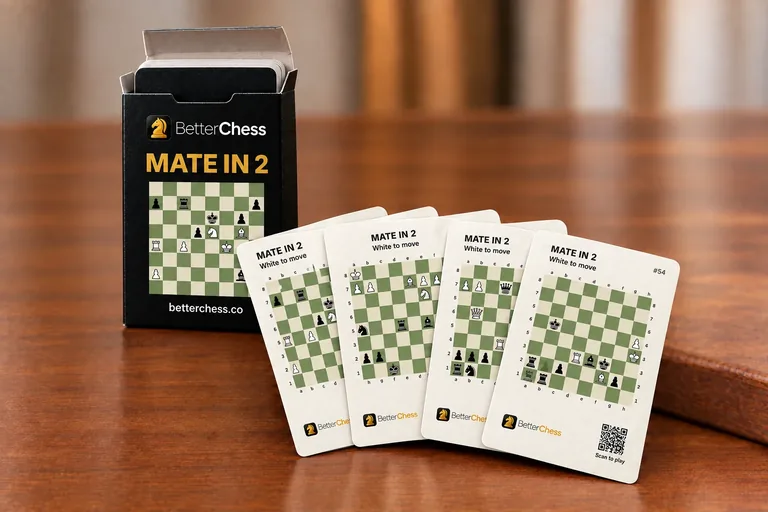
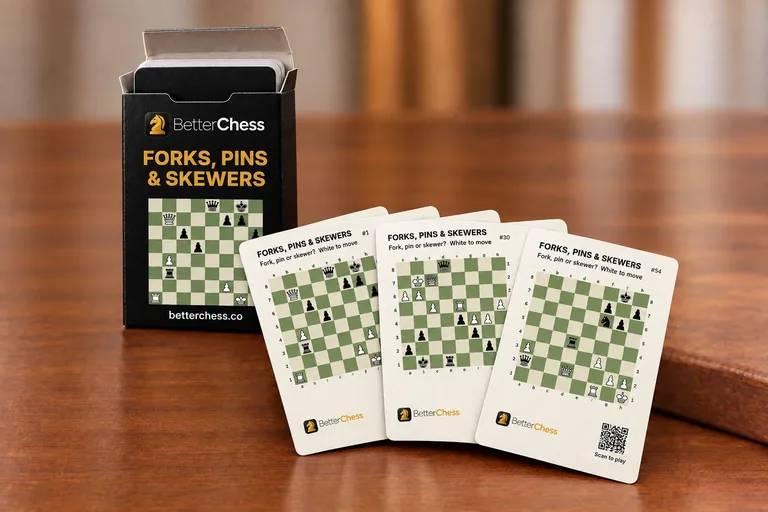
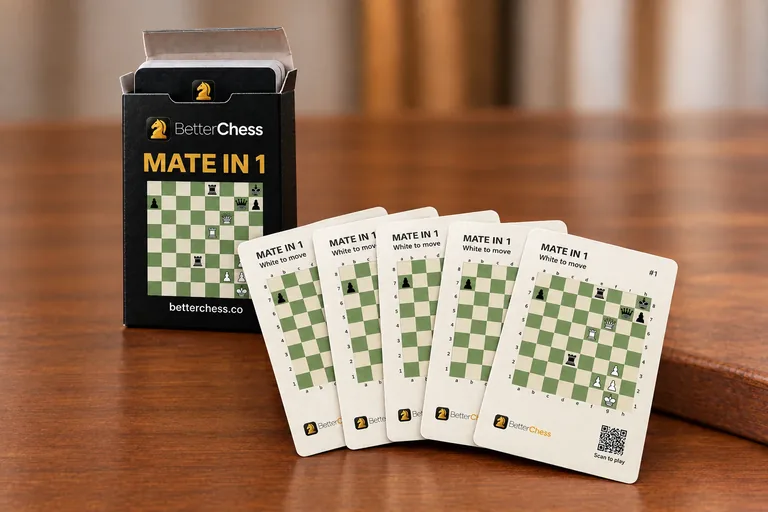
PRINTED CHESS PUZZLE CARDS
Chess puzzle playing card decks
54 poker-size cards in a tuck box. Puzzle on the front, solution on the back.