Scotch Game
Starting position
Engine ready — step through to see live evals.
Press ▶ Watch to play the line out, or Next to step through it — the engine evaluates every position.
The Scotch Game throws the centre open immediately: instead of the slow build-up of the Italian or Ruy Lopez, White plays 3.d4 on move three and trades pawns to free the pieces. It's a direct, forcing opening with far less theory than the Ruy Lopez — Kasparov revived it at the top level, and it's a great practical weapon for club players who like clear, open positions.
The idea in one line
Strike with d4 on move three to open the centre, recapture on d4 with the knight, and play a fast, piece-active game with a clear lead in development.
Key ideas
- 3.d4 opens the centre at once. Where the Italian and Ruy Lopez build slowly, the Scotch resolves the central tension immediately and frees both sides' pieces.
- After the trades White's knight sits proudly on d4, a strong central square from which it eyes f5 and b5.
- White usually gets the easier development and a small space edge; the plan is to finish developing, castle, and use the open lines.
- The exchange Nxc6 followed by ...bxc6 hands Black doubled c-pawns but the bishop pair — a classic structure-versus-pieces trade-off to understand.
Plans for each side
White: Open the centre with d4, recapture on d4 with the knight, then develop the bishops (often Bd3 or the sharp Be3/Qd2 setup), castle, and use the lead in development and central space before Black untangles.
Black: Hit White's centralised knight and the e4-pawn with ...Nf6, then free the position — either by trading on c6 and using the bishop pair, or with the active ...Bb4+ and ...Qe7 lines that pressure e4.
Common mistakes to avoid
- Don't skip the d4 break and drift into a slow set-up — the whole point of the Scotch is to open the centre on move three.
- After 4...Nf6 the e4-pawn needs care; defending it clumsily (or losing it) throws away White's edge.
- Recapturing toward the centre matters: meeting Nxc6 with ...bxc6 (not ...dxc6) is the standard choice because it keeps the d-file half-open and supports a later ...d5.
The main line, explained
2. Nf3Nf3 develops and attacks e5 — the same sensible start as the Italian and Ruy Lopez.
3. d4d4 — the move that defines the Scotch. White strikes the centre at once instead of building slowly.
3… exd4...exd4 — Black accepts the trade; declining and leaving the tension usually just helps White.
4. Nxd4Nxd4 recaptures and plants the knight on a dominant central square, eyeing f5 and b5.
5. Nxc6Nxc6 — White trades the strong knight to inflict doubled pawns; in return Black gets the bishop pair.
5… bxc6...bxc6 keeps the d-file half-open and prepares a freeing ...d5 — the standard recapture here.
Frequently asked
Is the Scotch Game good for club players?
Yes — it's forcing and principled with much less theory than the Ruy Lopez. You open the centre early, develop quickly, and reach clear positions where understanding beats memorization.
Scotch Game vs Italian Game — what's the difference?
Both start 1.e4 e5 2.Nf3 Nc6. The Italian plays 3.Bc4 and builds slowly; the Scotch plays 3.d4 and opens the centre immediately. The Scotch trades a bit of central tension for fast, active piece play.
Why does Black get doubled pawns after Nxc6 bxc6?
When White trades the d4-knight for the c6-knight, Black recaptures with the b-pawn, doubling the c-pawns. In return Black gets the bishop pair and a half-open b-file, so it's a fair structural trade, not a mistake.
More openings to explore
Italian Game
King's Pawn (1.e4 e5) · C50–C54
Learn & play ›Four Knights Game
King's Pawn (1.e4 e5) · C46–C49
Learn & play ›Knowing the moves of the Scotch Game is not the same as knowing why they work. Use Claude? BetterChess gives it a real engine, so it explains this opening from the board in front of you instead of from memory.
BetterChess is a practice tool — we make no guarantee you'll reach 1800 or any rating. The lines here are standard, well-established opening theory, and every move is checked legal with the same engine the board runs.
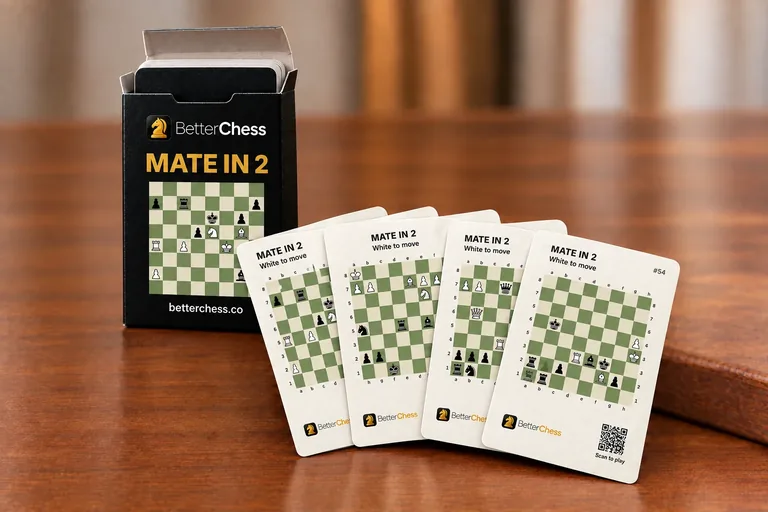
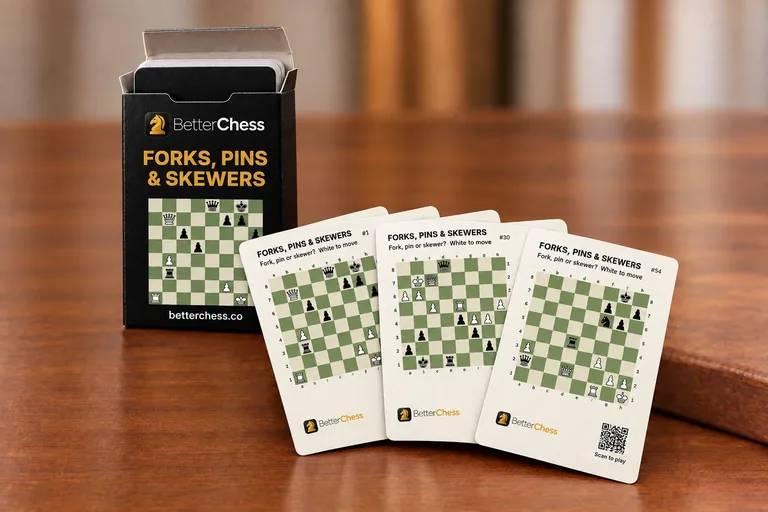
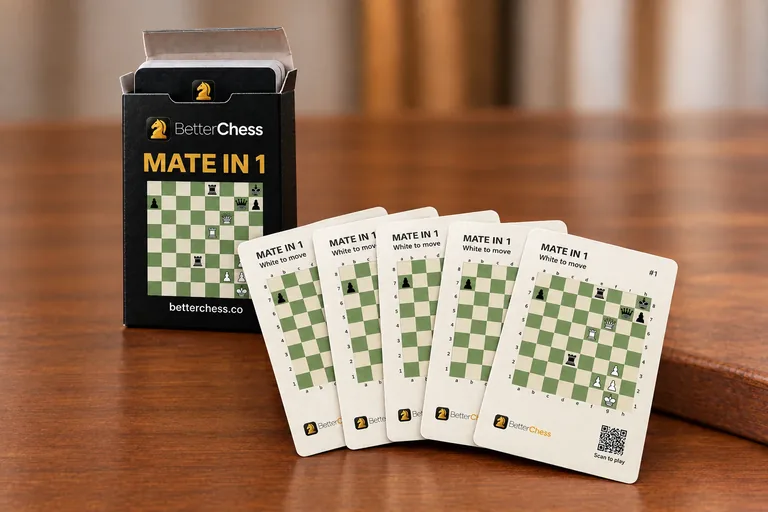
PRINTED CHESS PUZZLE CARDS
Chess puzzle playing card decks
54 poker-size cards in a tuck box. Puzzle on the front, solution on the back.