Vienna Game
Starting position
Engine ready — step through to see live evals.
Press ▶ Watch to play the line out, or Next to step through it — the engine evaluates every position.
The Vienna Game starts with the quiet-looking 2.Nc3, but it hides real bite. White develops the queen's knight first and keeps the option of a delayed f4 — a King's-Gambit-style pawn storm with the knight already supporting the centre. It ranges from calm positional set-ups to sharp gambits, which makes it a flexible surprise weapon at club level.
The idea in one line
Develop with 2.Nc3, then choose your character: a quiet build-up with g3 and Bg2, or the aggressive f4 push (the Vienna Gambit) to blast open the centre with a knight already developed.
Key ideas
- 2.Nc3 develops a piece, guards e4, and commits to nothing — White keeps every plan on the table.
- The f4 break is the Vienna's signature: a King's Gambit idea, but with the c3-knight already supporting the centre, so it's better backed up.
- Against the main reply 2...Nf6, the move 3.f4 leads to sharp play where Black must answer accurately with ...d5, the freeing central counter.
- A calmer Vienna with g3, Bg2 and d3 gives a sound, Closed-Spanish-style position if you'd rather avoid the gambit fireworks.
Plans for each side
White: Develop Nc3 to guard e4, then either launch f4 to open the centre and chase Black's pieces, or fianchetto with g3 and Bg2 for a quieter, solid game. Castle and use the resulting open lines or central control.
Black: Meet 3.f4 with the principled 3...d5! — counter-striking in the centre rather than grabbing on f4. After the exchanges Black develops actively and aims to neutralize White's initiative.
Common mistakes to avoid
- After 3.f4, taking with 3...exf4 is playable but invites a real attack; the cleaner equalizer is the central break 3...d5.
- Don't leave the knight on e4 unprotected after the smoke clears — Black's ...Nxe4 only works because the centre is loose, and both sides must calculate the follow-ups.
- As White, don't push f4 on autopilot if your king will be exposed; the Vienna Gambit needs concrete calculation, not blind aggression.
The main line, explained
2. Nc3Nc3 — the Vienna move. It develops, defends e4, and keeps both quiet and aggressive plans open.
2… Nf6...Nf6 — Black develops and pressures e4 in turn, the most natural and popular reply.
3. f4f4 — the Vienna Gambit. With the knight already on c3, White launches a King's-Gambit-style break on a better footing.
3… d5...d5! — the key equalizer. Black hits the centre instead of grabbing on f4, freeing the position.
4. fxe5fxe5 captures and opens the f-file; the position becomes concrete and both sides must calculate.
4… Nxe4...Nxe4 — Black wins the pawn back by taking the loose e4-pawn, reaching a balanced, lively middlegame.
Frequently asked
Is the Vienna Game a good surprise weapon?
Yes — it's less common than the Italian or Ruy Lopez, so opponents are often out of book quickly. You can steer it toward calm or sharp play depending on your mood, which makes it very flexible.
How is the Vienna different from the King's Gambit?
Both can feature an early f4 break. The King's Gambit plays f4 on move two; the Vienna develops 2.Nc3 first, so when f4 comes the centre is better supported and White's king is a touch safer.
What's the best answer to the Vienna Gambit (3.f4)?
The principled reply is 3...d5, a central counter-strike. Grabbing the pawn with 3...exf4 is possible but hands White a dangerous initiative, so most strong players prefer ...d5.
More openings to explore
King's Gambit
King's Pawn (1.e4 e5) · C30–C39
Learn & play ›Bishop's Opening
King's Pawn (1.e4 e5) · C23–C24
Learn & play ›Knowing the moves of the Vienna Game is not the same as knowing why they work. Use Claude? BetterChess gives it a real engine, so it explains this opening from the board in front of you instead of from memory.
BetterChess is a practice tool — we make no guarantee you'll reach 1800 or any rating. The lines here are standard, well-established opening theory, and every move is checked legal with the same engine the board runs.
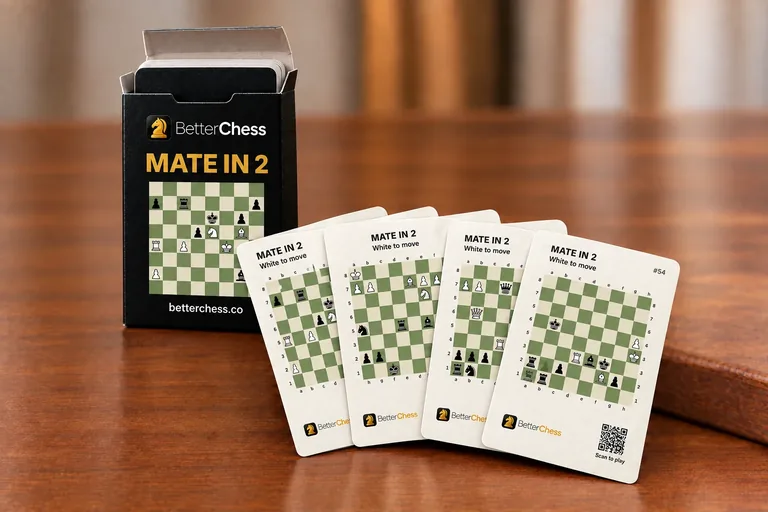
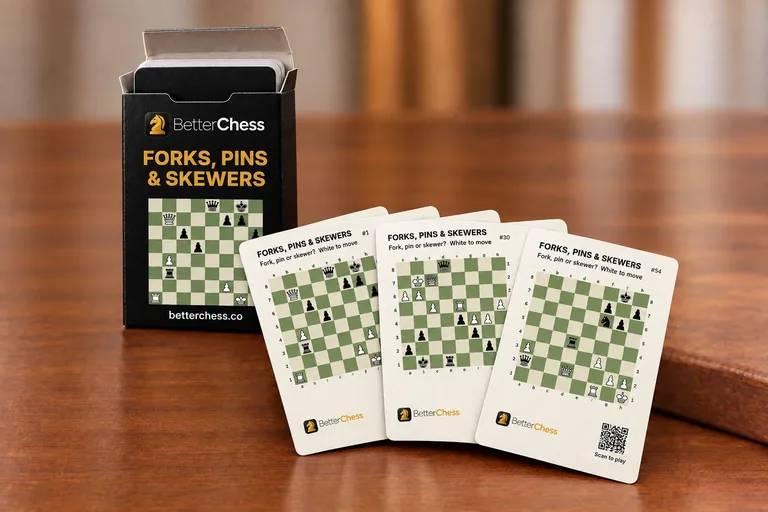
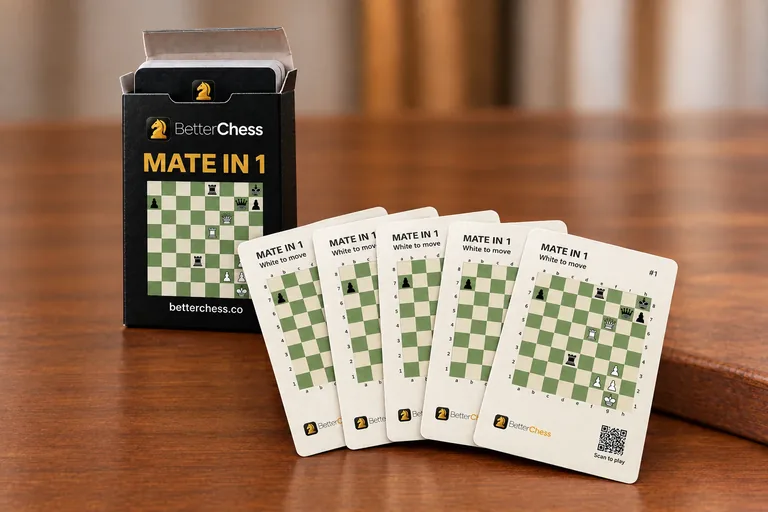
PRINTED CHESS PUZZLE CARDS
Chess puzzle playing card decks
54 poker-size cards in a tuck box. Puzzle on the front, solution on the back.