Sicilian Kan
Starting position
Engine ready — step through to see live evals.
Press ▶ Watch to play the line out, or Next to step through it — the engine evaluates every position.
The Kan (or Paulsen) is the flexible Sicilian: Black plays ...e6 and ...a6 before committing a single knight, keeping every plan available. There are far fewer forced lines than in the Najdorf or Dragon, so it suits club players who want a real Sicilian fight on understanding rather than memory. The cost of that freedom is space: White gets a comfortable centre, and Black must know the standard schemes to push back.
The idea in one line
Play ...e6 and ...a6 early, keep the knights flexible, and choose your setup based on what White shows: ...Bc5 hitting d4, ...Qc7 on the c-file, and ...b5 for queenside space.
Key ideas
- ...e6 plus ...a6 is a scheme, not a move order. Black delays ...Nf6 and ...Nc6, so White gets no early target and the usual anti-Sicilian pins (Bb5 ideas) never appear.
- ...a6 takes b5 away from White's pieces: no Nb5 jumps at d6 or c7, and the ...b5 space gain is always in the air.
- The dark-squared bishop is the Kan's hero: ...Bc5 gains time on the d4-knight, and after Nb3 it drops back to a7, raking the a7-g1 diagonal at White's king.
- The c-file and the ...Qc7, ...Nf6, ...d6 regroup give Black classic Sicilian counterplay while the structure stays clean and hard to attack.
Plans for each side
White: Take the free centre: the main line is 5.Bd3 with O-O, Nb3 and c4 or f4 to follow. Many players clamp with an early c4 (the Maroczy bind) to squeeze Black's ...b5 and ...d5 breaks, then build slowly with Be3 and Nc3.
Black: Develop with ...Bc5 (or ...Qc7 and ...Nf6), castle short, then generate play with ...b5 and pressure down the c-file and the a7-g1 diagonal. Against the c4 bind, regroup calmly with ...Nf6, ...d6 and ...Nbd7 and fight for the d4 and b4 squares.
Common mistakes to avoid
- The Kan starts with three pawn moves, so lazy development is fatal: get the bishop and king's knight out and castle before opening the position.
- If White clamps with c4, do not drift. You need a plan against the bind (...Nf6, ...d6, ...Nbd7 with ...Bb4 or a timed ...b5 break), or you will run out of moves.
- Do not put the queen's knight on c6 by reflex: in many Kan lines it belongs on d7, keeping c6 free for the pawn and the long diagonal open for a later ...Bb7.
The main line, explained
1… c5...c5 stakes the Sicilian claim: an asymmetric fight for d4 instead of the symmetric 1...e5.
2… e6...e6 opens the f8-bishop and keeps the d-pawn flexible: this is the Paulsen family, where structure comes before knights.
4… a6...a6, the Kan move. It denies b5 to White's minor pieces, prepares ...b5, and commits to nothing else.
5. Bd3Bd3 is the main line: the bishop supports e4 and eyes the kingside, and White plans O-O and c4 or f4.
5… Bc5...Bc5 develops with tempo against the d4-knight, the most direct of Black's schemes.
6. Nb3Nb3 steps out of the hit and gains a tempo back by attacking the bishop.
6… Ba7...Ba7 keeps the bishop on its best diagonal, a7-g1, pointing straight at White's castled king.
Frequently asked
What is the difference between the Kan and the Taimanov?
Both are ...e6 Sicilians. The Kan plays 4...a6 and delays both knights, staying maximally flexible; the Taimanov develops 4...Nc6 at once and puts immediate pressure on d4. They often transpose, but the Kan is the more scheme-based of the two.
Is the Sicilian Kan good for club players?
Yes. It gives you a genuine Sicilian counterattack with far less memorization than the Najdorf. The trade-off is that you must learn plans, especially against the c4 Maroczy bind, rather than concrete forcing lines.
What is White's most testing reply?
5.Bd3 is the main line, keeping natural attacking chances. The early c4 bind is the most annoying in practice because it restrains ...b5 and ...d5, so a Kan player needs a worked-out setup against it.
More openings to explore
Sicilian Taimanov
Sicilian Defence (1.e4 c5) · B44-B49
Learn & play ›Sicilian Defense
Black vs 1.e4 · B20–B99
Learn & play ›Knowing the moves of the Sicilian Kan is not the same as knowing why they work. Use Claude? BetterChess gives it a real engine, so it explains this opening from the board in front of you instead of from memory.
BetterChess is a practice tool — we make no guarantee you'll reach 1800 or any rating. The lines here are standard, well-established opening theory, and every move is checked legal with the same engine the board runs.
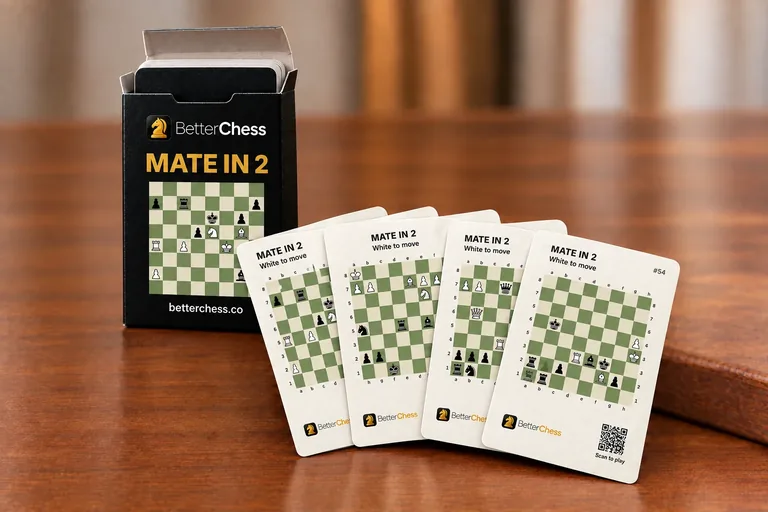
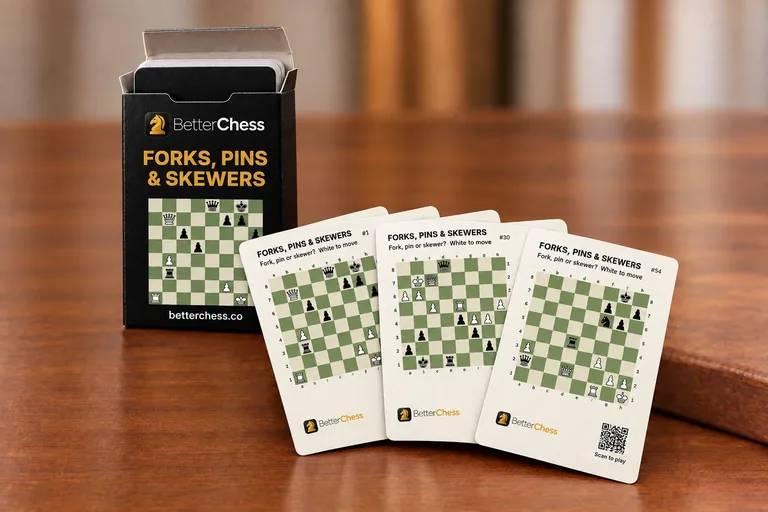
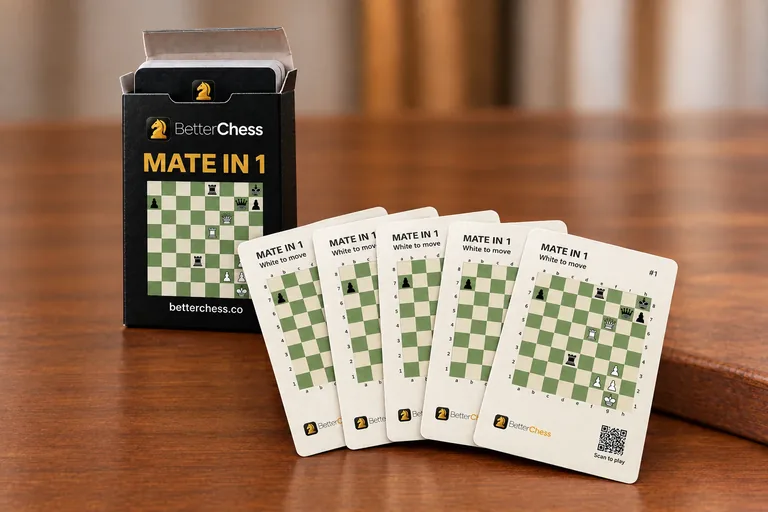
PRINTED CHESS PUZZLE CARDS
Chess puzzle playing card decks
54 poker-size cards in a tuck box. Puzzle on the front, solution on the back.