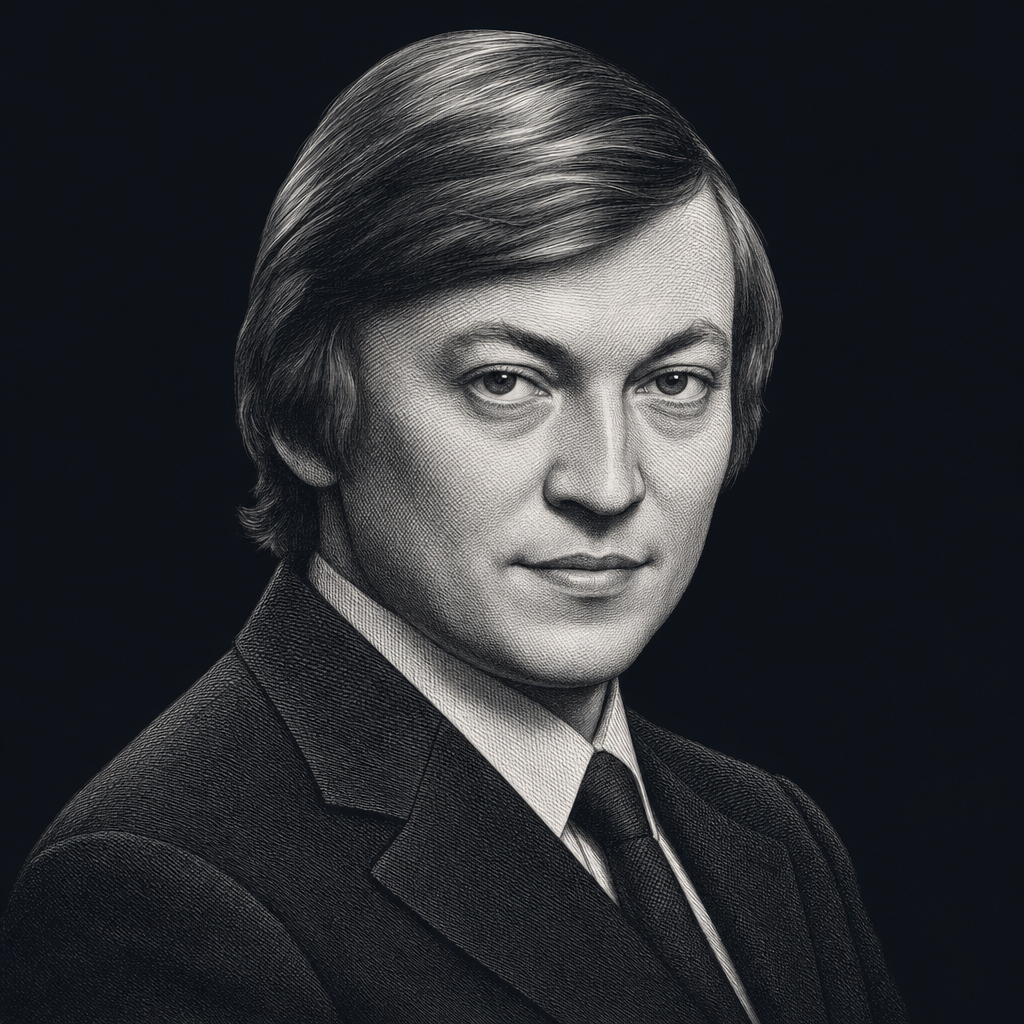
Anatoly Karpov
“The boa constrictor of positional chess”
A decade-long classical World Championship reign and a flawless, suffocating positional style
2780Peak ratingpeak FIDE rating (1994)
World #11976–1985 (approx.)
Born1951–present
CountrySoviet Union / Russia
Active era1966–present
Title12th World Champion (1975–1985); FIDE World Champion (1993–1999)
Anatoly Yevgenyevich Karpov was born on May 23, 1951, in the industrial town of Zlatoust in the Ural Mountains of the Soviet Union. He learned chess at the age of four and progressed with astonishing speed, becoming a candidate master by eleven. At twelve he was admitted to the elite chess school run by former World Champion Mikhail Botvinnik, whose disciplined, preparation-focused method shaped Karpov's approach for the rest of his career.
His ascent through the international ranks was swift and steady. In 1969 he won the World Junior Championship at Stockholm with a near-perfect score, becoming the first Soviet to take the title since Boris Spassky, and the following year he earned the grandmaster title at the age of nineteen. Through the early 1970s he established himself as the strongest of the new Soviet generation, and in 1974 he won the Candidates final against Viktor Korchnoi, earning the right to challenge Bobby Fischer.
Karpov became the 12th World Champion in 1975 in extraordinary circumstances: when Fischer refused to defend the title under the conditions he demanded, FIDE awarded the championship to Karpov by default. Determined to prove himself a worthy champion over the board, Karpov then embarked on one of the most dominant tournament runs in history, winning event after event and silencing any suggestion that his crown was unearned.
He defended the title in two bitter, politically charged matches against the defector Viktor Korchnoi, surviving a famous 1978 contest in Baguio City and winning more comfortably in Merano in 1981. His reign came to an end only against the next great force in chess: Garry Kasparov. Their first match in 1984–85 was aborted without result after 48 games, but in the 1985 rematch Kasparov took the title. Karpov pushed Kasparov to the brink in three further world title matches (1986, 1987, and 1990) without regaining it.
When Kasparov broke away from FIDE in 1993, the federation recognized Karpov as its World Champion, a title he held until 1999, defending it against Gata Kamsky and Viswanathan Anand. Across his career Karpov reached a peak rating of 2780 and spent well over a hundred months ranked world number one, the third-longest such reign in history. He remains one of the most successful tournament players ever and, in later life, a politician and chess ambassador.
Playing style
Karpov's style was the embodiment of positional chess: precise, economical, and almost entirely without weaknesses. He rarely sought the spectacular, preferring to accumulate tiny advantages and slowly tighten his grip until his opponent's position collapsed under the pressure — a method that earned him the nickname 'the boa constrictor.' He had an unrivaled sense of harmony and prophylaxis, neutralizing threats before they formed and squeezing maximum value from minimal material. His technique in slightly better endgames was widely regarded as the finest of his era.
Signature openings
“Chess is everything: art, science, and sport.”
— Anatoly Karpov, widely attributed
Rivalries & key opponents
- Garry Kasparov
- Viktor Korchnoi
- Viswanathan Anand
- Boris Spassky
Career highlights
- Won the World Junior Championship at Stockholm (1969)
- Became the 12th World Chess Champion (1975)
- Defended the title against Viktor Korchnoi in Baguio City (1978) and Merano (1981)
- Dominated elite tournament chess for over a decade, including the legendary Linares events
- Reached a peak FIDE rating of 2780 (1994)
- Held the FIDE World Championship from 1993 to 1999
- Defended the FIDE title against Gata Kamsky (1996) and Viswanathan Anand (1998)
- Spent more than 100 months as world number one, third-longest in history
Famous games on BetterChess
Kasparov's Octopus Knight (1985)
Anatoly Karpov vs Garry Kasparov · 1985 · Sicilian Defence
Replay & play ›Kasparov Wins the Crown (1985, Game 24)
Anatoly Karpov vs Garry Kasparov · 1985 · Sicilian Defence, Scheveningen
Replay & play ›More players




Biographical summary compiled by BetterChess. BetterChess is a practice tool — we make no guarantee you'll reach 1800 or any rating.
PRINTED CHESS PUZZLE CARDS
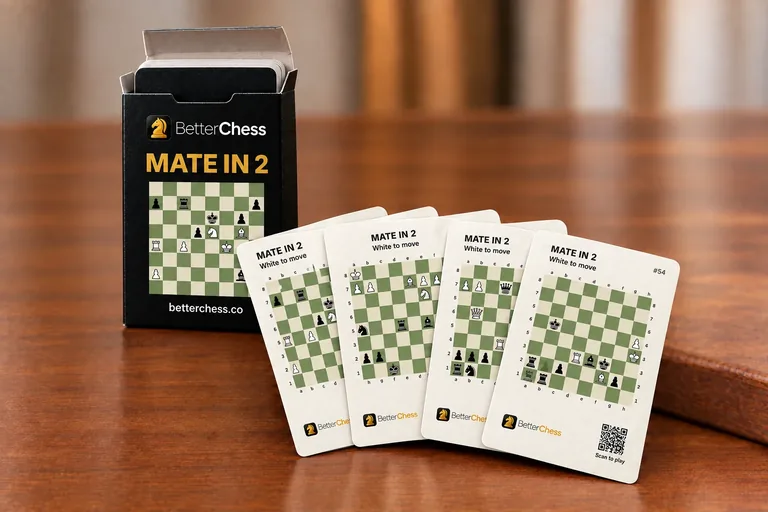
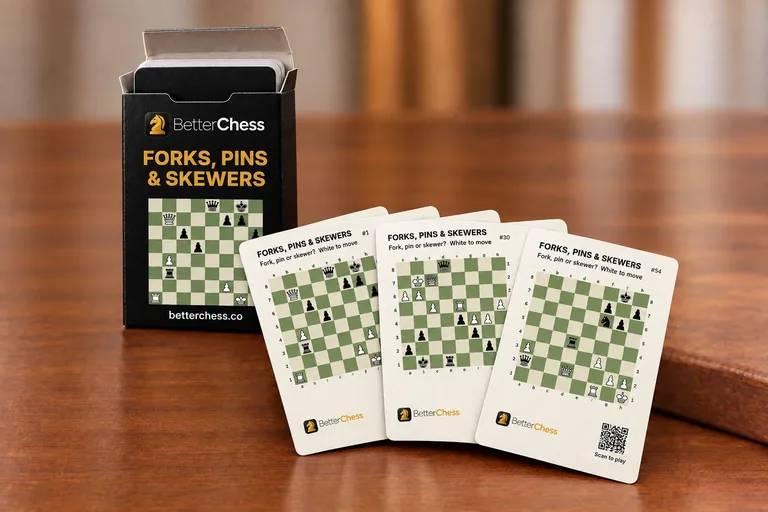
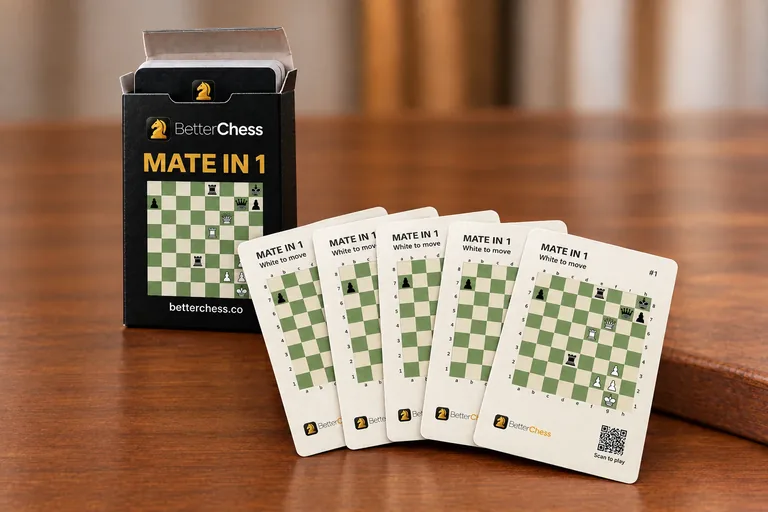
Chess puzzle playing card decks
54 poker-size cards in a tuck box. Puzzle on the front, solution on the back.