Kasparov Wins the Crown (1985, Game 24)
- White
- Anatoly Karpov
- Black
- Garry Kasparov
- Event
- World Championship, Moscow
- Year
- 1985
- Result
- 0–1
32. fxg5
32...Ng4! The turning point. The knight jumps in with tempo and clears the way for the decisive …Nxe3 and …Nxc2.
Why this game matters
Moscow, 9 November 1985. Everything hung on the final game. Karpov, the defending champion, had White and needed a win to level the match at 12–12 and retain the title; a draw or loss handed the crown to the 22-year-old Garry Kasparov. Kasparov met Karpov's must-win aggression with a razor-sharp Sicilian, weathered the kingside storm, and struck back with a counterattack that left Karpov's position in ruins. Kasparov called it the game of his life.
The lesson
When your opponent must win, you do not have to play safe — you have to play accurately. Kasparov invited Karpov forward, defended the critical squares, then exploited the holes the attack left behind. The decisive idea was …Nxc2, a knight that crashed into the queenside and tore open Karpov's king while his pieces were committed elsewhere.
Move by move
5. Nc35...a6 — the Najdorf move order into a Scheveningen structure. Kasparov chooses the sharpest set-up because a quiet game suits the champion, who only needs a draw to keep his title.
15. g415.g4 — Karpov launches the must-win pawn storm. He has to create threats; a passive game is a guaranteed loss of the crown for him.
21. Rd321.Rd3 — Karpov triples his heavy pieces toward the kingside. Every white piece is committed to the attack, which is exactly the imbalance Kasparov is counting on.
25. Rd125...f5! Kasparov strikes in the centre at the moment the attack is overextended. Counterattack in the centre is the classic answer to a wing assault.
32. fxg532...Ng4! The turning point. The knight jumps in with tempo and clears the way for the decisive …Nxe3 and …Nxc2.
34. Qxe334...Nxc2! The killer. The knight crashes into the queenside, hits Karpov's loose pieces and opens lines to his king while White's army is stuck on the other wing.
36. Rxd636.Rxd6 Karpov grabs material in desperation, but his king is now fatally exposed and Black's pieces swarm in.
39. Qc439...Kh8 — calm in the storm. Kasparov tucks the king away and lets his own attack roll; Karpov has no defence.
42. Kxg242...Nd4+! The final blow — a discovered attack that wins decisively. Karpov resigned. At 22, Garry Kasparov became the youngest World Champion in history.
Frequently asked
Why was Game 24 so important?
The match score stood at 12–11 for Kasparov. Karpov, the defending champion, needed to win the final game to tie at 12–12 and keep the title under the match rules; anything else made Kasparov champion. So Karpov was forced to attack, and Kasparov only had to avoid losing — but he won outright.
What opening did Kasparov choose?
A Sicilian Defence that transposed into a Scheveningen structure. It is a fighting, double-edged choice — exactly what Kasparov wanted, because it gave Karpov chances to overpress and create the weaknesses Kasparov then exploited.
Can I play the critical position?
Yes. Take the board as Kasparov before 32...Ng4 and try to find the counterstroke that breaks White's attack, or step through the whole game move by move — no sign-up.
Similar games
Kasparov's Octopus Knight (1985)
Anatoly Karpov vs Garry Kasparov · 1985 · Sicilian Defence
Replay & play ›Kasparov's Immortal (1999)
Garry Kasparov vs Veselin Topalov · 1999 · Pirc Defence
Replay & play ›Kramnik Cracks the Grünfeld (2000, Game 2)
Vladimir Kramnik vs Garry Kasparov · 2000 · Grünfeld Defence, Exchange
Replay & play ›The Pearl of Zandvoort (1935)
Max Euwe vs Alexander Alekhine · 1935 · Dutch Defence (Nimzo-Dutch)
Replay & play ›Want this on your own games? BetterChess puts a real engine inside Claude, so it finds the moves that actually decided the game instead of listing every inaccuracy.
BetterChess is a practice tool. We make no guarantee you'll reach 1800 or any rating. This is a historical game; the analysis is our own.
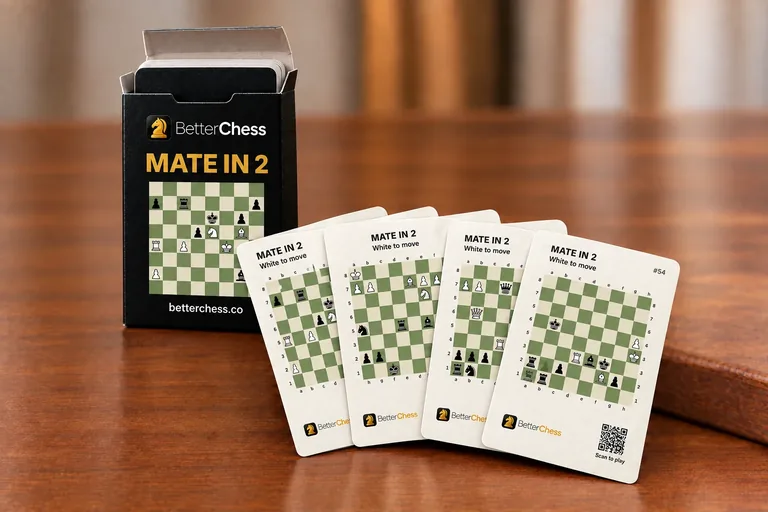
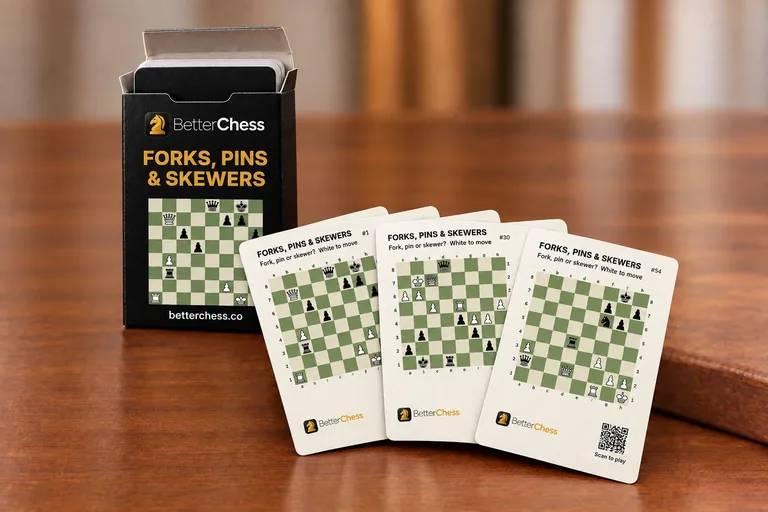
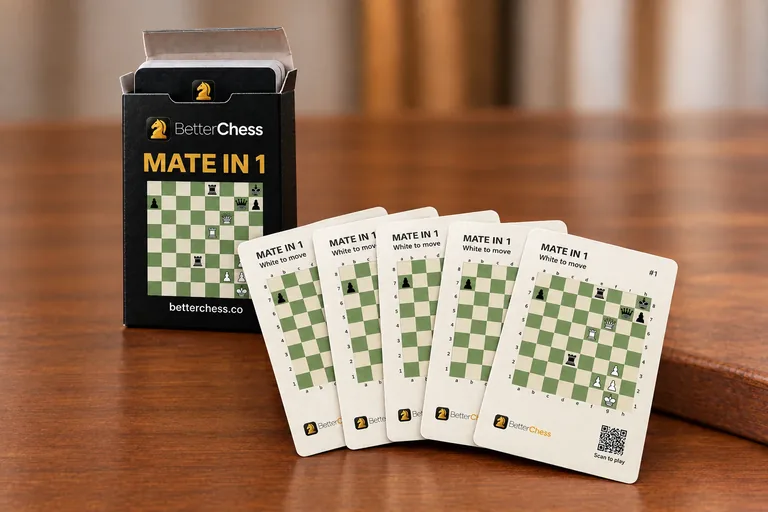
PRINTED CHESS PUZZLE CARDS
Chess puzzle playing card decks
54 poker-size cards in a tuck box. Puzzle on the front, solution on the back.