Caro-Kann Defense
Starting position
Engine ready — step through to see live evals.
Press ▶ Watch to play the line out, or Next to step through it — the engine evaluates every position.
The Caro-Kann is the solid player's answer to 1.e4. Like the French it supports a ...d5 strike at the centre — but unlike the French, it does so without locking in the light-squared bishop. Black gets a sound structure, an active bishop on f5, and a position that's very hard to crack. It's the choice of players who want safety with substance.
The idea in one line
Play ...c6 and ...d5 to challenge the centre, develop the light-squared bishop outside the pawn chain to f5, then complete development with ...e6, ...Nd7 and ...Ngf6 and castle into a resilient middlegame.
Key ideas
- ...c6 prepares ...d5 to hit the centre — the same idea as the French, but it keeps the c8-bishop's exit open.
- Getting the light-squared bishop out to f5 before playing ...e6 is the whole point. That 'bad bishop' problem the French suffers? The Caro-Kann sidesteps it.
- Black accepts a little less space in exchange for a sound, low-weakness structure that's tough to attack.
- Trade into safe, equal middlegames and outplay the opponent later — the Caro-Kann is built on resilience.
Plans for each side
White: Take central space, develop actively, and try to harass the f5-bishop or open the position before Black is fully coordinated — often with h4–h5 to gain kingside space.
Black: Develop the light-squared bishop to f5/g6, insert ...h6 to give it a safe retreat, then play ...e6, ...Nd7, ...Ngf6, and castle. Solid, flexible, and very hard to break.
Common mistakes to avoid
- Play ...Bf5 before ...e6. If you lock the bishop in first with ...e6, you get exactly the bad bishop the Caro-Kann is meant to avoid.
- When White plays h4, remember ...h6 to give the g6-bishop an escape — otherwise h5 traps or wins it.
- Don't get passive: finish development and castle. A solid structure with undeveloped pieces is still a losing recipe.
The main line, explained
1… c6...c6 — the Caro-Kann. A modest-looking move that prepares a full central strike with ...d5.
2… d5...d5 hits the centre head-on. Black is fighting for the centre immediately, not conceding it.
3… dxe4...dxe4 — Black resolves the central tension and will develop with tempo against the recaptured knight.
4… Bf5...Bf5! The key idea: the light-squared bishop gets outside the pawn chain before ...e6 ever locks it in.
5… Bg6...Bg6 keeps the bishop on its excellent diagonal after Ng3 nudges it. Black is comfortable and solid.
6… h6...h6 gives the g6-bishop a safe square, answering White's h4–h5 space grab. Prophylaxis at its simplest.
Frequently asked
Is the Caro-Kann a good opening for improving players?
Yes. It teaches sound structure, the value of a good bishop, and patient development — all transferable skills. It's solid enough to rely on for years without constant theory updates.
Caro-Kann vs French — which should I play?
Both answer 1.e4 with a ...d5 strike. The big difference: the Caro-Kann develops the light-squared bishop actively to f5, while the French often leaves it passive behind ...e6. If you dislike the French's 'bad bishop,' the Caro-Kann is for you.
Is the Caro-Kann too passive or drawish?
It's solid, not passive. Black accepts slightly less space for a structure with very few weaknesses, then plays for a win from a sound position. Plenty of attacking players use it.
Traps in the Caro-Kann Defense
- Caro-Kann Smothered Mate Trap: checkmate (smothered)
Famous games in the Caro-Kann Defense
- Réti vs Tartakower (1910): Richard Réti vs Savielly Tartakower
- Tal's Candidates Brilliancy (1959): Mikhail Tal vs Vasily Smyslov
More openings to explore
Ruy Lopez (Spanish)
King's Pawn (1.e4 e5) · C60–C99
Learn & play ›Italian Game
King's Pawn (1.e4 e5) · C50–C54
Learn & play ›Knowing the moves of the Caro-Kann Defense is not the same as knowing why they work. Use Claude? BetterChess gives it a real engine, so it explains this opening from the board in front of you instead of from memory.
BetterChess is a practice tool — we make no guarantee you'll reach 1800 or any rating. The lines here are standard, well-established opening theory, and every move is checked legal with the same engine the board runs.
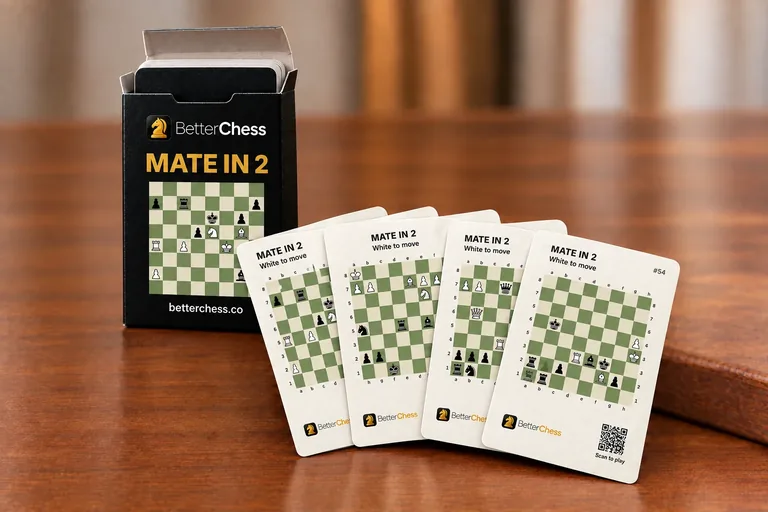
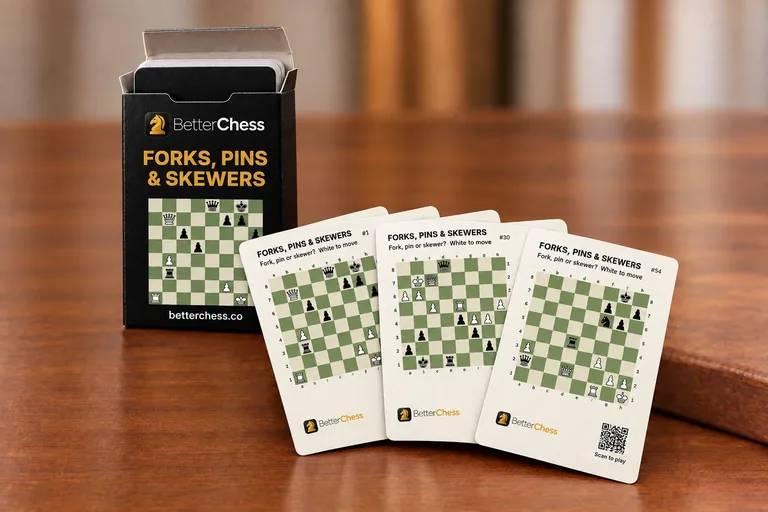
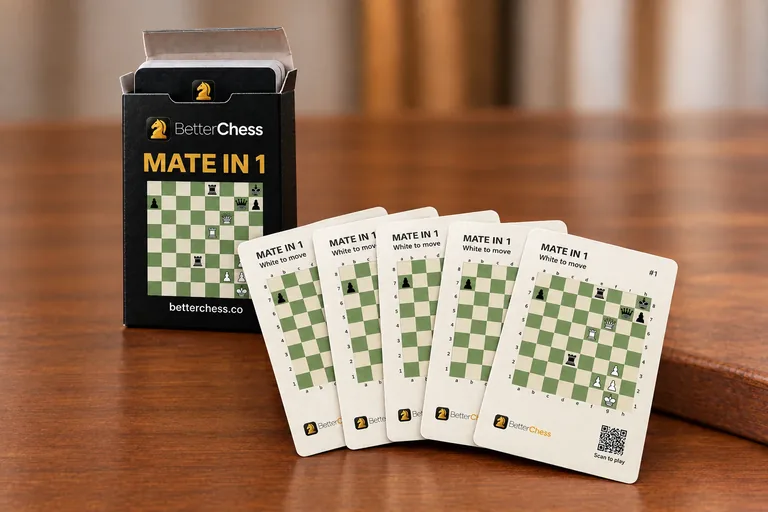
PRINTED CHESS PUZZLE CARDS
Chess puzzle playing card decks
54 poker-size cards in a tuck box. Puzzle on the front, solution on the back.