English Opening
Starting position
Engine ready — step through to see live evals.
Press ▶ Watch to play the line out, or Next to step through it — the engine evaluates every position.
The English Opening begins 1.c4, staking a claim on the centre from the flank rather than occupying it at once. It's flexible and rich: White often fianchettoes with g3 and Bg2, controls the d5 square, and can transpose into many other openings. When Black answers 1...e5 you get a 'Reversed Sicilian' — the Sicilian Defence with colours reversed and an extra tempo for White.
The idea in one line
Use 1.c4 to control the centre from the side, often fianchetto the king's bishop to g2, fight for the d5 square, and steer toward favourable structures — frequently a Sicilian with an extra tempo.
Key ideas
- 1.c4 grabs central control by pressure, not occupation; the d5 square becomes a key battleground for both sides.
- After 1...e5 it's a 'Reversed Sicilian' — you play Black's Sicilian set-ups a move up, which is a real practical bonus.
- The fianchetto (g3 and Bg2) is the backbone of many lines, putting the bishop on the long diagonal toward d5 and b7.
- The English is a transposition machine: it can slide into the Catalan, Réti, or even Queen's Gambit structures, so understanding plans beats rote lines.
Plans for each side
White: Play c4 and Nc3 to control d5, develop the king's bishop to g2 via g3, castle, and contest the centre — often capturing on d5 to leave Black's knight or pawn slightly exposed there.
Black: Stake a central claim with ...e5 and ...Nf6, develop naturally with ...Nc6, and look to free the position with ...d5; trade actively and aim for piece activity rather than getting squeezed.
Common mistakes to avoid
- Don't treat 1.c4 as purely passive — fight for d5 and the centre, or Black equalizes easily with ...d5.
- Leaving the king in the centre while manoeuvring on the flanks can backfire; complete development and castle.
- Be ready for transpositions: if you don't recognize when the game becomes a Catalan or Queen's Gambit, you can lose the thread.
The main line, explained
1. c4c4 — the English. White claims the centre from the flank and prepares to fight for d5.
1… e5e5 grabs central space; this set-up is a Sicilian Defence with colours reversed.
2. Nc3Nc3 develops and reinforces control of the key d5 square.
4. g3g3 prepares the fianchetto Bg2, the natural home for White's bishop in the English.
4… d5d5 — Black strikes in the centre to free the position.
5… Nxd5Nxd5 recaptures; the knight on d5 can be challenged by Nc3 ideas later, and White keeps a pleasant game.
Frequently asked
What kind of opening is the English?
It's a flank opening starting with 1.c4. Instead of occupying the centre with a pawn, White controls it from the side and fights for the d5 square, often with a kingside fianchetto.
Is the English good for club players?
Yes. It's flexible, sound, and built on plans you can reuse. You don't need to memorize huge lines — understanding the d5 fight and the fianchetto carries you a long way.
Why is 1...e5 called a Reversed Sicilian?
Because the resulting position is the Sicilian Defence with the colours flipped and White a move ahead. If you know Sicilian ideas, you can use them here with an extra tempo.
Famous games in the English Opening
- Zukertort's Immortal (1883): Johannes Zukertort vs Joseph Blackburne
- Staunton vs Williams (1851): Howard Staunton vs Elijah Williams
- Nakamura's Queen Sacrifice (2007): Michal Krasenkow vs Hikaru Nakamura
More openings to explore
Réti Opening
Flank opening (1.Nf3) · A04–A09
Learn & play ›Catalan Opening
Queen's Pawn (1.d4) · E00–E09
Learn & play ›Knowing the moves of the English Opening is not the same as knowing why they work. Use Claude? BetterChess gives it a real engine, so it explains this opening from the board in front of you instead of from memory.
BetterChess is a practice tool — we make no guarantee you'll reach 1800 or any rating. The lines here are standard, well-established opening theory, and every move is checked legal with the same engine the board runs.
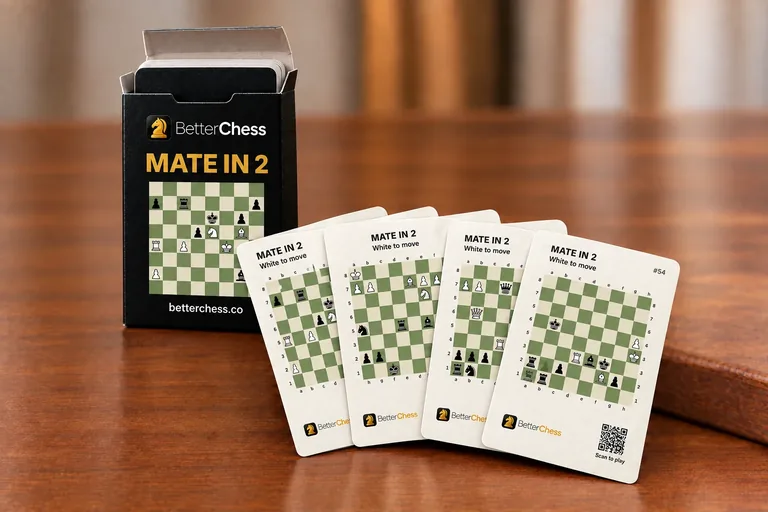
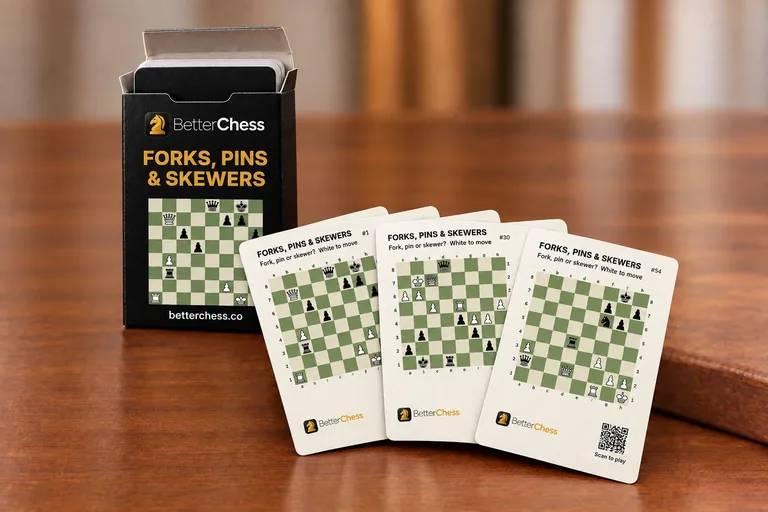
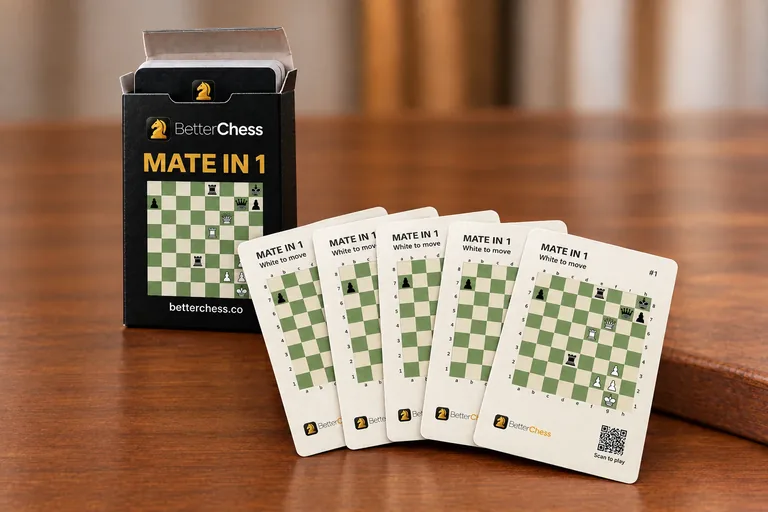
PRINTED CHESS PUZZLE CARDS
Chess puzzle playing card decks
54 poker-size cards in a tuck box. Puzzle on the front, solution on the back.