Alekhine Defense
Starting position
Engine ready — step through to see live evals.
Press ▶ Watch to play the line out, or Next to step through it — the engine evaluates every position.
The Alekhine is the most provocative answer to 1.e4: Black attacks the king's pawn with 1...Nf6 and invites White to chase the knight all over the board with tempo. The idea is hypermodern — let White build a huge advanced pawn centre, then attack it and prove it's overextended. It's a bold, asymmetrical defence that takes White straight out of comfortable, symmetrical waters.
The idea in one line
Provoke White's pawns forward by hopping the knight (...Nf6–d5), invite a big advanced centre, then chip away at it with ...d6, ...c5, and piece pressure to show the pawns are weaknesses, not strengths.
Key ideas
- ...Nf6 provokes e5, daring White to gain space by chasing the knight — the whole point is to let White overextend.
- Black plays the ultimate hypermodern strategy: surrender the centre temporarily, then undermine it with ...d6, ...c5 and pieces.
- White's big pawn centre (the 'Four Pawns' or the calmer Modern lines) is a double-edged sword: strong if it holds, a cluster of targets if it doesn't.
- Black's pieces aim at the advanced pawns — the d5-knight, a g7-bishop, and breaks like ...d6 and ...c5 question whether White can defend everything.
Plans for each side
White: Gain space by chasing the knight with e5 and grabbing the centre with d4 (and sometimes c4 and f4 in the sharp Four Pawns Attack), then try to use the extra space to attack before Black undermines it.
Black: Reroute the knight to safety, strike at the centre with ...d6 (and later ...c5), fianchetto the bishop to g7, castle, and pressure White's advanced pawns until they become weaknesses.
Common mistakes to avoid
- Don't let the knight get trapped or chased into passivity — know its retreat squares after the pawns advance, especially against c4 ideas.
- Time your ...d6 and ...c5 breaks; if you delay challenging the centre, White's space advantage can simply roll you over.
- Steer carefully against the Four Pawns Attack (c4, d4, e5, f4): it's the critical, most ambitious try, and Black needs accurate undermining play, not improvisation.
The main line, explained
1… Nf6...Nf6 — the Alekhine. Black attacks e4 immediately and invites White to chase the knight and overextend.
2. e5e5 takes the bait, gaining space and kicking the knight; this advance defines the Alekhine's character.
2… Nd5...Nd5 — the knight hops to a good central square; White will try to chase it again, and Black is happy to provoke.
3… d6...d6 strikes at the e5-pawn at once, beginning the undermining of White's centre — the core Alekhine plan.
4. Nf3Nf3 develops calmly and defends; this Modern set-up is far more common than the sharp Four Pawns Attack.
4… g6...g6 prepares to fianchetto the bishop to g7, adding pressure on the long diagonal against White's centre.
Frequently asked
Is the Alekhine Defense good for club players?
It's a great surprise weapon and teaches hypermodern ideas, but it asks White an aggressive question and you must follow up accurately. Players who enjoy unbalanced, provocative positions get the most out of it.
What is the Four Pawns Attack?
It's White's most ambitious answer, building a huge centre with pawns on c4, d4, e5 and f4. It's critical theory: if White's centre holds it's crushing, but it's also the most exposed to Black's undermining counterplay.
Why provoke White's pawns forward?
Because advanced pawns can be both a space advantage and a target. The Alekhine bets that White's big centre will become overextended, giving Black piece pressure and breaks like ...d6 and ...c5 to exploit it.
Famous games in the Alekhine Defense
- Tal's Knight Sacrifice vs Larsen (1965): Mikhail Tal vs Bent Larsen
More openings to explore
Pirc Defense
Black vs 1.e4 · B07–B09
Learn & play ›Scandinavian Defense
Black vs 1.e4 · B01
Learn & play ›Knowing the moves of the Alekhine Defense is not the same as knowing why they work. Use Claude? BetterChess gives it a real engine, so it explains this opening from the board in front of you instead of from memory.
BetterChess is a practice tool — we make no guarantee you'll reach 1800 or any rating. The lines here are standard, well-established opening theory, and every move is checked legal with the same engine the board runs.
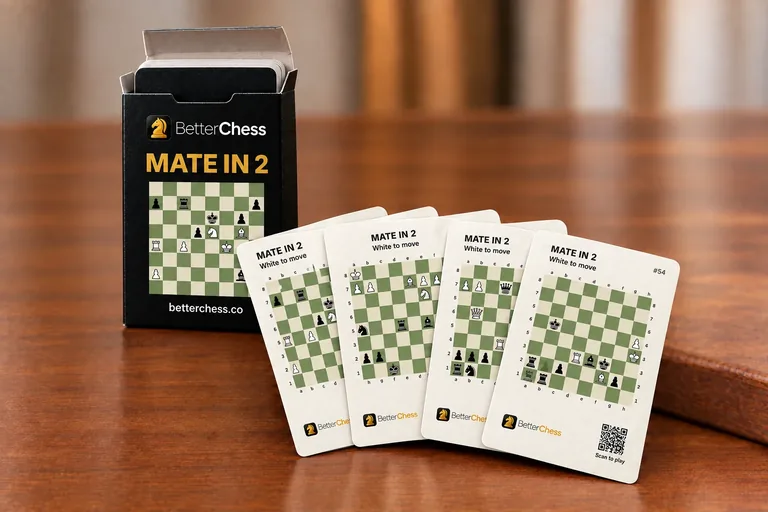
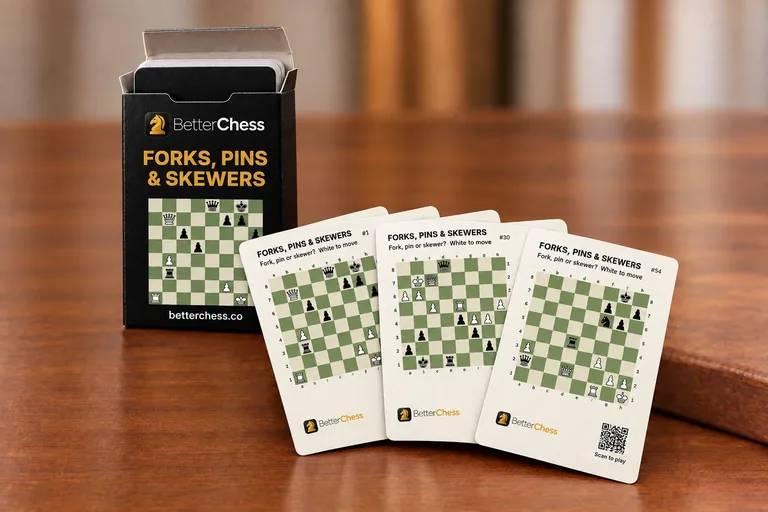
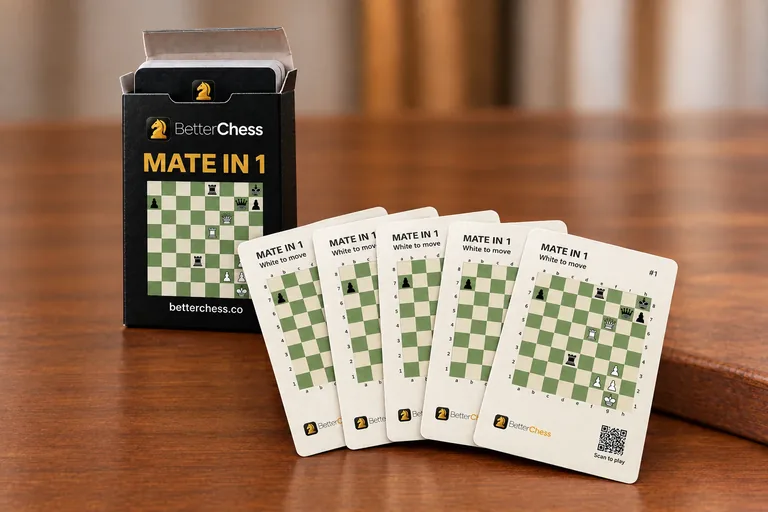
PRINTED CHESS PUZZLE CARDS
Chess puzzle playing card decks
54 poker-size cards in a tuck box. Puzzle on the front, solution on the back.