Alekhine vs Nimzowitsch (1930)
- White
- Alexander Alekhine
- Black
- Aron Nimzowitsch
- Event
- San Remo
- Year
- 1930
- Result
- 1–0
- Opening
- French Defence (Winawer)
26… Rbc8
White to move. Black is utterly tied up. Alekhine made a quiet, devastating move that completed the bind and left Black helpless. Can you find it? (Hint: reroute a bishop toward c6.)
Why this game matters
San Remo, 1930. Alekhine was crushing the field (he scored 14/15), and here he beats the great Nimzowitsch at his own positional game. Alekhine builds a queen-behind-doubled-rooks battery on the c-file — the formation now known as 'Alekhine's Gun' — and squeezes Black into total paralysis.
The lesson
Sometimes you don't need to checkmate — you just need to take away every move. Alekhine clamped the position with pins and the heavy-piece battery on the c-file, then advanced quietly until Black, in near-zugzwang, had to give up material to breathe. Patient pressure beats premature attacks.
Move by move
2… d52.d4 d5 3.Nc3 Bb4 — a Winawer French. Alekhine welcomes the locked centre; he intends to win on the wings with manoeuvring, not a direct assault.
9. f49.f4 — Alekhine grabs kingside space and fixes Black's structure. The plan is a long, patient bind, not a quick attack.
14. Nd614.Nd6! The knight occupies a magnificent outpost deep in Black's position, paralysing the defence.
17. a617.a6! A quiet pawn thrust that cramps Black's queenside permanently and fixes the b7 and a7 squares as targets.
21. Rc221.Rc2 — the first rook on the c-file. Alekhine is loading the famous battery: rooks doubled with the queen behind them.
23. Qe323.Qe3 then Rc3 — the heavy pieces line up on the c-file. This queen-behind-the-rooks formation is what later became known as 'Alekhine's Gun.'
25. R1c225.R1c2 — both rooks and the queen now bear down the c-file. Black is running out of useful moves entirely.
26. Qc126.Qc1 — the gun is fully loaded: Qc1 behind Rc2 and Rc3. Black is in near-total zugzwang.
27. Ba427.Ba4! The killing manoeuvre. The bishop reroutes to b5 to attack c6, and Black, with no good move, must concede material. Nimzowitsch was, in Alekhine's words, reduced to virtual zugzwang.
30. h430.h4 — the final quiet move. Black is completely paralysed and resigned: he must shed material to move at all. A positional masterpiece, and the origin of 'Alekhine's Gun.'
Frequently asked
What is 'Alekhine's Gun'?
It's the formation of two rooks doubled on a file with the queen placed behind them, rather than in front. The name comes from this very game, where Alekhine lined up his heavy pieces on the c-file to crush Nimzowitsch. It maximises pressure down an open or half-open file.
How does White win without an attack?
By zugzwang and bind. Alekhine took away all of Black's useful moves with pins, an outpost knight, and the c-file battery. Eventually Nimzowitsch had to give up material just to make a legal move that didn't immediately lose. Pressure, not checkmate, did the job.
Why is it impressive against Nimzowitsch?
Nimzowitsch was the world's leading expert on exactly this kind of restraining, prophylactic chess. Beating him with his own methods, at a tournament Alekhine dominated 14/15, showed Alekhine at the peak of his powers.
Similar games
The Immortal Zugzwang Game (1923)
Friedrich Sämisch vs Aron Nimzowitsch · 1923 · Queen's Indian Defence
Replay & play ›Bogoljubov vs Alekhine (1922)
Efim Bogoljubov vs Alexander Alekhine · 1922 · Dutch Defence (Nimzo-Dutch)
Replay & play ›Blackburne vs Schwarz (1881)
Joseph Blackburne vs Jacques Schwarz · 1881 · French Defence, Exchange Variation
Replay & play ›Paulsen vs Schwarz (1879)
Louis Paulsen vs Adolf Schwarz · 1879 · French Defence, Advance Variation
Replay & play ›Want this on your own games? BetterChess puts a real engine inside Claude, so it finds the moves that actually decided the game instead of listing every inaccuracy.
BetterChess is a practice tool. We make no guarantee you'll reach 1800 or any rating. This is a historical game; the analysis is our own.
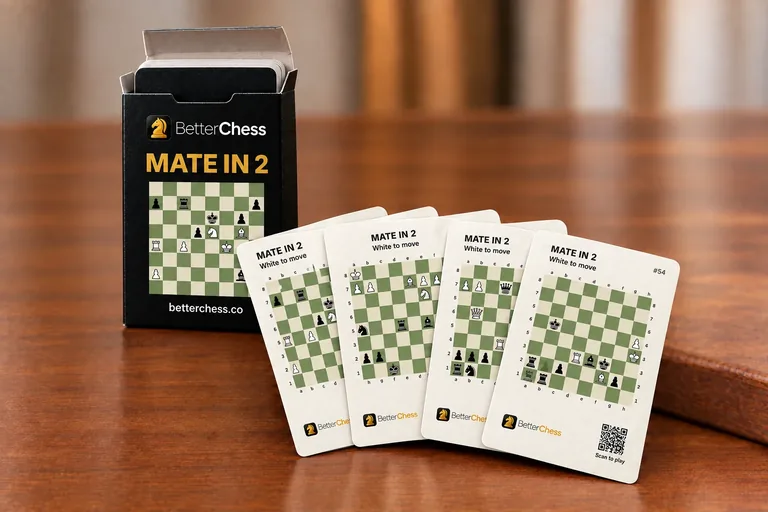
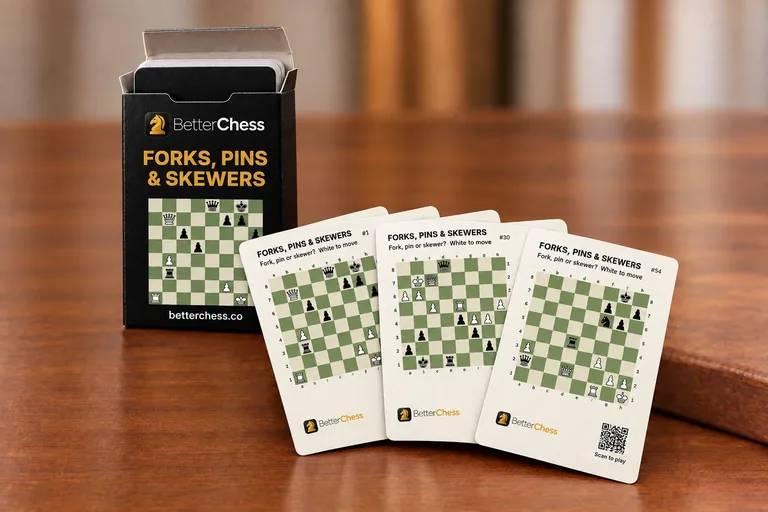
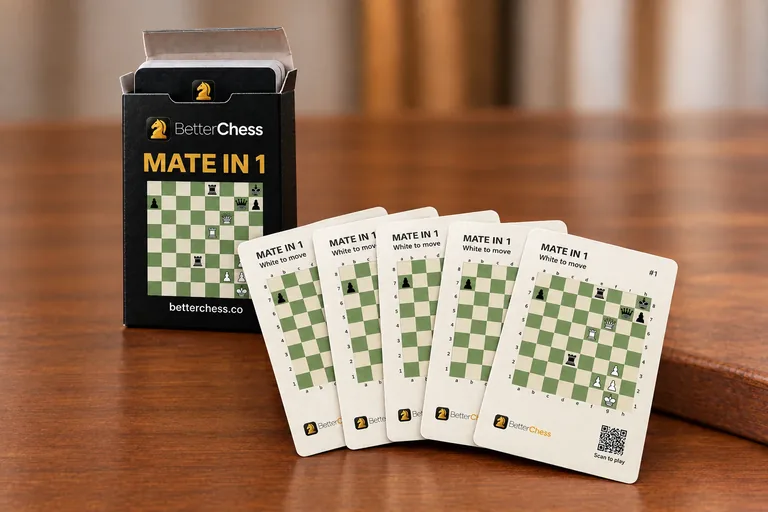
PRINTED CHESS PUZZLE CARDS
Chess puzzle playing card decks
54 poker-size cards in a tuck box. Puzzle on the front, solution on the back.