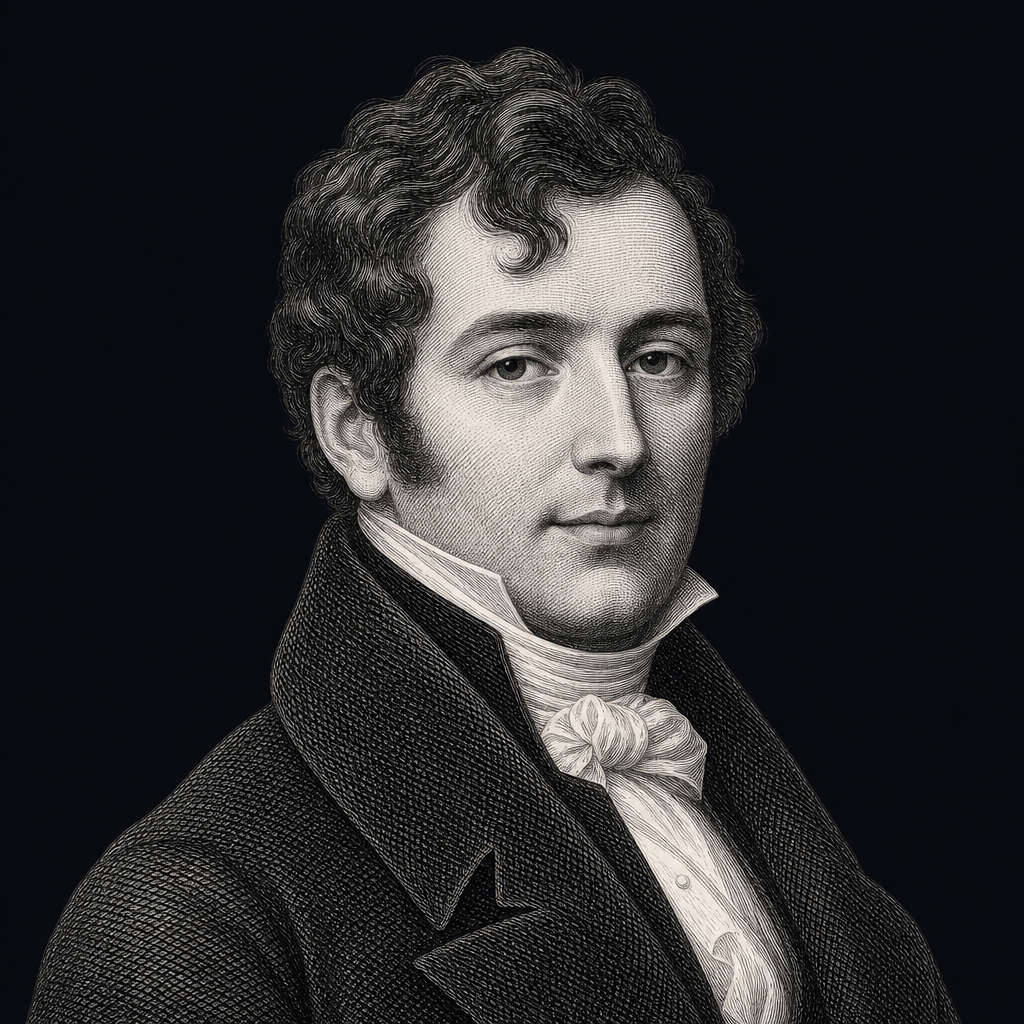
Louis de La Bourdonnais
“The strongest player of the early 19th century”
Winning the great 1834 matches against McDonnell, the first informal world-championship contest
2666Peak ratingEdo historical rating estimate (predates Chessmetrics coverage)
World #1c. 1821–1840 (generally regarded as the world's best)
Born–died1795–1840
CountryFrance
Active erac. 1818–1840
TitleUnofficial world's best (c. 1821–1840)
Louis-Charles Mahé de La Bourdonnais was born in 1795 on the island of Réunion, then the Île Bourbon, a French colony in the Indian Ocean, into a family of some distinction; his grandfather had been a colonial governor. He came to mainland France for his education and discovered chess as a young man, learning the game around 1814 and beginning to take it seriously about 1818, when he became a regular at the legendary Café de la Régence in Paris, the centre of the chess world.
He took lessons from the master Jacques-François Mouret and pitted himself against the reigning French champion, Alexandre Deschapelles, who had taught him much of what he knew. By about 1821 La Bourdonnais was able to beat Deschapelles even when receiving no odds, and from that point he was widely considered the strongest player alive, a position he held until his death. He played constantly at the Régence, often for stakes, and made his living from the game when his finances allowed.
His enduring fame rests on the extraordinary series of matches he played in London in 1834 against Alexander McDonnell, the strongest player in England. Over roughly six months the two contested six matches totalling eighty-five recorded games — by far the longest and most thoroughly documented contest the game had yet seen. La Bourdonnais won the overall series decisively, with forty-five wins, twenty-seven losses and thirteen draws, and the games were published and analysed across Europe, giving chess its first widely shared body of master play.
Among those games was the celebrated sixteenth game of the fourth match, which ends with three connected black passed pawns marching to the back rank — an image so striking it is often called the first 'immortal' game in chess history. The match as a whole revealed La Bourdonnais as a player of remarkable dynamism and endgame skill, decades before such qualities were formally understood, and his combinative imagination set the standard for the Romantic era that followed.
La Bourdonnais also contributed to chess literature, editing the early French chess magazine Le Palamède, the first periodical devoted to the game. His later life, however, was unhappy: he lost his fortune in ill-judged property speculation and was forced to support himself entirely by playing and writing about chess. Reduced to poverty and suffering from a stroke, he travelled to London hoping to earn money, and died there on 13 December 1840.
He was buried at Kensal Green Cemetery in London, where, by a poignant coincidence arranged by the chess writer George Walker, his grave lies near that of his great rival McDonnell, who had died five years earlier. Though no formal world championship existed in his lifetime, La Bourdonnais is universally counted among the unofficial world's-best players, and the 1834 matches are remembered as the true beginning of top-level international chess.
Playing style
La Bourdonnais was the supreme attacking and dynamic player of his age, distinguished by a fertile combinative imagination and — unusually for the time — a genuine feeling for the power of pawns and the endgame. He handled open, tactical positions with great energy and was famous for pushing connected passed pawns to devastating effect, as in the legendary sixteenth game against McDonnell. His play bridged the older calculating school and the Romantic era, combining sacrificial flair with a practical understanding of central force.
Signature openings
Rivalries & key opponents
- Alexander McDonnell — the 1834 London matches (85 games), won by La Bourdonnais, the first great international contest
- Alexandre Deschapelles — his teacher, whom he surpassed around 1821
Career highlights
- Regarded as the world's strongest player from about 1821 until his death in 1840
- Won the great series of matches against Alexander McDonnell (London, 1834)
- Played the famous 'pawn march' game (4th match, game 16, 1834), often called the first immortal game
- Edited Le Palamède, the first chess periodical (founded 1836)
- Dominated play at the Café de la Régence, the centre of world chess, for two decades
- Buried at Kensal Green, London, near his rival McDonnell
Famous games on BetterChess
More players







Biographical summary compiled by BetterChess. BetterChess is a practice tool — we make no guarantee you'll reach 1800 or any rating.
PRINTED CHESS PUZZLE CARDS
Chess puzzle playing card decks
54 poker-size cards in a tuck box. Puzzle on the front, solution on the back.