Sicilian Defense
Starting position
Engine ready — step through to see live evals.
Press ▶ Watch to play the line out, or Next to step through it — the engine evaluates every position.
The Sicilian is the most popular answer to 1.e4 and the great fighting defence. Instead of meeting a king's pawn with a king's pawn, Black strikes at the centre from the wing with ...c5, trading a flank pawn for White's central d-pawn. That swap leaves Black with an extra centre pawn and a half-open c-file — the seeds of real counterplay rather than mere equality.
The idea in one line
Answer 1.e4 with 1...c5, trade the c-pawn for White's d-pawn to open the c-file, then develop and play for active counterplay on the queenside while watching the centre. The shown line is the Najdorf, the Sicilian's most respected main line.
Key ideas
- ...c5 fights for the centre from the side: Black aims to trade the c-pawn for White's d-pawn and gain the half-open c-file for the rooks.
- Black willingly gives White a space and development lead in exchange for a sound pawn structure and long-term queenside chances.
- The half-open c-file is Black's highway — rooks and a queen pressing down it, often with ...Rc8 and pressure on c2 or the c3-knight.
- In the Najdorf, the small move ...a6 stops White's pieces using b5 and quietly prepares ...e5 or ...b5 to expand and take the initiative.
Plans for each side
White: Build the standard 'Open Sicilian' set-up — knight on d4, knight on c3 — then choose an attacking scheme such as Be2, Be3 with f3 and a queenside castle, or the sharp 6.Bg5 and 6.Be3 lines, and go for the king.
Black: Trade on d4, develop the kingside, complete with ...e5 or ...e6 and ...Be7, castle, and generate counterplay on the queenside down the c-file with ...b5, ...Bb7 and pressure on White's centre.
Common mistakes to avoid
- Don't drift into passivity: the Sicilian is about counterplay, so a Black setup with no active plan on the queenside just hands White a free attack.
- Be careful castling kingside if White has stormed pawns up with f3, g4, h4 — know when to delay castling or castle into the safer side.
- Avoid grabbing loose pawns (like the b2-pawn) too early and falling behind in development while White's pieces pour out.
The main line, explained
1… c5...c5 — the Sicilian. Black contests the centre from the wing and unbalances the game from move one.
2… d6...d6 supports a later ...e5 and keeps the centre flexible; this is the classic Open Sicilian move order.
3… cxd4...cxd4 — Black completes the key trade: the flank c-pawn for White's central d-pawn, opening the c-file.
4… Nf6...Nf6 develops with tempo by hitting the e4-pawn and forces White to defend the centre, usually with Nc3.
5. Nc3Nc3 defends e4 and develops; the position is now a true Open Sicilian, the most fighting branch of the opening.
5… a6...a6 — the Najdorf, the most famous Sicilian. It takes the b5-square from White's pieces and prepares ...e5 or ...b5.
Frequently asked
Is the Sicilian good for club players?
Yes, if you're willing to learn some plans — it gives Black real winning chances rather than just equalizing. It rewards understanding pawn structures and counterplay, which makes you a stronger player overall.
What is the Najdorf?
The Najdorf is the Sicilian line shown here, reached after 5...a6. It's the most analysed and most respected Sicilian, favoured by Fischer and Kasparov, because ...a6 is flexible and supports both central and queenside expansion.
Is the Sicilian too theoretical?
It can be at the top level, but club players don't need deep memorization — learn the main ideas (open the c-file, counterplay on the queenside, when to castle) and you'll handle most games on understanding alone.
Traps in the Sicilian Defense
- Magnus Smith Trap: wins the queen
Famous games in the Sicilian Defense
- Kasparov's Octopus Knight (1985): Anatoly Karpov vs Garry Kasparov
- McDonnell vs La Bourdonnais (1834): Alexander McDonnell vs Louis de La Bourdonnais
- Fischer Crushes Larsen (1971): Bobby Fischer vs Bent Larsen
- Kasparov Wins the Crown (1985, Game 24): Anatoly Karpov vs Garry Kasparov
- Carlsen's Queen Sac Decider (2016): Magnus Carlsen vs Sergey Karjakin
More openings to explore
French Defense
Black vs 1.e4 · C00–C19
Learn & play ›Caro-Kann Defense
Black vs 1.e4 · B10–B19
Learn & play ›Knowing the moves of the Sicilian Defense is not the same as knowing why they work. Use Claude? BetterChess gives it a real engine, so it explains this opening from the board in front of you instead of from memory.
BetterChess is a practice tool — we make no guarantee you'll reach 1800 or any rating. The lines here are standard, well-established opening theory, and every move is checked legal with the same engine the board runs.
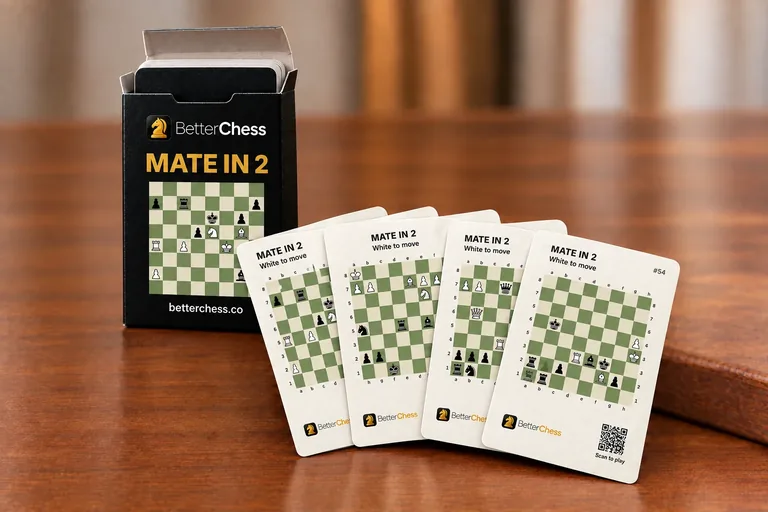
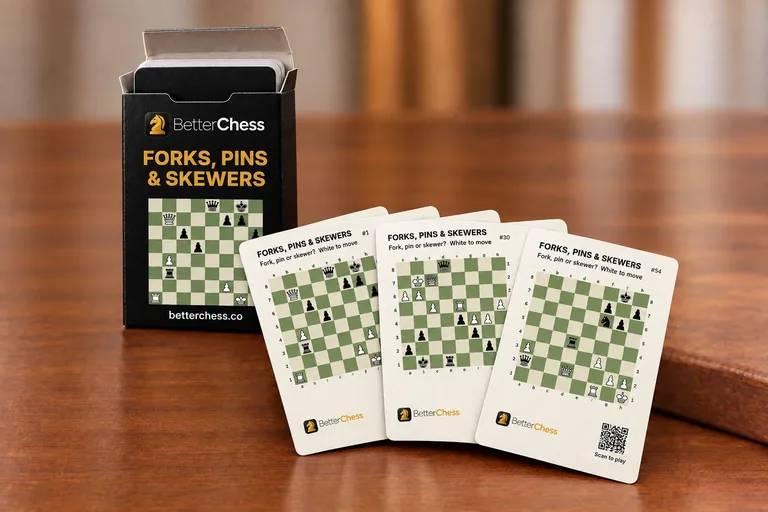
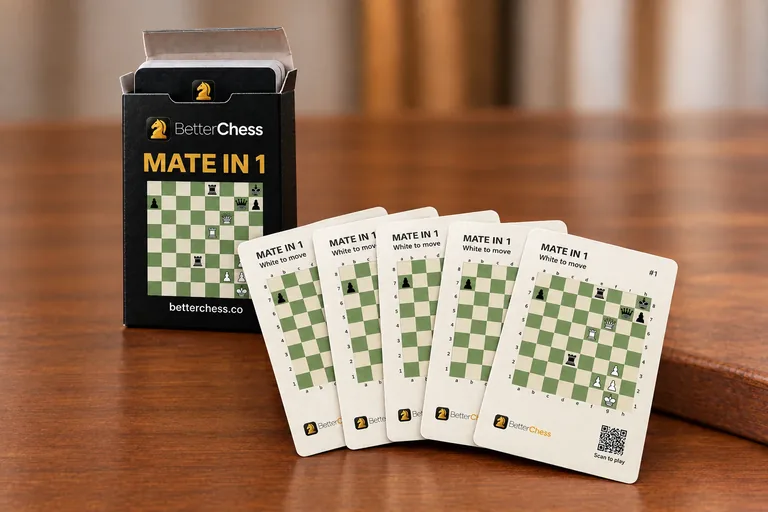
PRINTED CHESS PUZZLE CARDS
Chess puzzle playing card decks
54 poker-size cards in a tuck box. Puzzle on the front, solution on the back.