King's Gambit
Starting position
Engine ready — step through to see live evals.
Press ▶ Watch to play the line out, or Next to step through it — the engine evaluates every position.
The King's Gambit is the most famous attacking opening of the romantic era: White sacrifices the f-pawn on move two to rip open the f-file and seize the centre and the initiative. It's bold, double-edged, and enormous fun — beloved by Anderssen, Morphy and Spassky. It demands accuracy from both sides, which makes it a brilliant way to sharpen your tactics.
The idea in one line
Offer the f-pawn to deflect Black's e-pawn, then develop fast (Nf3, Bc4) to build a strong centre and attack down the half-open f-file toward Black's king.
Key ideas
- 2.f4 trades a pawn for the centre and the initiative: White wants pawns on e4 and d4 and an open f-file aimed at f7.
- 3.Nf3 is almost always played first — it develops with tempo and pre-empts the dangerous check on h4 that would disrupt White's plans.
- Black's ...g5 grabs space and tries to hold the extra f4-pawn, but it loosens the kingside — White attacks that weakened structure.
- This is an opening of initiative, not material: White's compensation is fast development and an attack, so passive play throws the gambit away.
Plans for each side
White: Sacrifice the f-pawn, play Nf3 to control the kingside and stop ...Qh4+, develop the bishop to c4 aiming at f7, build the big centre with d4, and attack down the half-open f-file before Black consolidates.
Black: Accept the pawn and try to hold it (or return it for development), fight to blunt White's centre and initiative, and aim to reach a safe, material-up endgame where the extra pawn tells.
Common mistakes to avoid
- Don't delay Nf3: leaving ...Qh4+ available can wreck White's castling and seize the initiative for Black.
- As Black, clinging to the f4-pawn with ...g5 and ...g4 can backfire if you fall behind in development — sometimes giving the pawn back is the safe, strong choice.
- White must keep attacking; trading pieces and drifting into a quiet position usually just leaves you a pawn down for nothing.
The main line, explained
2. f4f4 — the King's Gambit. White offers the f-pawn to deflect e5 and open the f-file toward Black's king.
2… exf4...exf4 — the King's Gambit Accepted. Black grabs the pawn and dares White to prove the compensation.
3. Nf3Nf3 — almost always first. It develops with tempo and rules out the annoying ...Qh4+ check.
3… g5...g5 — Black grabs space and tries to keep the extra pawn, but it loosens the kingside for White to target.
4. Bc4Bc4 develops the bishop to its best diagonal, eyeing f7, and prepares to castle and attack.
4… Bg7...Bg7 reinforces the g5-pawn chain and develops; both sides are now poised for a sharp middlegame.
Frequently asked
Is the King's Gambit sound for club players?
It's fully playable below master level and a fantastic way to learn attacking chess. It's sharp and a touch risky, so you'll occasionally get punished — but you'll improve your tactics and initiative faster than with any quiet opening.
Why play 3.Nf3 instead of grabbing the centre right away?
3.Nf3 develops with tempo and, crucially, prevents ...Qh4+ — a check that would force White's king to move and hand Black the initiative. Controlling the kingside first keeps White's attack on track.
Should Black accept the King's Gambit?
Accepting (2...exf4) is the most testing and most common reply, but declining with 2...Bc5 or the sharp 2...d5 (the Falkbeer Counter-Gambit) is perfectly respectable. Accepting wins a pawn but invites White's full attacking plan.
Famous games in the King's Gambit
- The Immortal Game (1851): Adolf Anderssen vs Lionel Kieseritzky
- Chigorin's King's Gambit (1892): Mikhail Chigorin vs Wilhelm Steinitz
- Spassky's King's Gambit (1960): Boris Spassky vs David Bronstein
More openings to explore
Vienna Game
King's Pawn (1.e4 e5) · C25–C29
Learn & play ›Bishop's Opening
King's Pawn (1.e4 e5) · C23–C24
Learn & play ›Knowing the moves of the King's Gambit is not the same as knowing why they work. Use Claude? BetterChess gives it a real engine, so it explains this opening from the board in front of you instead of from memory.
BetterChess is a practice tool — we make no guarantee you'll reach 1800 or any rating. The lines here are standard, well-established opening theory, and every move is checked legal with the same engine the board runs.
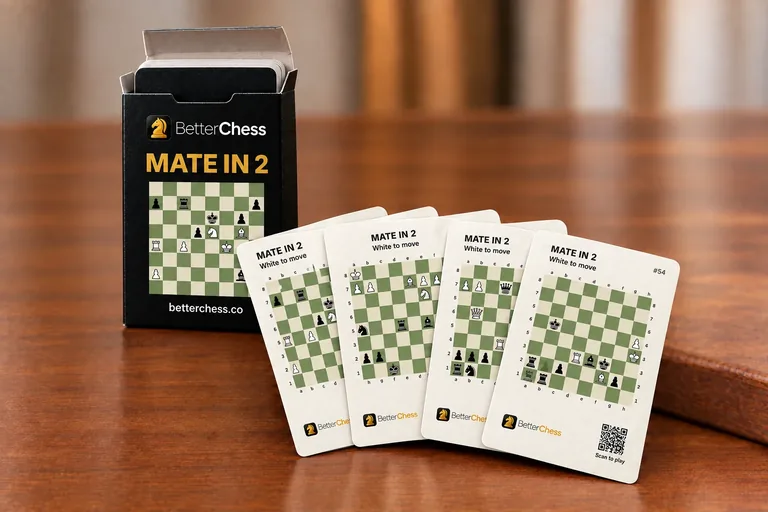
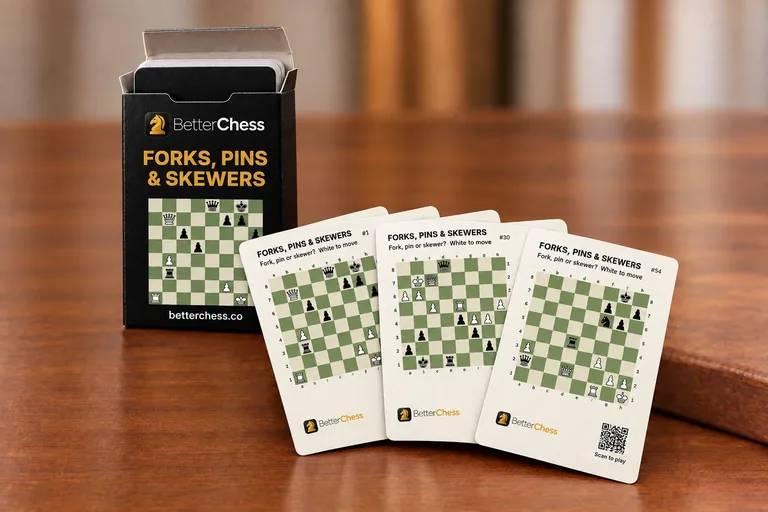
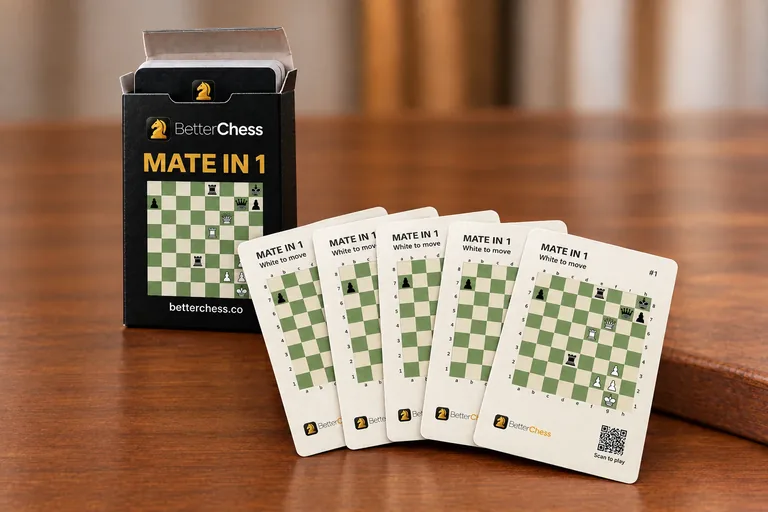
PRINTED CHESS PUZZLE CARDS
Chess puzzle playing card decks
54 poker-size cards in a tuck box. Puzzle on the front, solution on the back.