Queen's Gambit
Starting position
Engine ready — step through to see live evals.
Press ▶ Watch to play the line out, or Next to step through it — the engine evaluates every position.
The Queen's Gambit is one of the oldest and most respected ways to open with 1.d4: after 1.d4 d5 you offer the c-pawn with 2.c4. It looks like a sacrifice, but it isn't a true gambit — if Black grabs the pawn with 2...dxc4, you can almost always win it back. The real point of c4 is to challenge Black's strong d5 pawn and build a big, mobile centre.
The idea in one line
Use c4 to lever Black's d5 pawn and seize central space; if Black takes (the Accepted), regain the pawn with e3 and Bxc4 and develop quickly, and if Black declines with ...e6 or ...c6 you fight for the centre and the e4 break.
Key ideas
- It's not a real gambit: after 2...dxc4 you regain the pawn naturally with e3 and Bxc4, so don't fear giving it up.
- The c4 pawn attacks d5 — the goal is to undermine Black's centre and gain space, not to win material.
- Declining with 2...e6 (the Queen's Gambit Declined) is Black's most solid reply; declining with 2...c6 is the Slav. Both lead to rich, classical positions.
- Whatever Black does, White aims to develop smoothly and eventually engineer the e4 break to open the centre for the better-placed pieces.
Plans for each side
White: Play c4 to pressure d5; if it's taken, recapture with e3 and Bxc4 and develop with Nf3, Nc3, O-O. Against the Declined, complete development and prepare the central e4 break.
Black: Either hold firm with 2...e6 (Declined) or 2...c6 (Slav), keeping a solid pawn on d5, or take with 2...dxc4 (Accepted) and try to free the position with ...c5 and ...e6, accepting that White regains the pawn.
Common mistakes to avoid
- In the Accepted, don't try to cling to the c4 pawn with ...b5 too early — it weakens the queenside and White breaks with a4 or b3.
- As White, don't rush to recapture on c4 with the queen or knight; the clean way is e3 then Bxc4, keeping good development.
- Treating it like a real gambit and playing for a wild attack misses the point — this is a fight for the centre and space.
The main line, explained
2. c4c4 — the 'gambit'. It attacks d5 and fights for the centre; it is not a true sacrifice because White can regain the pawn.
2… dxc4dxc4 accepts the pawn (the Queen's Gambit Accepted). Declining with ...e6 instead leads to the Queen's Gambit Declined.
3. Nf3Nf3 develops and stops a quick ...e5 freeing break by Black.
4. e3e3 opens the f1-bishop's path so it can recapture on c4 — simple and strong.
5. Bxc4Bxc4 — White wins the pawn back with a well-placed bishop and easy development. The gambit was never a real sacrifice.
Frequently asked
Is the Queen's Gambit actually a gambit?
Not really. After 2...dxc4 Black can't safely hold the extra pawn, and White regains it with e3 and Bxc4. The name stuck for historical reasons, but it's a fight for the centre, not a sacrifice.
Should I be worried if Black takes the pawn?
No. The Queen's Gambit Accepted is fine for White — you recapture on c4 in a move or two and get a comfortable, well-developed position with a space edge.
What's the difference between the Accepted and the Declined?
Accepted is 2...dxc4 (Black grabs the pawn, then White wins it back). Declined is 2...e6, keeping a solid pawn chain. The Slav (2...c6) is another way to decline. All are sound, classical openings.
More openings to explore
Queen's Gambit Declined
Black vs 1.d4 · D30–D69
Learn & play ›Slav Defense
Black vs 1.d4 · D10–D19
Learn & play ›Knowing the moves of the Queen's Gambit is not the same as knowing why they work. Use Claude? BetterChess gives it a real engine, so it explains this opening from the board in front of you instead of from memory.
BetterChess is a practice tool — we make no guarantee you'll reach 1800 or any rating. The lines here are standard, well-established opening theory, and every move is checked legal with the same engine the board runs.
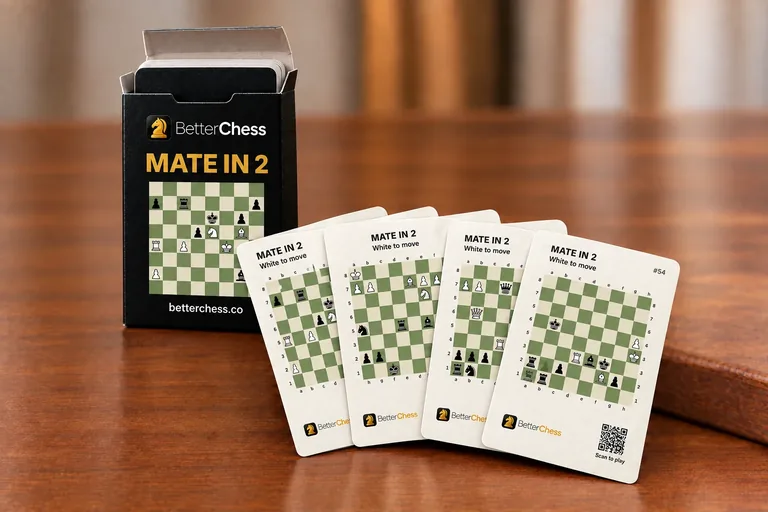
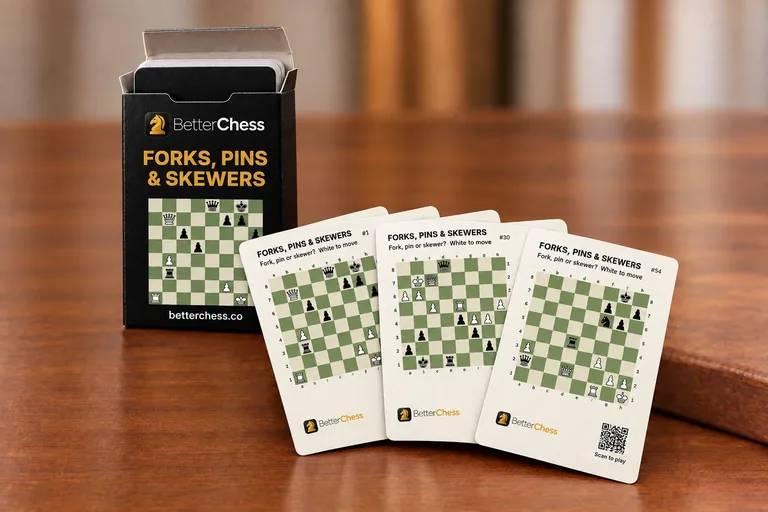
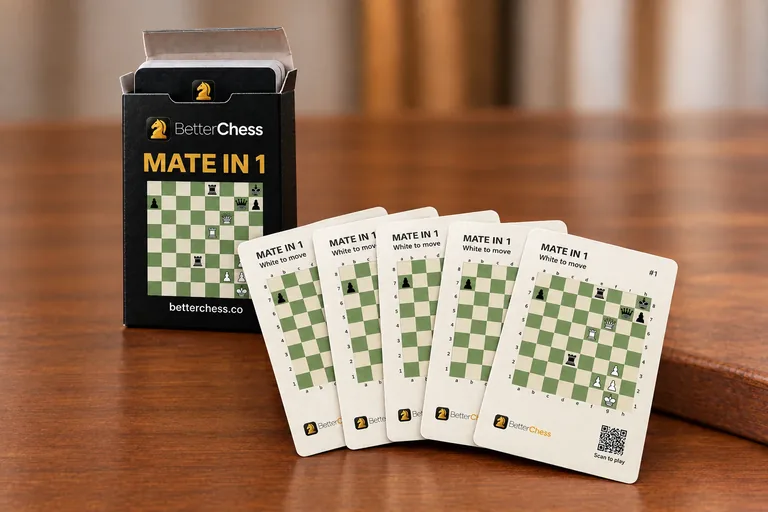
PRINTED CHESS PUZZLE CARDS
Chess puzzle playing card decks
54 poker-size cards in a tuck box. Puzzle on the front, solution on the back.