McDonnell vs La Bourdonnais (1834)
- White
- Alexander McDonnell
- Event
- 4th Casual Match, London, game 16
- Year
- 1834
- Result
- 0–1
28. Rf1
Black to move. White has just played Rf1. La Bourdonnais ignored the passed white pawn and pushed his own — three connected passers are about to decide the game. Can you find the plan?
Why this game matters
London, 1834. In the great series of matches between France's La Bourdonnais and England's McDonnell — the first informal world-championship contest — came this 16th game of the fourth match. It ends with one of the most famous images in all of chess: three connected black passed pawns rolling unstoppably to the eighth rank. The young Kasparov later said this position made him fall in love with the game.
The lesson
Connected passed pawns in the centre can be worth more than pieces. La Bourdonnais sacrificed material to set his d- and e-pawns rolling; once they reached the third rank, supported by the queen, no white piece could stop them all. Trust your passed pawns — they grow more dangerous with every square.
Move by move
5. Nxc65.Nxc6 bxc6 — McDonnell gives Black a strong pawn centre, a strategic concession modern masters would avoid.
13… d413...d4! La Bourdonnais fixes his protected passed pawn in the centre — the seed of the whole finish.
20… f520...f5 — after 20.Rac1, Black's central pawns and kingside pawns are poised to advance together.
26… Bc826...Bc8 — quietly redeploying; the engine line 26...d3! was even stronger, but Black's plan is unstoppable.
27… f227...f2! The first of the pawns crashes through to the second rank, supported by the rolling centre.
28… d328...d3! The second passer advances. White's pieces cannot cover every promotion square at once.
30… e430...e4 — both sides have passed pawns, but Black's three connected passers in the centre are far faster.
33… d233...d2 — the d-pawn reaches the seventh; the white rook and queen are overwhelmed by the phalanx.
35… e335...e3 — and the e-pawn follows. The famous trio of pawns is on the march.
37… e237...e2 — the final pawn reaches the seventh and promotion cannot be stopped. McDonnell resigned. The first chess immortal.
Frequently asked
Why is this game so famous?
Its finish — three connected black passed pawns marching to the back rank against the white pieces — is one of the most striking images in chess. It is often called the first 'immortal' game and is a textbook lesson in the power of passed pawns.
What was the La Bourdonnais–McDonnell match?
A series of six matches (85 games) played in London in 1834 between France's La Bourdonnais and England's McDonnell, widely seen as the first unofficial world-championship contest. La Bourdonnais won the overall series.
Can I try the finish myself?
Yes — take the board as Black near the end and push the connected pawns home, or replay the whole game move by move, no sign-up.
Similar games
The Immortal Game (1851)
Adolf Anderssen vs Lionel Kieseritzky · 1851 · King's Gambit
Replay & play ›The Evergreen Game (1852)
Adolf Anderssen vs Jean Dufresne · 1852 · Evans Gambit
Replay & play ›Staunton vs Horwitz (1846)
Howard Staunton vs Bernhard Horwitz · 1846 · Dutch Defence, Staunton Gambit
Replay & play ›Chigorin's King's Gambit (1892)
Mikhail Chigorin vs Wilhelm Steinitz · 1892 · King's Gambit
Replay & play ›Want this on your own games? BetterChess puts a real engine inside Claude, so it finds the moves that actually decided the game instead of listing every inaccuracy.
BetterChess is a practice tool. We make no guarantee you'll reach 1800 or any rating. This is a historical game; the analysis is our own.
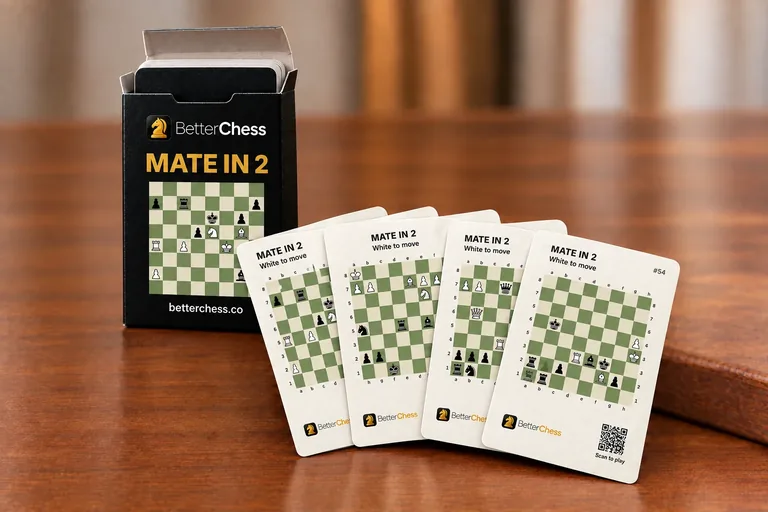
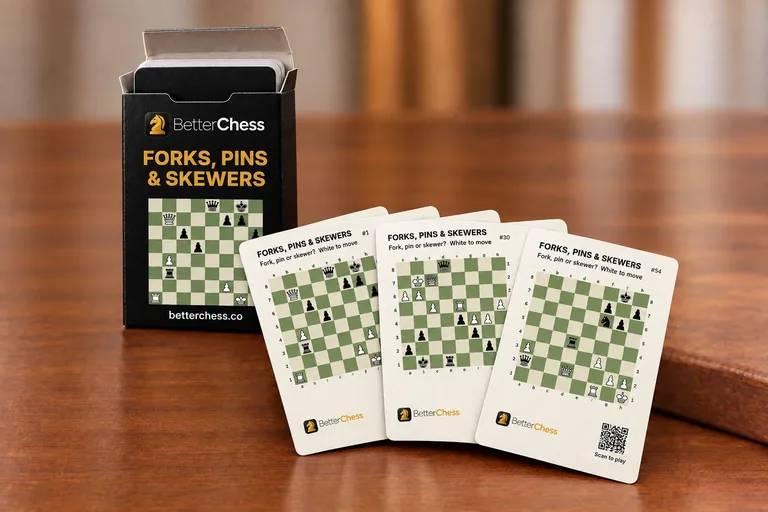
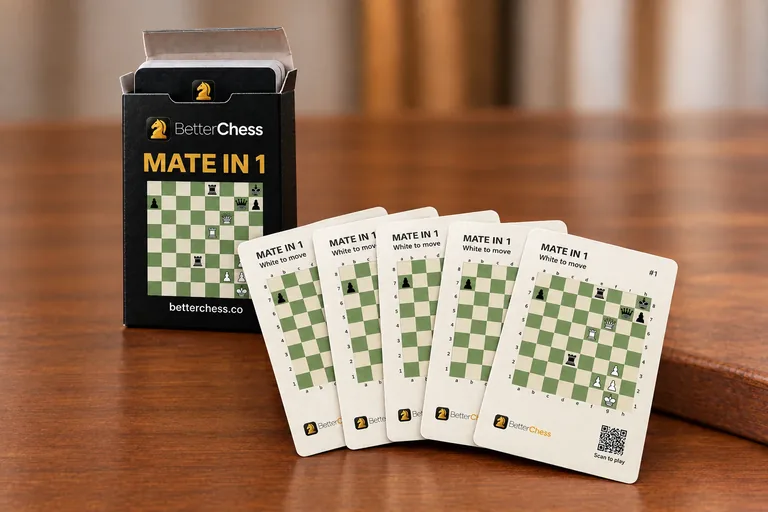
PRINTED CHESS PUZZLE CARDS
Chess puzzle playing card decks
54 poker-size cards in a tuck box. Puzzle on the front, solution on the back.